
Choosing a new Email Service Provider (ESP) is a critical decision for any marketer. The question of how many vendors to consider inevitably arises. While you want to explore multiple options for thorough comparison, an unnecessarily lengthy selection process can be counterproductive. This guide will help you navigate the vendor selection journey efficiently and effectively.
Every Additional Vendor Requires Significant Investment
Every additional email marketing vendor you consider demands more of your time and effort. This investment escalates, especially in the later stages when you delve into detailed evaluations. While a small business owner sending basic newsletters might opt for a quick self-service trial, a more structured selection process is essential for comprehensive needs.
The key is to determine where to draw the line: how many ESPs warrant an in-depth evaluation, and ultimately, an invitation to pitch their solution?
ESPs Appreciate Focused Selection Processes
From the perspective of Email Service Providers, the number of competitors in a selection process is also a significant factor. A pitch with too many contenders diminishes their chances of winning, potentially reducing their willingness to invest extensive effort. Having an enthusiastic ESP that is committed to going the extra mile during your selection can be incredibly valuable. Vendors universally prefer to be in a selection alongside only a small number of other companies.
Savvy business developers often try to ascertain “who else is in the running.” Even if they don’t, clearly communicating your expectations for their effort can positively manage expectations. Therefore, **being selective upfront not only saves you time but also encourages vendors to bring their A-game, offering you extra value.** But how do you achieve this selectivity, and how narrow should your focus be?
The Four Stages of ESP Vendor Selection
When discussing “shortlists” and “pitches,” we’re primarily referring to the final stages of the selection process. While marketers may have high expectations for ESP pitches, it’s crucial to recognize the substantial effort required from both parties for Requests for Proposals (RFPs), demos, and presentations.
However, this doesn’t mean you shouldn’t begin with broader market exploration. If you’re new to the market or haven’t explored MarTech recently, it’s beneficial to get a feel for the landscape and the various players.
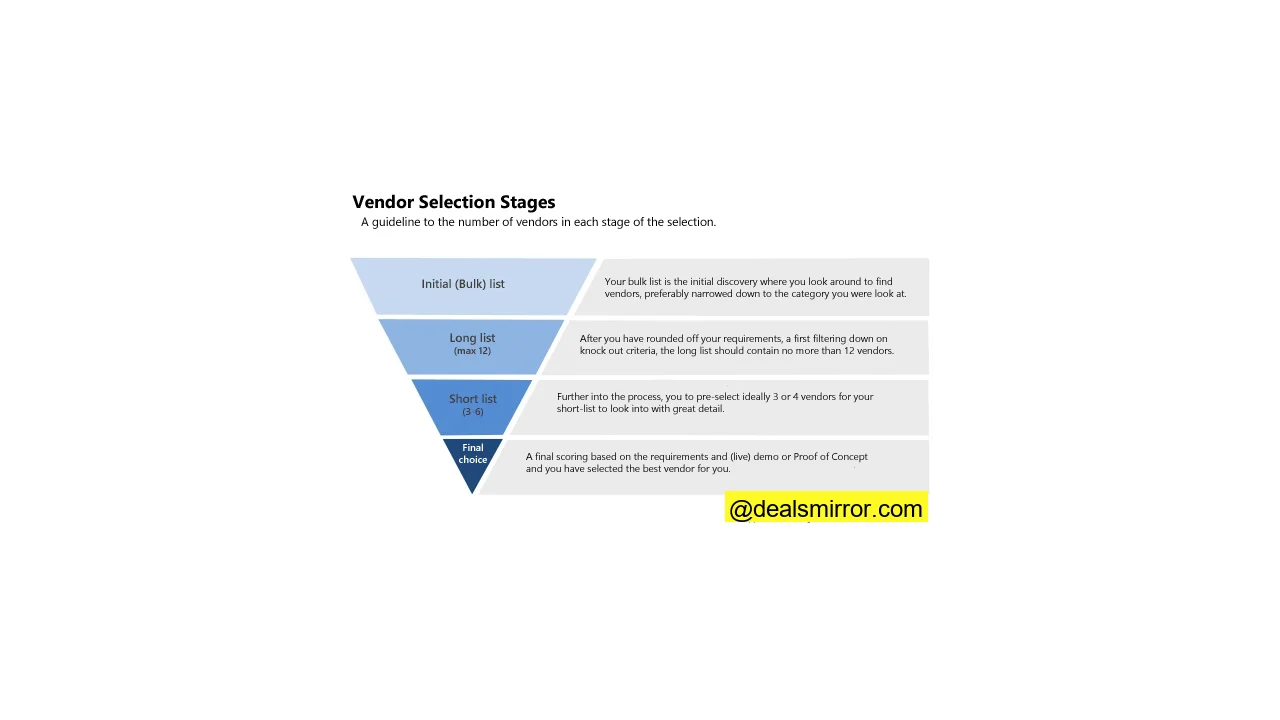
The process typically begins with a **bulk list** (all potential vendors in a category with very limited initial filtering), which then progresses to a **long list** (initial filtering based on high-level or “knock-out” criteria). The goal is to narrow this down as quickly and efficiently as possible.
Optimizing Your ESP Long List
The Email Marketing Landscape alone features over 450 providers, making a comprehensive review a daunting task. A common pitfall for companies initiating their own “awkward” shortlists is grouping candidates from vastly different categories. This often indicates a lack of clear requirements or an underdeveloped understanding of the specific type of ESP or Marketing Automation provider needed.
You can significantly narrow your initial long list by first identifying the type of Email Service Provider that best aligns with your business needs. Alternatively, vendors might be misjudged and added to a list due to listed features they don’t truly possess.
Seeking expert guidance in selections can greatly speed up the process. Experienced consultants can help you leverage proper knock-out criteria—those essential requirements that lead to immediate elimination of unsuitable candidates.
As a general rule of thumb: **If your long list contains more than 20 Email Service Providers, it’s more of a bulk list than a long list, indicating insufficient selectivity. Aim to keep your long list to a maximum of 12 vendors.**
Refining Your View: From Long List to Short List
Transitioning from a long list to a short list of email marketing vendors demands a clearer and more precise definition of your requirements. At this stage, you’re not yet inviting pitches; your short list should only comprise candidates that are genuine contenders.
Your short list should ideally contain a **maximum of 3 to 5 ESPs**. Fewer is perfectly acceptable if you can confidently restrict your options further before entering a formal “selection mode.” If you reach 4-5 potential vendors and still have a few that don’t perfectly fit but might be viable, consider these options:
* **Seek Expertise:** An experienced consultant or agency often has pre-existing knowledge or can quickly assess these marginal candidates, reducing investigation time.
* **Create a “Hold” List:** If you’re managing the process independently, consider placing these less-than-perfect fits on an “on hold to investigate” list. These reserves can be activated if no satisfactory solution emerges from your primary short list.
It’s crucial to document your arguments when eliminating an Email Service Provider at any point. Note both general pros and cons you encountered. This record is valuable if your requirements evolve over time, helping you understand past decisions. It also facilitates internal collaboration, allowing colleagues to comment on explicit opinions and preventing unintentional roadblocks in the selection process.
The Email Marketing Pitching Begins (Sort Of)
Before formal pitches, based on the project’s complexity, scope, and size, you’ll want to investigate your shortlisted ESPs further. This involves conducting online demos and thoroughly reviewing their websites to perform a sanity check. Verify if vendors can genuinely fulfill your requirements and provide the services you seek. Some may not pass this check and can be safely removed from the shortlist.
A High-Quality Group of ESPs Ready for Pitching
With your refined shortlist in hand, do you have any favorites? Your confidence level will depend on your experience with both email marketing and the selection process.
* For typical projects, invite **2 to 4 email vendors** to present their case and pitch.
* If you’re less confident, seeking a more creative solution, or facing a more complex or high-stakes situation, you might consider inviting **3 to 6 email suppliers** to pitch. However, inviting more than six is rarely necessary; trust that a thorough vetting process will yield high-quality options within these numbers.
Ensure that the vetting part is done right, resulting in a selection of high-quality ESPs for your pitch that truly match your desired profile.
Ultimately, when inviting ESPs to your pitch, always adhere to this simple truth:
**Invite as few as you can, and as many as you need.**
What Do the Experts Say?
Insights from online marketing specialists provide diverse perspectives on optimal vendor selection numbers:
Chris Marriott, President & Founder at Email Connect:
“Great article… I agree that your initial list should not be too limited. For the RFPs we manage with our clients, we usually start with 8 ESPs. We cut that down to 4 after scoring the RFP responses, and those 4 get to present their solutions to the use cases we’ve developed. Then it’s down to 2 for the sandboxes.”
Panos Ladas, Online Marketing & E-commerce Expert at ON.Marketing:
“Probably 5. It is not easy but it makes a lot of sense. If you go for only 3 then 2 of the 3 are very similar in capabilities, experience, price, and you won’t benefit from the extensive experience out there. Talk to 5 vendors and you will find 2 vendors that are big and similar, 2 that are very creative and interesting, and 1 that is probably trying to disrupt the market. In every case, this will bring out a better outcome than a more narrow approach to it (although it does take more effort).”
Peter van der Schaar, Founder of Marketing Makers and Basedriver:
“From a vendor point of view… If there is such a process, we mostly see two or three competitors. I think a potential client should also acknowledge that a pitch costs both the vendor and the client a lot of time, so a smaller number of vendors will probably lead to a higher quality of the pitches.”
James Lamb, Senior Program Manager, Email and Lifecycle:
“If it’s more than 3, you haven’t collected enough information. If necessary, give them a use case they can walk through on a conference call. That will get you some interaction with someone not on the sales team and help you see how deep they are in the industry and how they think creatively and if they’ve worked with customers with similar needs.”