
It’s no wonder that online courses are more popular than ever. The creation and launch of online courses are booming, offering incredible opportunities for educators and learners alike.
Perhaps you’ve just developed an exceptional online course – interactive, engaging, and ready to welcome new students for a transformative learning experience. Or maybe you’re still in the early stages of planning your course content or platform. Either way, at some point, you’ll need to write a course description. And it needs to be powerful enough to make people not just interested, but eager to enroll.
Writing an effective course description can be challenging. You often have limited space to capture attention, explain what the course offers, and convince your target audience to sign up. The simplest path to success is to learn from and adapt already successful course description examples.
In this comprehensive guide, we will:
- Outline what a course description is and provide a step-by-step guide on how to write one.
- Describe how to master the tone and structure of your course description for maximum impact.
- Offer practical course description templates and real-world examples you can implement immediately.
Once you master the art of writing compelling course descriptions, you can create a repeatable template for all your future courses, streamlining the entire process. Let’s dive in!
What Is a Course Description?
A course description serves as a concise summary of what students will gain from completing an online course. A truly effective course description should be adaptable in length for various platforms and marketing channels. Fundamentally, a good course description aims to achieve three main goals:
- Attract Attention: Capture the interest of your prospective student or participant.
- Define the Audience: Clearly explain who the course is designed for.
- Detail the Offering: Describe the course content, what will be taught, and the teaching methodology.
Your course description is often the deciding factor in whether someone enrolls. Therefore, focus its content on the most critical points that resonate with your potential customers.
How to Write a Course Description
Writing a killer course description follows a deceptively simple yet powerful process:
- Write Down Your Course Outline: Start by detailing all your course content.
- Nail Tone and Structure: Refine the voice and organization to engage your audience.
- Describe Your Ideal Audience: Clearly articulate who the course is for.
- Spotlight Student Progress: Show prospective learners what achievements they can expect.
- Special Attention to Benefits: Emphasize the positive outcomes and value for the student.
Having inspiring course description examples that align with your course’s feel can significantly aid this process.
How to Write a Course Description Based on an Outline
The most effective way to craft your course description is to build it directly from your course outline. Your course outline is a detailed (or simple) list of your course content, section by section. The more comprehensive your outline, the easier it becomes to extract key information and create a robust course description template. A well-structured outline provides all the essential points needed for your description.
Here’s an example of a course outline to inspire your own development:
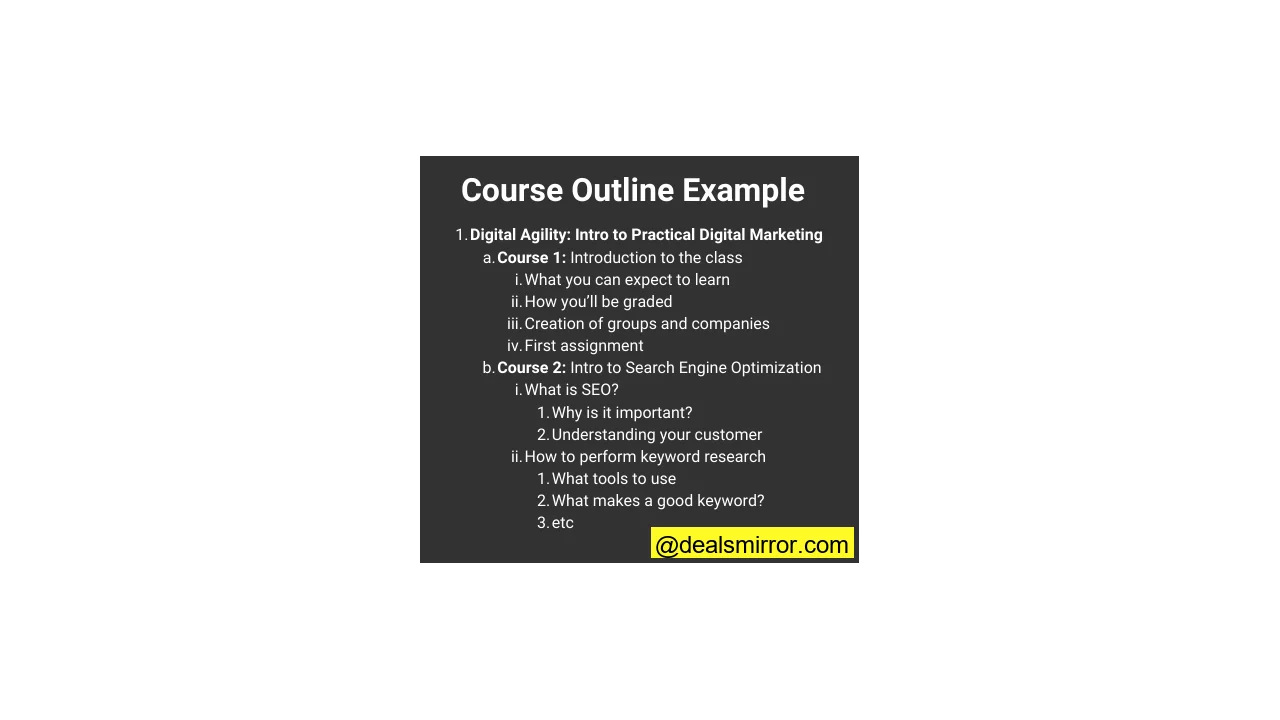
With a detailed outline, you can easily create course descriptions of varying lengths. One of the primary challenges is attracting and informing the right audience within the space limitations of different platforms.
For example:
- In a broad course catalog, you might only have space for the title and three short lines of text.
- In a syllabus, you might allocate two paragraphs.
- On a dedicated landing page or your own website, you have complete freedom to structure and format your course description as desired.
If you’re publishing your course via a course marketplace, you’re often subject to the platform’s specific requirements. For instance, Udemy typically requires a minimum of 200 words for their course descriptions. You gain more flexibility when hosting your content on your own platform.
So, how do you create a course description that works across all contexts? The key is to distill the most critical information and develop different formats for each channel. Start by defining the tone of your course description.
Here is a course description example that could be derived from the outline above:
In Digital Agility, you’ll learn key digital marketing fundamentals that will empower you to create your own digital strategy regardless of what you sell. By the end of the course, you will understand SEO, and how to implement your own keyword research to reach the first page of Google.
This snippet demonstrates how elements from your outline can form a compelling course description.
Get the Tone and Structure Right (With Course Description Examples)
The tone and structure of your course description significantly influence whether potential students sign up. Reviewing successful course description templates can guide your writing process. Several key elements are crucial to include:
Describe the Content of the Course
Begin by clearly outlining the content that will be covered within the course.
Who is this course for?
When crafting your online course description, it’s vital to explicitly state your target audience. A strong course description should address:
- Whether it’s a beginner or advanced-level course.
- Any necessary prior knowledge or prerequisites.
- How this course will solve specific problems your audience might face.
When your ideal student reads your course description, they should immediately recognize that it’s the right course for them. There’s nothing more frustrating than enrolling in a course only to discover it’s too basic or too advanced for your needs.
Use a Conversational Tone
Examine other course description examples similar to yours. What tone do they adopt? While some academic catalogs might feature more formal language, for most online courses, a conversational tone is highly effective. Keep it approachable and accessible. Instead of referring to your customers as “students” or “participants” in the third person, use the second person (e.g., “you”). This human touch allows them to easily envision themselves taking your course or training. Here are two online course description examples:
Formal (less appealing):
“In this course, participants will become proficient in methodologies of using digital marketing strategies. They will examine and practice strategies found in typical employment opportunities of the digital era, and create their own brand marketing strategies for evaluation throughout this course.”
Conversational (much better):
“In this course, you’ll learn key digital marketing strategies and their practical application. We’ll go through 5 very successful examples and unpack how you can use their tactics yourself. By the end of this course, you’ll know how to plan, implement, and execute a digital marketing strategy from start to finish. And you’ll be applying it to your own strategy within this course.”
Which course would you prefer to sign up for? Both descriptions convey similar information. However, a conversational approach makes your course description more open and accessible to a broader audience.
Spotlight Participants’ Progress
Progress is an essential component of any educational journey. By including details about how student progress will be measured, your course description instantly builds trust and credibility. Consider how different learning platforms visually represent student advancement for their courses.
How will you gauge that progress? Will your course offer a certificate or another incentive upon completion? Will finishing this course unlock access to a more advanced or specialized program in the future?
Review other sample course descriptions to see how they benchmark progress. If your course carries significant prestige, a certificate can be a powerful motivator. Otherwise, focus on the practical benefits and tangible achievements your students will gain from your course.
Course benchmarks you can add:
- A certificate of completion (its impact grows with your authority on the subject).
- Formal letters or numbered grades for participation or assignments.
- An exam designed to measure the participant’s mastery of key course objectives.
Focus on the Benefits, Avoid Negativity
Every course exists to benefit students in some way, so clearly articulate how yours achieves this. Your course description is a primary sales tool; ensure it highlights precisely how it will improve your customers’ lives.
It’s important to avoid negative sales tactics within your course description itself. While FOMO (Fear Of Missing Out) can be effective in promotional materials, your course description should concentrate on the positive benefits you’ve already outlined.
Instead of telling them what they’d lose by skipping this course, focus on what they will gain by completing it. Using positive reinforcement is far more powerful and tends to drive more enrollments.
For example, if you find yourself tempted to mention a negative consequence, reframe it as a positive benefit. Here are a few common examples you can use:
| Negative Consequence | Positive Benefit |
| Miss out on insights | Learn how to impress others with clear insights |
| Do something wrong | Do it in the most effective / best / enjoyable way |
| Losing time without this course | Adding more time to your busy schedule |
| Leaving money on the table | Earning more money because this course helps you optimize/cut costs |
How to Write a Long-Form Course Description for a Syllabus
For a detailed, long-form course description, look to syllabus writing best practices. A course description at the beginning of a syllabus should provide your students with:
- A general overview of the course’s scope.
- Clear expectations for coursework and engagement.
- The benchmarks they’ll need to achieve to measure their success.
While a syllabus course description is typically more extensive, it doesn’t need to be an exhaustive list of every single course component. Optimize its layout to prioritize the most important information first.
Here’s a great training course description template and breakdown suitable for a syllabus:
- Intro: Begin with a brief introduction, approximately 2-3 sentences, providing a general summary of your course.
- Subtitle: For longer descriptions, use formatting to attract interest. Employ a subtitle that isn’t your main catchy course title, but a secondary, actionable, and snappy title.
- Short Bullet List: Next, outline what your students can expect to learn. Make your longer course description skimmable by using this section to highlight the key benefits of your course.
- Context: Follow with a short paragraph that provides context around your course. What makes it unique? What’s the story behind its creation? How is it relevant to current trends? Include any real-life examples or short teasers to maintain customer interest.
- Methodology: Conclude with a brief paragraph outlining your teaching approach. Mention how student progress will be measured and the level of interactivity they can anticipate.
This structured course description sample also works well for online course platforms and independent landing pages. Equipping your customers with more information, while making the most important aspects scannable, will significantly increase your ability to convince them to take your course.
Start with this comprehensive course description template and then adapt it. Create smaller, more concise descriptions as needed, always prioritizing the most impactful information.
7 Course Description Examples to Inspire
1. Short-Form Formal: Art History 101
Art History 101: A critical view of art within a historical context; the impacts of war and economy on art; a guide through different ages of art; artistic concepts as a means of expression.
Note how this course description example precisely explains student expectations. It covers significant ground in just 34 words. Aim to cover as much essential information as possible, even with limited space for your course description.
2. Short-Form Informal: Art History 101
Art History 101: Learn the historical context behind well-known and prolific art pieces; better understand how war and the economy impact artistic expression, and learn to correctly identify the age of different art pieces.
This course description example achieves the same goals as the formal version but uses a more approachable and conversational tone. This makes your course appear more accessible to potential students.
3. Mid-Length Formal: Social Media Marketing
Social Media Marketing: This course will cover key concepts to marketing using a variety of social media networks. Participants will learn how to create, plan, and execute a social media marketing strategy for the purposes of promotion. By the end of this course, participants will understand which engagement metrics to follow, how to cultivate an engaged social following, and how to appropriately curate content and engage with followers on social platforms.
A mid-length course description example provides more context for your course while still highlighting its most important aspects.
4. Mid-Length Informal: Social Media Marketing
Social Media Marketing: In this course, you’ll learn key concepts for using a variety of social media networks successfully. You’ll learn how to create a social media marketing strategy, and then how to use that strategy to promote your brand. By the end of the course, you’ll know exactly which metrics matter the most, how to organically earn new followers, and how to create and repurpose content for your social accounts.
The mid-length format is an ideal example of a course description, offering sufficient space to convey the value and benefits you’ll provide to your potential students.
5. Long-Form Formal: Digital Agility
Digital Agility: Introduction to Digital Marketing
Digital Agility will cover the fundamentals of digital marketing and equip participants with the skills necessary to completely implement a digital strategy. Participants will be introduced to critical strategies and practical skills necessary to create and execute a full digital marketing plan.
Learn Practical Digital Marketing Skills Fit for the Industry
In this course, participants will learn:
- How to strategize with digital marketing from the base concept of a company or service, across a variety of industries.
- How to perform accurate keyword research, and implement keywords into content across different digital platforms.
- How to create a content marketing strategy that accompanies search engine optimization research.
- How to appropriately use social networks to promote a brand, and how to incorporate socials into a digital strategy.
- How to build an email list for digital marketing, and how to use email to earn more conversions.
Benefits Participants Can Expect from this Course
Marketing courses often focus on brand theory built on a foundation of traditional marketing. While brand theory is relevant for understanding marketing basics, the landscape of marketing has fundamentally changed in the digital age. With digital formats and channels taking prominence in the past decade, traditional tactics are ill-adapted to today’s practical marketing needs. This course aims to instruct participants in practical applications of digital marketing strategies that can be applied immediately.
How Participants Skills Will Be Assessed
This course will be three hours long, with half the course period dedicated to lecture. The second half of the course will be dedicated to practical application of the skills learned in class. Participants will be assigned to groups and maintain the group format for the duration of instruction. Assessment will be based on projects completed within these groups on a weekly basis. At the end of the course, participants will be expected to present a final, cohesive digital marketing strategy that compiles the totality of all projects completed throughout the semester.
This long-form course description example provides the freedom to delve deeper into the context of your course and clearly explain how student success will be measured.
6. Long-Form Informal: Digital Agility
Digital Agility: Introduction to Digital Marketing
Digital Agility aims to cover the fundamentals of digital marketing and will equip you with the skills you need to put your own digital strategy in place. You’ll be introduced to a variety of different critical strategies necessary for basic digital marketing comprehension.
Learn Practical Digital Marketing Skills You’ll Really Use
You will learn:
- How to begin strategizing with digital marketing in mind from the very concept of a company/service.
- Why search engine optimization is critical for your strategy, and how to perform accurate keyword research.
- The fundamentals for creating a content strategy built on that keyword research, how to create proper internal linking, and why you should try for backlinks.
- How to share the content you create across social media, create ads for your social media, and retarget ads for your customers.
- The basics of email marketing, and how to use it to convert your customers.
What Sets This Course Apart from Other Marketing Courses
Many marketing courses focus on theory built around traditional marketing. While those theories are still important for understanding the core goals behind marketing, in today’s digital landscape, the focus has shifted to digital formats. Unlike traditional marketing channels, digital marketing channels can be interconnected to create a unified, cohesive strategy. This course aims to teach you how to appropriately utilize each of these channels, with practical skills you can use immediately.
How Your Growth Will Be Measured
The course will be three hours long, with an hour and a half dedicated to lecture. The second half of the course will be dedicated to putting your newly learned skills to practice. You’ll be split into groups and work with the same group on your collective digital strategy throughout the semester. You’ll be graded on the different weekly projects that you’ll complete to demonstrate your understanding of the skills learned in class. At the end of the course, you’ll present a final project, which will be the full demonstration of your combined digital marketing strategy that had been compiled throughout the semester.
The informal version achieves the same goals as the formal one. This course description acts as an informational, value-adding pitch. Using your course description as a soft-sell is effective as long as you maintain a non-overly promotional tone.
7. Course Description Template
Writing a course description can be challenging, especially if you’re new to it. Here’s a flexible course description template to help you create your own:
Short-Form Course Description Content:
[Name of Course]
[Very brief introduction; 10-15 words]
[Main benefit participants can expect; 10-15 words]
[How you’ll assess participants; 10-15 words]
Short-Form Course Description Template:
In [Name of course], you’ll learn [brief description of a few things participants will learn. 10-15 words]. By the end of this course, you can expect to [know something, be able to do something, etc. 10-15 words or so]. Course participants will be assessed through [grades, assignments, exams, certifications, etc].
With limited space, outlining the course’s benefits is paramount. What can your customers truly expect to gain? In some cases, you might choose to elaborate on additional benefits over detailing the assessment methods.
3 Real Course Description Examples for Inspiration
We’ve collected some real-world course description examples to demonstrate how experts craft compelling summaries. Below, you’ll find examples spanning different lengths, styles, and industries.
Product Marketing Alliance
This mid-form, informal course overview from the Product Marketing Alliance is excellent. It clearly defines the course topic at the outset, then builds trust by outlining the promised outcomes for visitors. They also perfectly capture a casual tone without overdoing it.
Sew It! Academy
Sew It! Academy opted for a short, informal description for this course hosted on Thinkific. In a single sentence, they convey the course length, topic, and host. Crucially, they frame the promised outcome in a way that deeply resonates with individuals who often find commercial patterns confusing.
Content Marketing: Blogging for Growth
This course description clearly states the benefit and topic of the course. However, its most compelling aspect is how it builds trust by highlighting the impressive achievements of the host – a truly effective hook.
Key Takeaways
A truly great course description is built upon a foundation of proven best practices. Utilize these foundational elements to effectively communicate the genuine benefits your course offers. By highlighting these advantages and differentiating your course from others, you’ll be well-equipped to write attractive course descriptions for any medium.
Pay close attention to the tone of your course description, ensure it clearly identifies your target audience, and outline how student progress will be measured. By following these various course description templates and guidelines, you’ll see an enthusiastic response from students eager to enroll in your courses.