
The Customer Relationship Management (CRM) software market experienced significant growth last year, expanding by 15%. This surge is a clear indicator of evolving business landscapes where effective customer data management is not just an advantage but a necessity, driven by customer expectations and new regulations.
If your business isn’t currently leveraging a CRM, now is undoubtedly the time to consider its implementation. The challenge, however, lies in selecting the most suitable CRM from a crowded market.
While industry giants like Salesforce, Microsoft, Oracle, and SAP collectively dominate 75% of the market, a multitude of specialized CRMs exist. You’ll find industry-specific solutions tailored for freelancers, multi-level marketing, or even legal offices. Additionally, some CRMs excel in a single feature like automation or email marketing, while others claim to be all-encompassing platforms.
With such a vast array of options, the crucial question remains: which CRM should your business choose? This comprehensive guide aims to help you navigate the selection process and find the perfect fit.
Featured CRM Solutions for Your Business
Here are some top-tier CRM platforms that stand out for their robust features and diverse applications:
- monday.com: A versatile Work OS with a lightweight CRM built-in, designed to manage everything from sales and marketing to IT and software development.
- Pipedrive: An intuitive sales CRM renowned for its ease of setup and use. It offers powerful sales automation, task management, lead qualification, and tracking capabilities.
- EngageBay: An all-in-one CRM platform providing marketing, sales, and service tools, including automation, at highly affordable prices. It also offers a free plan for up to 15 users.
- BenchmarkONE: A convenient all-in-one sales CRM and marketing software known for its excellent value, including an impressive ‘free forever’ plan for up to 250 contacts.
- Salesforce: A leading sales CRM platform suitable for businesses ranging from small operations to large enterprises, offering robust pipelines and automation. A 30-day free trial is available.
How To Choose Your CRM
Selecting a CRM can feel overwhelming, regardless of whether you’re a small to medium-sized business (SMB) or an enterprise. The key is knowing where to start and ensuring all critical aspects are covered. A lack of thorough research often leads to choosing an unsuitable CRM, whether due to mismatched functionality or poor user experience.
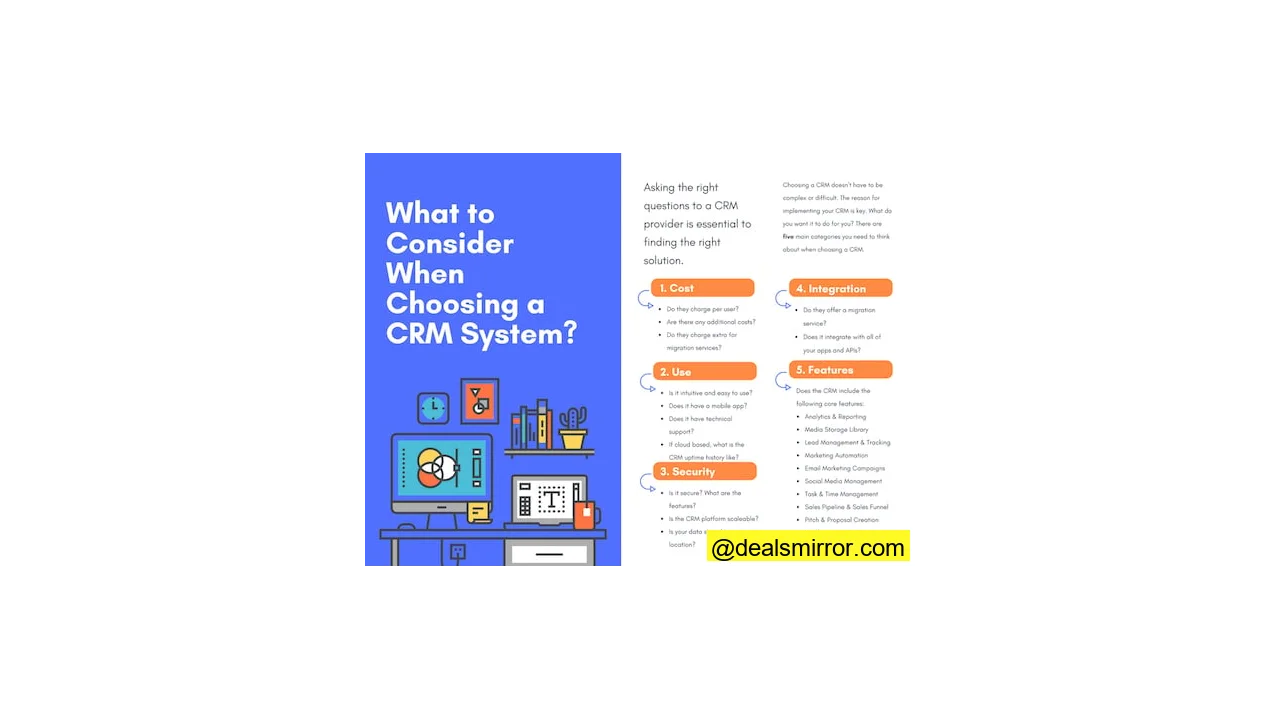
However, choosing a CRM doesn’t have to be complex. The fundamental step is to clearly define your primary reason for implementing a CRM. What specific goals do you want it to achieve for your business? There are three main ways to identify your CRM needs, which we’ll explore below.
The Transformative Benefits of CRM
Without a CRM, your business is likely grappling with inefficiencies such as:
- Managing customer data across disparate spreadsheets.
- Organizing customer information in cumbersome paper files.
- Relying on physical written task lists.
- Attempting to keep track of essential to-dos mentally.
- Leaving critical time management solely to individual employees.
This list merely scratches the surface of common challenges.
A CRM offers numerous advantages that significantly impact your business. The two most prominent benefits are **substantial time savings** and the **potential for increased revenue**.
Here are additional benefits of integrating a CRM into your operations:
- Centralize all your customer data, eliminating scattered paper files.
- Automate repeating task reminders, minimizing the chance of missed deadlines.
- Effectively track staff goals, targets, and time utilization.
- Generate automated staff reports to identify high-performing areas and pinpoint where further staff training may be needed.
- Analyze comprehensive marketing data, including Return on Investment (ROI), all within a single, central hub.
Ultimately, a CRM empowers you to foster stronger customer relationships and optimize staff performance—two critical elements that profoundly influence your bottom line.
The 5 Core CRM Uses That Matter Most
CRMs can often present a bewildering list of features, which can be intimidating. While most users seek a simple and intuitive CRM, not everyone requires the same functionalities. Let’s delve into the five core uses of CRMs, allowing you to identify those most crucial for your business:
1) Contact Management: This feature centralizes all data related to your customers or clients. Every detail—from demographics to preferences—is stored in one accessible location, allowing any authorized department user to retrieve it at any time.
Purpose: To enhance efficiency across all departments by providing unified access to customer information.
2) Social Media Management: Track and analyze your audience’s social media activity in relation to your content.
Purpose: To gain deeper insights into the effectiveness of your social media engagement strategies.
3) Campaign Management: Manage your marketing campaigns comprehensively from initiation to completion. You can set up target customer groups and collect post-campaign success data directly through the CRM.
Purpose: To standardize, test, and significantly improve the effectiveness of your marketing initiatives.
4) Email Tracking: Monitor key email metrics such as opens, reads, and click-through rates.
Purpose: To accurately assess the performance and impact of your email campaigns.
5) Reports and Analysis: Consolidate and analyze your marketing data within a single CRM platform. This allows you to compare different data streams and even track customers/clients in real time.
Purpose: To thoroughly analyze your business performance, highlighting successful areas and identifying opportunities for improvement.
Once you’ve identified which of these core features are most valuable to your business, research how other organizations in your industry utilize them.
For larger enterprises, a CRM’s relevance extends beyond Sales and Marketing to departments like Accounting and HR. A Capterra report on CRM Industry User found that 80% of businesses use a CRM in Sales, and just under 50% utilize it in both Marketing and Customer Service. Therefore, a strategic starting point for CRM selection is to determine how each department could benefit.
Specifically:
- For Sales: You need robust capabilities to track leads and sales progress through the pipeline.
- For Marketing: The ability to identify lead sources, assess purchase likelihood, and gather relevant advertising information is crucial.
- For Accounting/Finance: Integration for working with invoices directly within the CRM is highly beneficial.
- For HR: Tracking communications for complaint resolution or potential disciplinary actions can be essential.
Consider other departments like Legal, IT, and Customer Service, as their needs might also align with CRM functionalities.
How To Find the Right CRM Functionality
Begin by conducting a comprehensive review of every department in your organization. For smaller businesses, assess the entire operation. Compile a list of all challenges, problems, and bottlenecks encountered over the past 12 months.
Also, consider potential future issues that may arise as your business grows. These could relate to customers, staff, marketing, or a combination. For example, a receptionist manually updating records in spreadsheets might not be an issue with 20 customers, but it could become a significant time sink with 200.
Use this detailed list as a testing framework to determine which CRM features will effectively resolve existing problems or mitigate the likelihood of future ones.
One Important Factor When Selecting a CRM
If you’re seeking an all-around performance boost from a CRM, prioritize solutions that offer these significant benefits:
- Boost falling sales figures: Efficient lead tracking enhances sales effectiveness, and targeted email marketing campaigns drive repeat sales.
- Generate all sorts of useful data: Consolidate data from marketing, sales, and inventory to gain genuine insights into your business operations.
- Generate more complete, more accurate customer profiles: With all data centralized, you can build richer customer profiles and recall more details than ever before.
- Help you make more accurate forecasts: A clear view of your sales pipeline allows you to accurately predict who is where and who is likely to convert into a sale soon.
- ‘Bring everybody together’ by having each department working within the same CRM: Ensures everyone has access to the same data and workstreams, fostering collaboration.
If any of these concerns resonate with your business, then **choose a CRM that primarily addresses those specific issues**. Avoid distractions from flashy but unnecessary features, focusing instead on the functionalities you genuinely need.
CRM Examples: How Leading Businesses Utilize CRM
Five industries most commonly use CRMs: retail, business services, technology, manufacturing, and real estate. Let’s explore how CRMs are deployed across different sectors to inspire how they can add value to your business and your customers.
Healthcare: Valley Surgical
A notable example is the US small business Valley Surgical, founded about 10 years ago, which specializes in buying and redistributing excess medical supplies. Their CRM is instrumental in helping them dominate their niche market.
David Johnson, Vice President of Valley Surgical, highlighted the primary benefits of their CRM:
“I would say bringing all of the sales process under one roof, meaning I didn’t have multiple systems. I now have everything in one place so streamlining it makes it more efficient. I’m able to track all my data.
We have been able to customize it to fit us perfectly. The campaigns section in the marketing module allows you to add members, so good strong data in means good strong data out. This allows us to be able to really drill down on certain contacts and accounts and be able to home in on them much more.” (source)
This illustrates the core value: the ability to tailor your CRM precisely to your business processes and needs. For Valley Surgical, the capacity to ‘drill down’ into their data is vital, as knowing when and from whom to buy is central to their business model.
IT and Computing: 848 Group
848 Group is a small business that provides IT services, including system transitions and cloud technology adoption. They integrate their CRM with an email marketing software plugin to create highly targeted email campaigns.
In a competitive sector like IT, leveraging a CRM to differentiate and improve outreach is crucial. 848 Group also employs time-tracking features within their CRM to accurately log client hours and generate precise invoices. This time-saving functionality is invaluable for small businesses and freelancers, enabling them to automate time tracking and invoicing processes.
CRM in Banking/Finance: Wells Fargo
Observing how large corporations utilize CRM provides insights into its extensive capabilities. Wells Fargo employs CRM for various purposes, including:
- Setting and incrementally increasing call targets for sales teams.
- Managing social media interactions and campaigns.
- Utilizing CRM data to deliver personalized messages to customers via ATMs. (source)
Interestingly, their sales targets, driven by CRM data, became a point of contention when management relentlessly increased quotas, not just for general sales but for cross-selling new accounts to existing customers. (source)
This case illustrates both the power and limitations of CRMs. While they can significantly enhance sales effectiveness, they cannot compensate for flawed strategic decisions or unrealistic goal-setting.
CRM in Travel: British Airways
Airline British Airways was an early adopter of CRM tools, implementing its bespoke T-CRM system in 2002. (source) This pioneering system centralized all marketing and sales data.
With T-CRM, British Airways was among the first businesses to integrate email, direct mail, and call center data onto a single platform. They used it to deploy targeted email campaigns to executive clients, thereby boosting sales.
The centralization of data was paramount, enabling swift analysis and direct visibility into ROI, which facilitated sound, data-driven decision-making. T-CRM was instrumental in British Airways’ recovery from a slump in the late 90s and early 2000s, by focusing on high-value travel customers. Today, businesses can readily leverage off-the-shelf SaaS CRM solutions, which are a far more practical and proven alternative to commissioning a custom data center and CRM platform.
Selecting the Best CRM – A Recap
The CRM landscape offers a solution for virtually every need, often with extensive plugin ecosystems. True success with CRM isn’t solely about setting sales goals; it’s about leveraging the platform to foster natural, sustainable growth. The key is to choose a CRM that aligns perfectly with your industry and specific business requirements.
To recap, here are the essential steps for effective CRM selection:
- Thoroughly analyze your business needs and objectives.
- Identify any recurring problems or issues experienced in recent years.
- Proactively anticipate any future challenges your business is likely to encounter.
- Evaluate various CRM providers and their offerings based on how effectively they can help your business resolve current problems and prevent future ones.
If you’re considering a CRM, it’s likely because you’ve recognized its crucial role in your business’s ongoing success. While the desire to quickly implement a solution is understandable, dedicating sufficient time to research and select the right CRM platform is a worthwhile investment. Choose wisely for a successful CRM journey!