Email marketing consistently delivers one of the highest Returns on Investment (ROI) for businesses, especially for franchises. Every franchise business and retail chain operates with a unique set of requirements when it comes to selecting the ideal email marketing software. While email marketing offers inherent flexibility and scalability, let’s dive into the franchise-specific criteria that demand careful consideration.
Why Franchises Have Unique Email Marketing Needs
Franchises, like many other business models, leverage email marketing for significant benefits:
- Drive sales: Generate immediate revenue through targeted promotions and offers.
- Engage customers and prospects: Foster stronger relationships and maintain brand top-of-mind awareness.
- Build loyalty and repeat business: Nurture customer relationships, encouraging continued patronage and brand advocacy.
However, distinct operational characteristics set franchises apart, directly influencing the choice of email marketing tools:
1. Diverse Franchise Business Models
The structural approach to email marketing programs within a franchise is deeply intertwined with its business model. This can involve a core franchisor overseeing numerous individual franchisees, or a mix that includes company-owned units and locations. For instance, in the restaurant industry, where the franchise model is prevalent, diverse structures are common. A franchise might even operate with a master franchisee model, under which several sub-franchisees manage their own units.
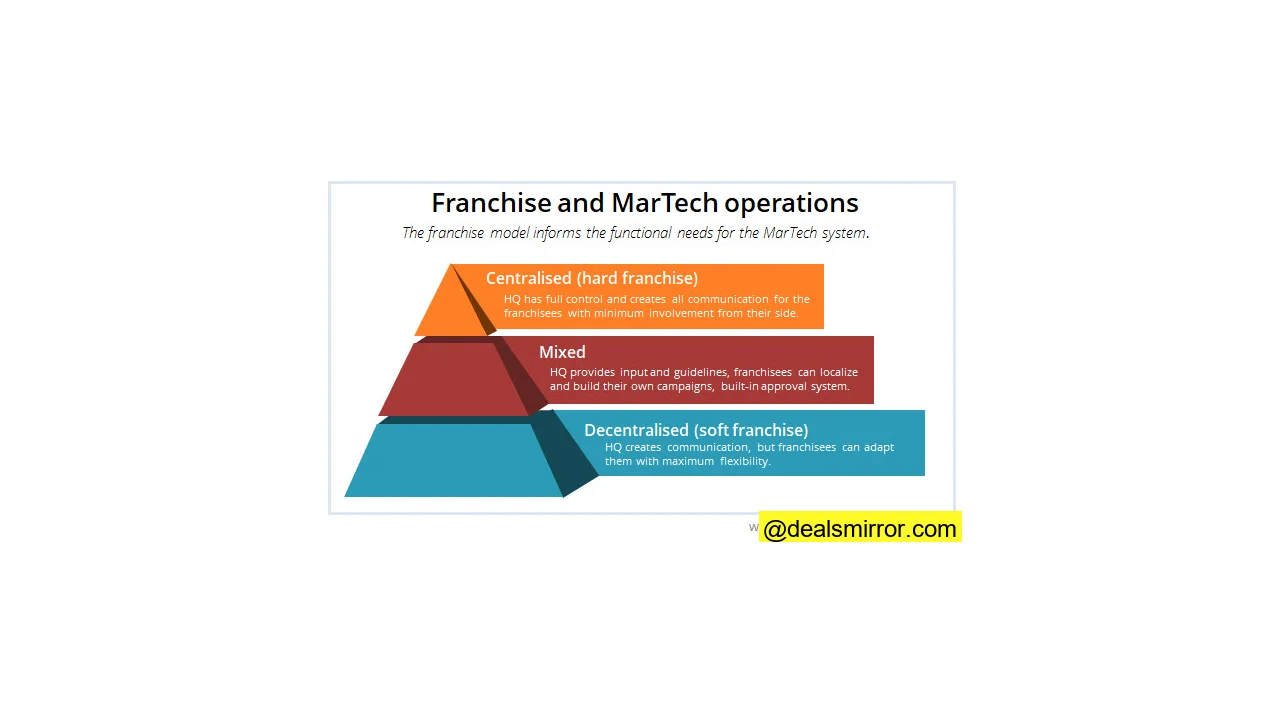
2. Centralized vs. Decentralized Marketing Control
Franchises exhibit significant variation in how much marketing control, power, and flexibility they retain at the corporate level versus what they delegate to individual franchisees. Some franchises operate with a blend of corporate-owned stores and independently-owned franchisee locations.
In highly centralized franchise models, headquarters might maintain complete control over all marketing communications. Conversely, other structures empower franchisees to create and deploy their own direct email promotions tailored for their local audiences.
A notable example involved a large restaurant franchise that shifted its email marketing strategy from 100% headquarters-driven sends to a 60% HQ-controlled model. By allowing each franchisee to send communications and offers directly to their local customers (within defined guidelines and controls), the franchise observed an 8% increase in email opens, an 11% increase in clicks, and an impressive 3.7% overall increase in direct sales.
In some scenarios, corporate headquarters develops promotions and content, and franchisees then have the option to choose whether or not to run those campaigns.
3. Varying Size, Shape, and Scope of Franchises
Franchise systems are designed for streamlining and scalability, relying on easily replicable processes. Yet, the actual size and shape of franchises vary widely. Franchises can differ dramatically in the number of locations, overall size, product or service offerings, geographical spread, target audience demographics, ownership structure (corporate vs. privately owned), and countless other factors. These differences profoundly impact each franchise’s specific email marketing requirements.
For example, a sprawling franchise with hundreds of units across an entire country will undoubtedly require different email software capabilities than a smaller, more localized franchise with a handful of locations. This underscores the reality that there is no single “best” email marketing software for all franchises; the optimal choice will always depend on your unique situation.
The 5 Essential Criteria for Franchise Email Software Selection
Franchises need an email solution that perfectly aligns with their specific operational needs, offers robust flexibility, and possesses the scalability to support future growth. To streamline your Email Service Provider (ESP) selection process, here are five critical franchise-specific criteria to evaluate:
1) Robust Parent and Subaccount Structure
Many franchises require an sophisticated parent account / subaccount setup for effective email marketing management. The parent account typically resides at the corporate or headquarters level, while subaccounts are designated for individual franchisees. More complex structures might even necessitate sub-subaccounts, especially for master franchisees who own and operate multiple units or locations.
An email software designed with this subaccount functionality must enable both centralized and decentralized data management. This ensures that each franchisee can manage their own email database within their subaccount, while corporate headquarters retains oversight of the entire system. Headquarters can then access and compare vital data on performance, loyalty program engagement, and other key metrics across all units.
Smart selection questions:
- What specific parent/subaccount hierarchy does your franchise model require?
- Will email marketing activities be permitted at the individual store level, or will they be managed at a higher tier?
- Do you foresee the need for sub-subaccounts to accommodate complex ownership structures?
2) Comprehensive Branding and Email Campaign Template Library
Franchises face the dual challenge of protecting their established brand while simultaneously fostering its growth across all locations. This can be particularly complex when dozens or even hundreds of independent franchisees are representing the brand. An effective email marketing tool must provide options for creating and “pushing down” standardized email campaign templates and content to franchisees.
Templates are crucial for ensuring a consistent look, feel, and message across every email sent. Franchises can easily share approved images and content with their franchisees. However, these templates also need to offer sufficient flexibility, allowing franchisees to select from pre-approved content choices or customize specific content blocks where autonomy is granted.
Consider the ability to lock and unlock content within your email marketing system to balance brand control with local customization.
Smart selection questions:
- What level of control do you need over branding, email templates, and content?
- Is the ability to lock and unlock specific content sections essential for your brand guidelines?
3) Granular Access Levels within the Email Marketing Tool
Franchise operations necessitate varying degrees of access to functionality and information within the email marketing platform. For instance, headquarters will typically require full visibility into all statistics and complete access to each franchisee’s database.
Conversely, individual franchisees might only need to view aggregated data relevant to their own operations and access their specific campaigns and subscriber lists. Permission levels should naturally align with user functions – whether someone is part of the corporate marketing team, an independent franchisee, the manager of a specific brick-and-mortar location, or an employee at a single unit tasked with local marketing. The degree of independence corporate wishes to grant each user will dictate their access privileges.
A capable ESP will allow you to precisely define rights and permissions based on various roles within the account, ensuring secure and appropriate access.
Smart selection questions:
- Who will be involved in email creation and management, and at what organizational level?
- What specific tool access and functionalities will different user roles require?
- How much control do you need to exert over user permissions?
- Do you need to restrict access to particular aspects, such as only data viewing or only content editing?
4) Advanced Data and Email Marketing Reporting
For franchises to make informed business decisions, robust data is indispensable. Headquarters needs clear insights into what their franchisees are doing and how effectively they are performing across the entire network.
Centralized access to data via a corporate dashboard is critical, enabling headquarters to compare performance across different units, geographical regions, and various campaigns. The primary challenge often lies in aggregating data seamlessly from numerous sources into a single, cohesive view. Corporate teams need to analyze all email campaign performance, including that of individual franchisees, in one consolidated location. This data aggregation is paramount for comprehensive comparisons and strategic decision-making.
Smart selection questions:
- What specific business insights do you need to glean from your email marketing data?
- At what organizational level do you require reporting, and what level of detail is necessary?
5) Seamless Integrations with Key Systems
Finally, franchises often require their email marketing software to integrate seamlessly with other crucial business solutions. For example, a retail restaurant franchise might benefit from integrating with their WiFi provider, point-of-sale (POS), or loyalty program provider. This connection helps to bridge the gap between offline and online customer behavior.
Such integration capabilities allow franchises to send highly relevant messaging across multiple channels at opportune moments and meticulously track patterns of behavior. Marketers can gather richer data for more targeted segmentation, develop incentives to drive foot traffic, or enhance loyalty programs. Integrating this diverse data with their email marketing software is key to achieving the next level of segmentation sophistication and personalized customer experiences.
Franchise Email Marketing: A Smart Business Investment
All franchises stand to gain significantly from strategic email marketing. Email consistently delivers the best return on investment dollar for dollar. It effectively reaches customers on the go via their mobile devices, offers straightforward tracking and measurement of performance, integrates powerfully into cross-channel campaigns, and generates invaluable data to continuously refine and improve email programs and overall results.
However, unlocking this immense ROI potential hinges on selecting the *right* email marketing provider. Your franchise business model is built on uniformity and scalability, and you likely have unique goals that will inform how you prioritize the five selection criteria discussed. Keep these franchise-specific needs at the forefront as you compare ESPs. Focus on an email marketing service that offers the ideal balance of ease-of-use, robust power, essential flexibility, and scalable capabilities to grow with your entire network.
What is the Best Email Marketing Software for Franchises?
Given the typical franchise model, the ideal email platform should prioritize ease-of-use. Often, the end-user at the local level may not be a seasoned email marketing expert. Simultaneously, the platform must possess a powerful backend to deliver all the advanced features outlined above.
Look for an email provider that masterfully combines power with user-friendliness. Key functionalities include intuitive drag-and-drop email builders, comprehensive access to performance data, and extensive flexibility in setting user permissions and locking content to maintain brand integrity.