
The demand for various Mail Transfer Agent (MTA) solutions, including on-premises options, is growing across all industries. However, what works for one company may not be ideal for another. To make an informed decision, it’s crucial to understand the distinct advantages and disadvantages of cloud, on-premises, and hybrid MTA deployments, considering factors beyond just features.
Cloud vs. On-Premises MTA: The Core Debate
The choice between cloud and on-premises MTA software often sparks vigorous debates. Proponents of cloud solutions frequently highlight market trends suggesting a shift towards readily adoptable, scalable services. Conversely, advocates for on-premises deployments emphasize concerns that while easy-to-adopt solutions may seem appealing initially, they can quickly become unmanageable and less cost-effective in the medium to long term, especially for high-volume senders or those with stringent compliance needs.
Key Reasons to Consider an On-Premises MTA
Companies often weigh several critical factors when deciding between a cloud and an on-premises MTA solution:
- Security and Privacy: For many organizations, data security and privacy are paramount. Additionally, various market regulations often impose strict constraints on how data is stored and managed. In some cases, achieving full compliance necessitates complete control over the software infrastructure, making an on-premises solution the only viable option.
- Technical Capabilities: While MTAs are not overly complex to install and configure, managing the underlying infrastructure does require a certain level of in-house technical expertise. This requirement is often a deciding factor, pushing some companies towards cloud solutions if they lack the internal resources.
- Cost Efficiency: The cost model typically depends on specific needs. A one-time license fee for an on-premises solution can often be less expensive over time compared to monthly or annual volume-based fees associated with cloud services. However, it’s important to note that on-premises solutions generally involve a higher initial startup cost.
Big senders, such as Email Service Providers (ESPs), marketing automation platforms, large eCommerce businesses, and frequent notification services, are often more inclined to opt for an on-premises MTA. This preference stems from the more attractive long-term cost model for high volumes and the significant gains offered by more granular configuration options.
A volume of 1 million emails per month is often considered a good starting point for evaluating an in-house MTA. However, volume isn’t the sole determinant. If a sender needs to generate diverse types of communication—such as transactional emails alongside newsletters—a dedicated on-premises MTA provides superior control over aspects like the delivery time of specific email types. In such scenarios, the volume threshold for considering an on-premises solution can be lower.
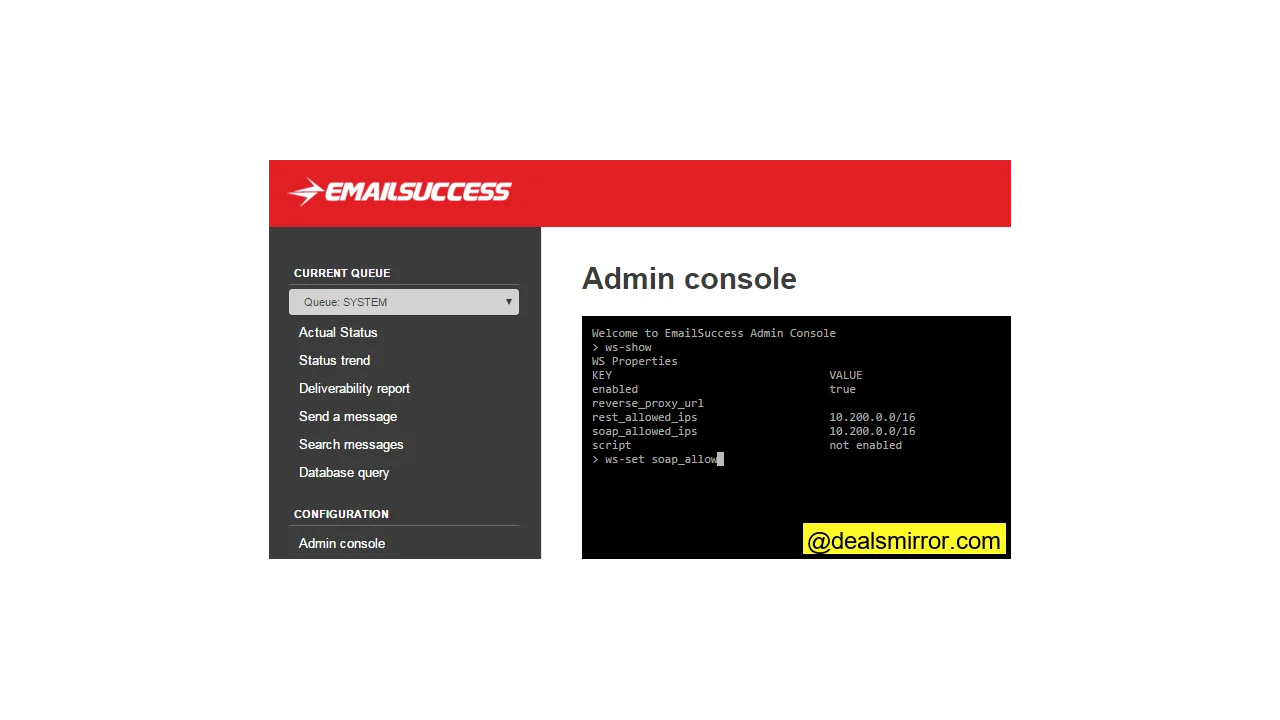
Example of how a configuration interface might look
Sectors like banking and healthcare, which are highly sensitive to data retention and often possess robust in-house technical capabilities, frequently lean towards on-premises services. Ultimately, an on-premises MTA can be the right choice when a company requires a high level of control over its email sendings and sensitive data.
Evolving Landscape of the MTA Market
The MTA market continues to grow, with a clear trend toward cloud-based solutions. However, many cloud offerings still don’t fully address the specific needs for stringent data protection and privacy, which are increasingly crucial. Market regulators globally are imposing new constraints on personal data management almost every year, and companies must be prepared for these rules when they become universally enforceable. A prime example is the General Data Protection Regulation (GDPR) in the EU, which became enforceable in May 2018.
The MTA market has also undergone significant changes recently, with some established players evolving their offerings and new actors emerging to provide alternative solutions. Companies should regularly re-evaluate their options through new software selections to ensure they are utilizing the best available technology.
The Rise of Hybrid MTA Solutions
For highly structured companies, engaging with a robust vendor capable of supporting both cloud and on-premises deployments is essential. Many clients now need to internalize parts of their email sending infrastructure due to factors such as unique business models, massive email volumes, or strict security and privacy policies. This has led to an increased evaluation of hybrid solutions, where, for instance, an in-house ESP might leverage outsourced MTA components.
A hybrid approach presents an interesting scenario for companies that aim to satisfy their needs for privacy, complete data control, and high deliverability performance simultaneously. Email vendors must rapidly adapt their propositions to offer flexible and sustainable solutions that cater to the specific requirements of clients across all industries.
Indeed, interesting hybrid MTA solutions, where only a portion of the marketing stack resides in the cloud, are becoming more prevalent. This evolving landscape underscores the importance of performance, problem-solving capabilities, and economic competitiveness in vendor selection. What truly matters for users is to clearly define their objectives and capabilities before embarking on their MTA software selection process and making a final choice.