
Email stands as one of the most potent channels for restaurants to engage with their audience. The most successful restaurant email marketing programs are built upon a foundation of a strong strategy combined with the right tools and tactics.
For restaurants, email marketing is an excellent way to boost foot traffic and transform first-time visitors into loyal regulars. This comprehensive guide will illuminate how restaurants can harness email marketing to encourage repeat visits, increase customer spending, and even inspire referrals.
The Benefits of Email Marketing for Restaurants
If your restaurant isn’t leveraging email marketing, you’re undoubtedly missing out on significant revenue opportunities. This is particularly true for franchise restaurants where an unsuitable email program can hinder growth and impact overall success.
The statistics underscore the immense power of restaurant email marketing:
- According to the DMA, email marketing generates $44 for every dollar spent, making it approximately 10 times more effective than platforms like Facebook, which typically yield $4-$5 per dollar spent.
- The average open rate in the restaurant industry stands at a robust 20.26%.
A well-executed restaurant email marketing strategy offers several key advantages:
- Staying Top of Mind: A significant challenge in restaurant marketing is maintaining brand recall. Effective email campaigns ensure your restaurant remains a preferred choice for customers.
- Increased Sales: Direct communication with your customer base often leads to a direct uplift in sales. Regular restaurant newsletters and targeted promotions are crucial for audience engagement and boosting revenue.
- Recovered Lost Conversions: Many online visitors initiate orders but don’t complete them. Utilizing abandoned cart or site visit follow-up emails can significantly help in recovering this potential revenue.
- Upsell and Cross-sell Opportunities: Restaurants consistently upsell in-store, and this tactic translates effectively online. By using subscriber data, you can send highly relevant emails that cater to individual preferences, offering complementary dishes or premium upgrades.
Email marketing is unequivocally one of the most effective and profitable methods to connect with customers and drive sales. Here’s how to maximize its potential.
Chapter 1. Take Advantage of the Most Effective Emails for Restaurants and Bars (Overview)
Restaurants have a diverse array of email marketing types at their disposal. These can generally be categorized into three primary groups:
- Mouthwatering Marketing Emails: Designed to keep your brand prominent in customers’ minds.
- Spicy Promotions: Created to entice customers to visit your establishment or place an online order.
- Tasty Triggered Emails: Personalized and perfectly timed messages delivered one-on-one based on specific actions or events.
Understanding when and how to deploy each email type is crucial for maximum impact. Let’s explore each category and its most effective applications.
Mouthwatering Marketing Emails for Restaurants and Bars
Marketing emails are incredibly versatile, ideal for sharing information, telling engaging stories, and ensuring your restaurant remains top-of-mind. The key is to balance your business objectives with your subscribers’ interests and preferences.
Common restaurant marketing emails include:
- New and seasonal menu items
- Newsletters
- Upcoming events or a calendar of events
- Calls to action for reservations, online orders, or delivery scheduling
- Recipes and culinary tips
- Behind-the-scenes content, such as “meet the chef” features or the story behind a signature dish
Spicy Promotion Emails for Restaurants and Bars
Promotional emails provide your subscribers with compelling reasons to visit your restaurant, order online, or spread positive word-of-mouth. These emails are designed to drive conversions, whether it’s redeeming a coupon code or utilizing a special deal.
Emails in this category typically include:
- Special promotions
- In-store promotions, discounts, and coupons
- Gift card offers
- Emails related to rewards and loyalty programs
Tasty Triggered Emails for Restaurants and Bars
A well-crafted welcome email series can effectively set the tone for all future interactions with your brand. Triggered emails are uniquely effective because they are based on a subscriber’s behavior, profile, and preferences, allowing for perfect timing. These emails should be integrated at every stage of the customer lifecycle.
Popular triggered emails for restaurants often include:
- Welcome email series
- Birthday emails
- Requests for customer reviews
- Confirmation emails (for orders, reservations, etc.)
Chapter 2. Choosing the Best Restaurant Email Marketing Software
The email marketing software you select plays a pivotal role in the success or failure of your restaurant’s campaigns. It’s natural to wonder how to choose the right solution.
Beyond standard features like deliverability and ease of use, there are specific functionalities that restaurant email marketing software absolutely must possess. In fact, there are 11 “make or break” features to carefully consider.
List Growth Features
A core function of your restaurant email marketing service is its ability to help you build and maintain an engaged subscriber base. The software should seamlessly support your list-building efforts.
- Easy contact management
- Segmentation capabilities based on diverse factors (e.g., age, location, lifetime spend, zip radius, DMA)
- Integrations with other list-building tools like popup forms
- API for custom solutions
- Automation workflows
- Advanced list maintenance (e.g., automatic removal of hard bounces, management of soft bounces after multiple failures, handling subscription preference changes)
- Cross-channel inbound and outbound marketing capabilities within the same platform for unified reporting and retargeting ease
- Simple content personalization for both offers and location-specific messaging
The faster you can expand your mailing list, the greater the ROI you’ll see from your restaurant email marketing campaigns. Robust list growth features are essential for this expansion and even for entering new markets.
Use Email Software That Caters to Sub-accounts (For Franchises)
For restaurants operating multiple brands or locations, sub-accounts are an invaluable feature. They are also crucial if you plan to empower franchisees to manage (or partially manage) their own promotions.
Sub-accounts address the critical question of permissions. Rather than giving franchisees full access to your master account and all its data, sub-accounts allow you to define who has access to what, maintaining control while enabling individual teams to create relevant email content. This flexibility allows for faster execution and ensures that restaurant newsletters are crafted by those with an intimate understanding of their specific local market.
Share Content and Data with Individual Stores
When managing multiple restaurant locations, the ability to drill down into data for individual stores is essential. This granular insight helps you identify what’s working and what isn’t at each specific location.
Armed with this information, you can share performance data with individual stores and collaborate on strategies for improvement. Simultaneously, you may need to share specific content with certain locations that have unique requirements. For instance, a flagship location might run fewer promotions or cater to a different customer demographic, necessitating unique content. The capacity to selectively share both content and data is a must-have in this scenario.
Implement Location-Specific Marketing
The “one size fits all” messaging approach is increasingly ineffective, especially as your restaurant’s reach grows and your email marketing strategy becomes more sophisticated.
Consumer language and preferences can vary significantly between different cities, such as Atlanta and Los Angeles. Similarly, promotions or specific menu items might be unique to certain locations. Your email marketing campaigns should reflect these differences through location-specific marketing. This necessitates dynamic content capabilities and easy segmentation within your software. You shouldn’t have to struggle to implement this crucial feature with your chosen restaurant marketing platform.
Integration with Loyalty Partners, Online Ordering, and POS
Many restaurants overlook the importance of integrations until after they’ve already invested in an email marketing service. Loyalty programs are proven revenue generators, and their effectiveness is magnified when every customer touchpoint can be tracked. Your loyalty program, online ordering system, and POS (Point of Sale) should integrate deeply with your restaurant email marketing service.
This deep integration allows you to accurately track the revenue generated by your emails and assess message effectiveness, all while providing a seamless experience for your customers.
Create Coupons and Discount Codes
Being able to track the performance of your created coupons and discounts is vital. Deep integrations with your email marketing service will provide the necessary insights to understand their true impact on your bottom line.
Whether unique coupon codes need to be generated directly within the email marketing software or synchronized with a CRM/database, ensure that any email marketing service you consider is compatible with your existing systems.
Master Brand Control
Your brand is unique, and maintaining its integrity across all communications is paramount. When multiple team members are involved, it’s easy for brand elements to be accidentally omitted or incorrectly applied.
Minor inconsistencies, such as using the wrong font or misplacing a logo, can gradually erode brand perception. Master brand controls allow you to set up brand assets once and easily access them for every email campaign. This ensures that anyone using your restaurant email marketing software can create perfectly branded content consistently.
Create Drag and Drop Customer Journeys
Every individual interacts with your brand in a unique way. Some become subscribers after placing an order, while others sign up via your website or in-store. Each interaction may lead to a different email journey.
There are countless approaches to mapping out customer journeys. Drag-and-drop customer journey builders simplify the process of editing automation rules, triggers, triggered messages, and SMS, ultimately leading to a higher ROI from your email marketing efforts.
Prebuilt Restaurant Email Templates
While you might possess the skills to design all your restaurant email marketing templates from scratch, it’s often not the most efficient use of your time. Prebuilt templates save time and provide a foundation based on proven designs. Even if you don’t use them exactly as offered, they can serve as valuable inspiration. Furthermore, A/B split testing becomes easier and less time-consuming when you have a solid starting point.
Integrations (In-store WiFi / Mobile App)
Your marketing efforts likely involve a suite of different software tools. Your restaurant’s email marketing system should not be an isolated platform; instead, it should integrate deeply with your other essential tools.
If you use a CRM, lead generation tools, or other specialized software, your email service should integrate effortlessly. A mobile app integration is also a crucial feature, allowing you to monitor and manage campaigns while on the go.
Two particularly relevant channels for restaurants are mobile apps and in-store Wi-Fi. If your restaurant has a mobile app, you’ll want the ability to push content to it directly through your email marketing platform, providing another avenue for timely and relevant communication. In-store Wi-Fi offers an opportunity to capture customer data by prompting sign-ups for free internet access. This provides valuable information about customer presence at your locations, enabling more targeted marketing.
Drag and Drop HTML Email Builder
The final essential feature on our list is a drag-and-drop email editor, crucial for creating visually stunning emails with ease. This functionality allows you to quickly add, rearrange, or remove content blocks, significantly accelerating the email creation process.
Combining a robust template library with a drag-and-drop builder ensures that all your emails are not only beautiful but also highly effective. Many other features, such as CRM functionalities, dashboard customization, and social media sharing, can further enhance your restaurant email marketing software.
Chapter 3: Great Email Examples for Restaurants and Bars Not to Miss in Your Strategy
It’s one thing to understand the theory, but how do you translate it into practical application? That’s where real-world examples come in. They help visualize the concepts you’ve learned.
We’ve curated some excellent restaurant email newsletter ideas and examples that you can adapt as building blocks for your next campaigns. Each example includes a description of its effectiveness and the type of email marketing software capabilities required to execute it.
Show off Fresh and Seasonal Menu Items
Your restaurant’s menu naturally evolves, with new dishes being introduced and others retired. To keep offerings exciting, many restaurants feature seasonal menu items. Marketing emails are perfect for spreading the word, and promoting “new and improved” items is an inviting way to inform customers about your latest culinary delights. Here are a few examples illustrating how to promote new and seasonal menu items.
Pizza Express employs a clean design with bright, complementary colors, a popular email marketing trend. This example highlights a limited-time offer: a 2-for-1 deal on main dishes from Monday to Wednesday. This strategy effectively drives traffic during typically slower weekdays, demonstrating the power of email to smooth out peak times. Subscribers can directly download the deal, accessing the menu and offer via a link.
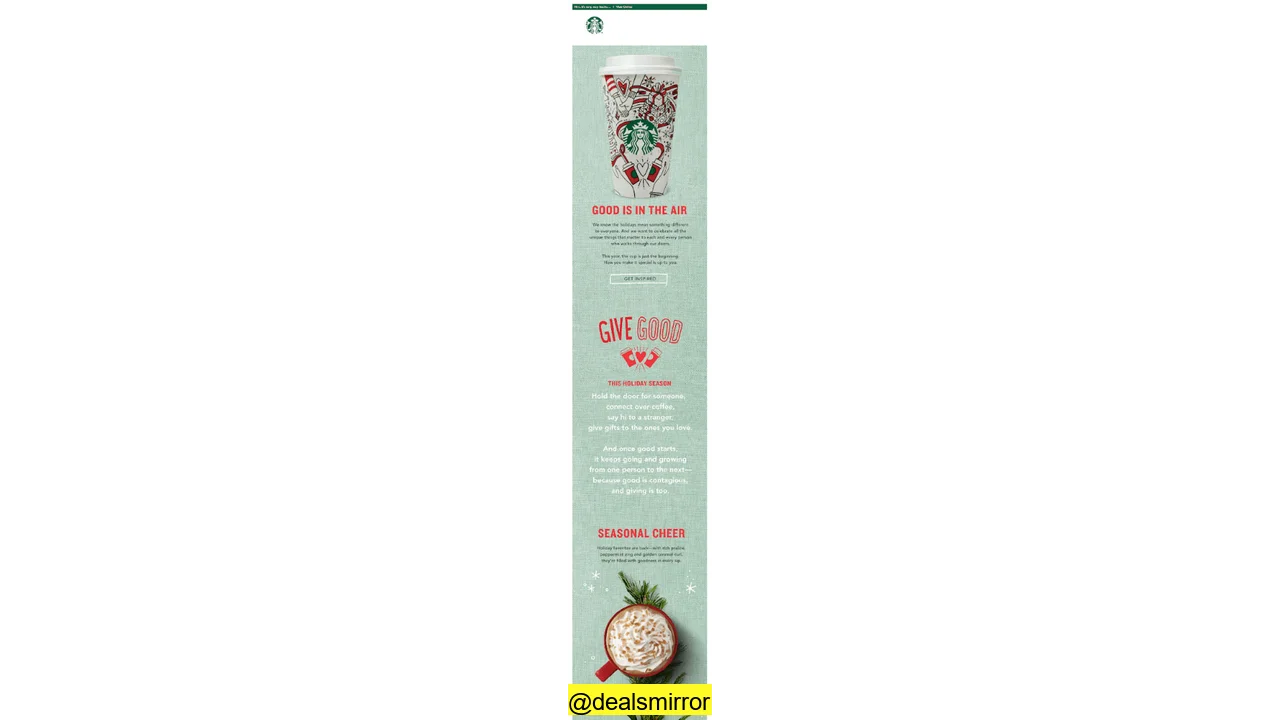
In the example above, Starbucks promotes its Christmas holiday drinks, calling it “Seasonal cheer.” The email features beautiful imagery and concise copy alongside a festive, meaningful message. The images are seamlessly integrated into the design. While the Call to Action (CTA) ghost buttons look aesthetically pleasing, a more prominent color might increase clicks.
What your ESP needs for seasonal promotion emails:
To send these types of promotions, top restaurant email software should offer flexible templates and automated A/B testing to optimize results.
- Ability to use background images in your email
- Mobile-responsive HTML drag-and-drop editor
- A/B split testing for different versions
- Social media sharing integrations with your accounts
Send Compelling Newsletters
Newsletters are an excellent way to stay top-of-mind. When it’s time to introduce new offers, your customers won’t feel like all your communications are purely sales-driven. Newsletters also provide an opportunity to personalize the relationship based on how subscribers signed up, their purchase history, and email interactions. The ideal frequency for newsletters should be determined through testing, but starting with once or twice a week and adjusting is a good approach. Additionally, features like Send Time Optimization (STO) or Recipient Local Time Delivery (RLTD) can further enhance personalization and optimize delivery.
Here are a few content ideas for restaurant newsletters:
- Community news and your restaurant’s involvement
- Spotlights on local suppliers you partner with
- Features on staff members and their stories
- Testimonials from satisfied customers
- Explanations of unique aspects of your restaurant or website (e.g., how to order online)
- Links to your latest blog posts
For restaurants, short, visual, and to-the-point newsletters work best. Make your email easy to digest. 😉
Here’s a restaurant newsletter example from Applebee’s:
This email leads with a header image above the fold, immediately communicating the main offer: new $1 margaritas with Twizzlers. It’s remarkably concise and, instead of a discount, highlights that the new flavor is available for only a month, encouraging readers to find their nearest location. The email is direct and features a clear call to action.
Following the main offer, it displays the reader’s presumed location and prompts them to update it if incorrect—a thoughtful touch that considers customer mobility.
What your ESP needs for these emails:
To bring your restaurant newsletter ideas to life, your ESP should offer flexible content options and robust location targeting for precise campaigns.
- Location-specific targeting
- Content blocks
- Support for high-quality image uploads
- Custom text blocks
Inform Subscribers About Upcoming Events/Calendar of Events
Events are a fantastic way to draw customers to your restaurant and showcase your community involvement. The success of event emails hinges on localization and segmentation. Sending event information for Charleston to someone in Miami is ineffective; ensure your invitations are relevant to your audience’s location and ability to attend.
To optimize targeting, capture relevant lead information at the point of sign-up. For instance, after subscribing to Applebee’s mailing list, they request preferences, starting with a birth date (necessary for alcohol-serving establishments).
It then progresses to the types of messages you’re interested in. Use this preference information as a guide; someone who only checks “delivery” might still be open to special event messages.
When it’s time to send event promotions, you’ll know exactly who should receive them. If you can’t gather extensive information upfront, focus on collecting the most important data initially and gather additional preferences through your welcome email series or other touchpoints.
The email example from Tock specifically promotes New Year’s events at Chicago venues.
The Tock email effectively provides just enough information to pique interest, encouraging click-throughs for more details.
What your ESP needs for upcoming events emails:
Sending these emails requires multiple functionalities to work in harmony. Your ESP should offer dynamic content and robust segmentation.
- Location-based segmentation
- Sub-account management (for franchises)
- Use of content blocks and dynamic content
- Easy email testing and QA checks for different (personalized) versions
Make Reservations, Order Online, and Schedule a Delivery
Your restaurant management system should be capable of handling online orders and seamlessly pushing them to your kitchen staff. When combined with timely email notifications, this approach can significantly increase your throughput and service levels. A new customer or subscriber can receive an email explaining how to order online, followed by a reminder email for subsequent orders. Strive for clear and concise messages when detailing the ordering process; any friction removed in these steps directly translates to better conversion rates. This is the power of restaurant email automation!
This functionality requires seamless integration between your restaurant management or POS software and your email marketing service.
This email from Tock excels in several ways. At the top, it prominently highlights a specific booking. Below, it provides restaurant details and an order/booking link. This strategy leverages consumer psychology, using social proof and exclusivity by framing the suggestion as an insider tip.
What your ESP needs for these emails:
To create emails like these, a strong selection of customizable email marketing templates coupled with a drag-and-drop editor is highly beneficial. Note the summary of items at the top—very helpful for quick scanning.
- Customizable restaurant email marketing templates
- HTML responsive email drag-and-drop editor
- Fine-grain control over what content is displayed on mobile versus desktop
Share Recipes and Tips
It might seem counterintuitive to share recipes for dishes served in your restaurant. Will customers simply make them at home? While some might, people dine out for more than just good food.
Beyond recipes, you can provide other valuable content in your restaurant newsletter:
- Lifestyle tips aligning with your brand
- Nutritional breakdowns of dishes
- Fun facts about your community
- Interesting information about common foods
- Trivia
- And more!
The goal is to build a content library for regular engagement with your email subscribers. This also keeps communications fresh and breaks the pattern of purely promotional emails. In the best-case scenario, customers look forward to opening your emails because you consistently provide interesting and valuable content.
Recipes are an excellent way to stay within the “food zone” and on-topic. These don’t always have to be full recipes; for a bar, sharing favorite celebrity drink recipes could be a good approach. The food newsletter example above shares a series of seasonal recipes customers can prepare at home.
What your ESP needs for these emails:
You shouldn’t have to build your food newsletter from scratch every time. Your ESP should allow you to save templates and easily swap out content blocks as needed.
- Styled text options
- Content blocks
- Dynamic content capabilities
- HTML drag-and-drop editor
- Reusable templates
Background – Meet the Chef / Story Behind the Dish
Joshua Glenn and Rob Walker famously demonstrated the power of storytelling to increase perceived value. They tasked writers with creating backstories for thrift-shop items, which then sold for significantly more on eBay. Storytelling is incredibly potent.
Do you have dishes you’re particularly proud of? Do any have intriguing backstories? Share the narrative of the people who brought the dish to life. Provide readers with insights into the special challenges, triumphs, or the creative process behind its creation.
This email from Delicia is remarkably simple, and while visuals could enhance it, its charm lies in its personal feel. It features:
- The backstory of the executive chef and their passion for their craft
- A recommendation for a specific dish, with a touch of social proof
- A link to delve deeper behind the scenes or try the dish at home
This example subtly communicates your brand values. For increased engagement, consider sharing the story through video, inserting an image of the video’s first frame.
What your ESP needs for these emails:
The strength of this restaurant email lies in its simplicity and narrative. You’ll want to link to a dedicated landing page, either on your main site or built directly within your ESP. This type of email also works well within a welcome program, especially with video integration.
- Landing page builder
- Triggered email functionality for a welcome program
- Ability to embed video in emails
Send Promotions with Discounts and Coupons
The primary goal of this type of restaurant email is to generate direct revenue. Make your email promotions time-sensitive with a clear deadline to encourage immediate action from your subscribers. You can offer options for coupon redemption both in-store and online, if feasible. While promotions are most impactful when used occasionally, different businesses will have varying discount strategies.
Starbucks sends a concise email to highlight their happy hour deal. The inclusion of a happy smiley in the design is a nice bonus. It’s common for bars and restaurants to use happy hour promotions to attract customers during specific times. Sometimes, simply reminding people of existing promotions is enough. Given its specific date and time, the ideal Call to Action is an “add to calendar” option for a timely reminder.
What your ESP needs for these emails:
Your restaurant marketing ideas shouldn’t be constrained by your ESP. This example uses a custom design and template, likely leveraging reusable blocks for the footer and other recurring information.
Promote Gift Card Offers
Gift card sales in the United States reached $160 billion in 2018, a significant increase from 2015, underscoring their effectiveness. While sometimes criticized as impersonal, gift cards remain one of the most requested gifts. Moreover, First Data found that 80% of consumers spend more than the value of their gift card, a trend particularly prevalent in restaurants.
Promote gift cards to your email subscribers or provide a straightforward way for them to purchase. After a purchase, send a follow-up transactional email that includes:
- Instructions on how to redeem the gift card
- Guidance on transferring it as a gift
- A call to action encouraging prompt redemption of the gift card
If you have a rewards program, consider integrating gift cards there as well. Gift cards also serve as an excellent entry point for new customers who may not have interacted with your restaurant before.
This restaurant newsletter campaign from Denny’s is quite busy, yet it aligns with their brand aesthetic. It prominently offers subscribers 20% off their check at the top. Playful arrows direct attention, and food images stimulate appetite.
Here’s another example from Denny’s. This one places the gift card offer front and center in the top navigation bar. The main promotion is a coupon, similar in setup to the first example, as it also showcases menu items and includes a call to action to order directly from the email.
What your ESP needs for these emails:
Your restaurant mailer should support:
- Mobile-optimized templates
- Integrations with your POS software
- Coupon functionality to generate or display unique codes, barcodes, and links
Reward Guests and Loyalty Program
Loyalty programs are a distinct type of promotion, fostering continuity and rewarding repeat behavior. Their effectiveness is amplified when integrated with email marketing. While there are various types of loyalty programs, if yours involves points or savings, set up triggered emails whenever someone earns points. Show them how close they are to their next reward. For inactive members, send emails highlighting their progress and encouraging them to re-engage with the loyalty program.
Allow patrons to use points as currency in your restaurant and establish specific tiers where they can claim rewards.
The Starbucks email informs coffee enthusiasts of their accumulated points and a waiting reward. It’s crucial for loyal customers to understand how to redeem their points. For those managing loyalty marketing programs, encouraging point redemption is a key objective. A loyalty program is also an excellent method for collecting email opt-ins and expanding your email list.
In other coffee-related news: McDonald’s might not be the first brand that comes to mind for coffee, but this email uses a great color palette and tone. The top image, message, and clock dynamically change each time the email is opened, a clever touch that captures reader attention.
The special offer is a “7th coffee free” at any location. In this specific case, purchases are tracked via the app, which also encourages app downloads.
What your ESP needs for loyalty and rewards emails:
Executing restaurant loyalty and rewards programs requires several key features, beyond just creating great emails with drag-and-drop tools and a “welcome to the club” automation series.
- Dynamic, time-based images
- Loyalty program integration
- Dynamic text replacement
- Trigger emails based on behavior and point balance
- Integration with your POS system
- Potentially, a connection to your mobile app
Use Special Promotions
Many promotions don’t neatly fit into standard categories or are executed infrequently. These special promotions can be highly effective in driving customers to your restaurant. They are also ideal for A/B testing to refine messaging and format for optimal results.
Your restaurant email marketing service should include built-in A/B split testing capabilities, allowing you to test variations of subject lines, messages, and layouts to continually optimize your emails.
What your ESP needs for special promotion emails:
Special promotion emails are most effectively managed with the following features in your restaurant marketing software:
- Dynamic content blocks
- Customizable templates
- A/B split testing on subject lines and content
- HTML drag-and-drop editor
- Email segmentation
- Automatic resend functionality to non-openers/non-clickers
Create a Compelling Welcome Email Flow
Your welcome emails are instrumental in setting the tone for the customer relationship. They ensure new subscribers know what to expect from your communications. Whether subscribers register in-restaurant or online, your welcome email flow should commence immediately. Delaying these emails significantly reduces engagement, as subscribers may forget why or how they registered.
Furthermore, a welcome email series, comprising multiple emails, consistently outperforms a single welcome email in terms of conversion rates.
The welcome email from Moe’s, while not overly complex, executes two key actions effectively:
- It establishes personality with a casual headline to welcome new subscribers, then swiftly outlines what to expect in upcoming emails.
- It smartly prompts subscribers to update their preferences. Clicking “introduce yourself” leads to a second page where users can update their profile and select their closest location.
What your ESP needs for these emails:
Even the best marketing ideas for restaurants can falter without the right tools. Look for:
- Welcome email triggers and automation capabilities
- A drag-and-drop canvas for planning event-driven emails
- A linked profile center or customer preferences page
- Customizable templates
- Robust opt-in registration and a GDPR-compliant, SOC-2 secure, and future-proof database
Birthday Emails
You can—and should—capitalize on birthdays, anniversaries, and other related events. These triggered emails are highly effective. The beauty lies in setting them up once, after which they automatically personalize for every new subscriber. A birthday or similar event presents a unique opportunity for personalization. Let your subscribers know you’re thinking of them. Since it’s a once-a-year occasion, offer a personal or group discount to encourage them to celebrate at your restaurant.
Baskin Robbins, a popular ice cream restaurant, offers subscribers $3 off an ice cream cake for their birthday. The message is customized and perfectly aligns with their brand. The cake offer is a thoughtful touch (they previously offered free ice cream but transitioned to cake).
What your ESP needs for these birthday emails:
- Birthday welcome email trigger sending
- Coupon functionality (if you utilize coupons)
- HTML drag-and-drop editor
- Analytics on triggered emails
Pay Attention to Confirmation Emails
Traditionally, confirmation emails are generic, providing only basic order information. While functional, this approach leaves significant revenue on the table. How? By neglecting to forge a deeper connection with the subscriber and missing upsell opportunities. The confirmation email is an ideal place to direct customers to engaging content, social media links, and additional offers.
Crucially, confirmation emails boast a much higher open rate than your average newsletter or promotional email.
This confirmation email example from Guerilla Tacos is distinctive. While confirmation messages typically relate to online transactions, this one confirms an in-store visit. It thanks the reader for their order, offers a freebie on their next visit, and clearly outlines how to redeem it.
What your ESP needs for these emails:
Crafting effective restaurant confirmation emails requires several features: dynamic content insertion, coupon integrations with your Point of Sale (POS) system, content blocks, and reusable templates.
Conclusion: Restaurant Email Marketing Success
As we’ve explored, restaurant email marketing is a highly effective method for growing your brand and driving more conversions.
Hungry for success? Understanding what makes your restaurant email marketing a winner involves three key elements:
- Familiarize yourself with the different types of email campaigns and identify which are most effective for your goals.
- Carefully assess your feature needs and select the best restaurant email marketing software that aligns with them.
- Utilize the examples provided in this guide as a reference when developing your own campaigns.
By following these principles, you can create restaurant email marketing campaigns that successfully increase revenue, enhance customer engagement, and build lasting goodwill for your brand.