For years, ActiveCampaign has been a top contender in the marketing automation space. It’s a highly popular marketing automation and CRM platform known for its versatility. Users can create virtually any marketing automation workflow imaginable, from simple email sequences to complex, fully automated campaigns.
This comprehensive ActiveCampaign review will put the platform to the test, examining all its core features, pricing, and a balanced look at its pros and cons.
ActiveCampaign Review Summary:
- ActiveCampaign is excellent software for both beginners and advanced marketers.
- Marketing automation is where it truly excels, allowing users to build any automation workflow they dream of.
- The tool is relatively easy to set up and use once you master its interface.
- It might be overly powerful if the sole need is to send simple newsletters.
- While not the cheapest, ActiveCampaign offers competitive pricing, starting at $15, or $79 with CRM and lead scoring included.
With its extensive feature set, ActiveCampaign comes highly recommended and proves its value.
ActiveCampaign Review: The Core Features
ActiveCampaign is renowned as email marketing automation software with sales CRM, but its capabilities extend far beyond that. Upon logging in, users will discover a wide array of functions within the dashboard.
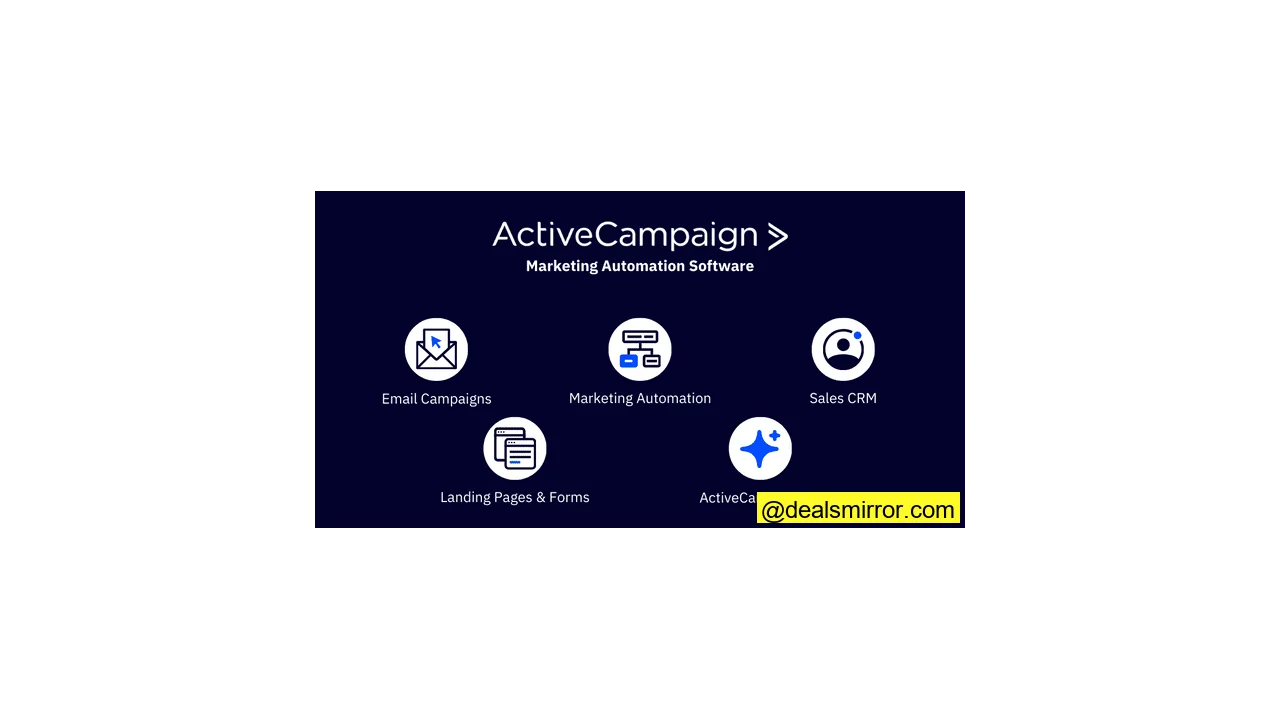
Here are the most notable ActiveCampaign features:
- Send Email Newsletters. ActiveCampaign provides over 240 professional templates and an intuitive drag-and-drop email builder.
- Create Automated Campaigns. The platform’s true strength lies in its marketing automation builder, making it simple to assemble automated campaigns. Users can jumpstart automation building with over 900 templates, then customize them to their specific needs.
- Close Sales with ActiveCampaign CRM. Automate sales follow-up to significantly reduce manual work in closing deals and managing sales.
- Generate More Leads with the ActiveCampaign landing page builder, designed to convert traffic into signups and customers.
- ActiveCampaign AI assists in automation building, content generation, segmentation, reporting, and campaign scheduling.
ActiveCampaign stands out as one of the few tools that integrates extensive functionality without overwhelming the user. While there’s much more to explore than on its main features page, its foundation remains robust email marketing and marketing automation software.
ActiveCampaign Pros & Cons
Pros
- Excellent email deliverability from the outset.
- Free migration assistance; ActiveCampaign helps users transition from their current email tool.
- Incorporates machine learning to continuously improve marketing results.
- The email builder is powerful and offers significant flexibility.
- The CRM includes sales automation to streamline the sales process.
- Fast and robust automation builder with over 900 templates.
Cons
- The sales CRM is an add-on, which some users might prefer to see included.
- New users to email marketing automation may require time to master its more advanced features.
- It is not the most budget-friendly option available.
Is ActiveCampaign for You?
Recommended if:
- You are starting simple but plan to automate parts of your emails. ActiveCampaign integrates with your site and includes site tracking, making it easy to plan multi-stage email follow-ups and campaigns.
- You’re looking for advanced marketing automation. ActiveCampaign offers one of the best automation builders for creating custom workflows, complete with goals, tags, and over 900 automated workflow templates to help you start.
- You’re looking for email marketing automation and a simple CRM in one platform. The built-in CRM in ActiveCampaign simplifies managing and automating deals within your sales pipeline.
Not recommended if:
- You only want to send simple newsletters. ActiveCampaign is overly powerful for basic newsletters and lighter automation needs. Many features might go unused. In this case, consider alternatives like MailerLite and Moosend.
- You’re seeking the cheapest email marketing tool. ActiveCampaign does not offer a free tier, with prices starting at $15/month. More basic, cost-effective options are available if simplicity is your priority.
ActiveCampaign Review Rating Details
| Ease of Use | ActiveCampaign is user-friendly, supporting advanced features with a well-designed interface and abundant on-screen tips. |
| Value for Money | ActiveCampaign’s prices begin at $15/month. Larger businesses will find necessary features in its Pro and Enterprise plans. The automation builder and marketing CRM provide excellent overall value. |
| Email Editor and Templates | The email builder is intuitive, offering advanced campaign options like A/B testing, personalization, and conditional content. It includes over 240 high-quality email templates. |
| Marketing Automation | The workflow builder is user-friendly, and more than 900 pre-built templates facilitate quick starts. Users can automate everything from email sending to updating deals in their sales pipeline. |
| Segmentation and Contact Management | Custom contact fields and tags enable storage of any desired data about contacts. The new segment manager allows segments to be utilized across the platform. |
| Lead Generation | The form and landing page builders are straightforward and effective. While functional, more form and page templates would be beneficial. |
| Reporting and Analytics | ActiveCampaign offers detailed performance analytics. Users can track website visits and create custom reports to analyze campaign performance from various perspectives. |
| Functionalities | Few email marketing services in the SMB market offer more features than ActiveCampaign. |
| Customer Service | Live chat, email, and call-back support are available 20 hours a day Monday-Thursday and 13.5 hours on Fridays. The platform also offers excellent contextual, on-page support, and a comprehensive, up-to-date knowledge base with guides and videos. |
Getting Started with ActiveCampaign
Signing up and getting started with ActiveCampaign is a quick process, taking approximately 5 minutes. The platform prompts for industry information and existing tools used. After filling in details and activating the account via email, users receive a personalized onboarding checklist. For instance, signing up as a Shopify ecommerce store provides a checklist to connect the store, import data, and set up a first cart abandonment automation. This step-by-step wizard is highly beneficial for immediate value. Users can explore with a free 14-day trial without a credit card.

ActiveCampaign Review: Marketing Automation and CRM Platform
ActiveCampaign is packed with features designed to make marketing easier, faster, and more effective. Let’s explore them in detail.
ActiveCampaign Email Marketing
While many users initially come for ActiveCampaign’s email marketing, they often stay for its broader capabilities. Email marketing encompasses individual emails and campaigns, with six distinct types to choose from:
- Standard
- Automated
- RSS triggered
- Split testing
- Date based
- Autoresponder
After selecting an email type, users choose the appropriate contacts by picking an email list. Beyond lists, ActiveCampaign’s site and event tracking provides an additional layer of targeting for individual campaigns.

For example, users might send emails to a specific list only if contacts have visited certain pages or performed a specific action on their site. This is relatively straightforward with ActiveCampaign, with more details covered in the automations feature section.
Email Templates in ActiveCampaign
During campaign setup, users can select from over 240 professional-looking email templates, categorized by use case. Additionally, more than 30 layout templates with building blocks are available for those preferring a design-free starting point.

The drag-and-drop editor facilitates crafting emails with content blocks. While not the most elaborate editor, it effectively handles customization, allowing adjustments to fonts, background colors, line height, padding, and more. Users can save customized emails as templates for future reuse.

One particularly useful feature within the email builder is conditional content. By adding tags to subscribers based on their profile or actions (like clicks or list sign-ups), these tags and other contact data can be used to show or hide specific content blocks within an email.

This allows for highly granular personalization. For example, if a business segments people into lists using quizzes and tags them based on answers (e.g., “starting a business” or “pre-revenue”), conditional blocks can tailor content to match each person’s specific situation. This means one email can effectively serve diverse contacts on a single list.
Further personalization is possible by adding contact data like names and company names.


The ActiveCampaign email editor also features AI content and image generation. Users can generate images by describing the desired visual, selecting a style, and clicking “generate.” This integrated image generator speeds up the process of testing different designs to find the best fit for a campaign. To fully appreciate the email builder experience, a free trial of ActiveCampaign is recommended.
Beyond features, email deliverability is crucial. Based on independent tests and user experience, ActiveCampaign’s deliverability consistently scores high, ensuring emails reach the inbox.
ActiveCampaign Marketing Automation
This is arguably ActiveCampaign’s strongest suit: its industry-leading marketing automation capabilities, simply referred to as “automations” within the platform.

When creating a new automation, users can start from scratch or select from over 900 ActiveCampaign automation templates designed for specific outcomes, such as:
- Interest follow-up based on site tracking.
- Welcome workflow for new contacts.
The automation builder allows for extensive customization. The example image above shows a condition checking if a contact recently made a purchase. If they have, they receive a follow-up email with accessory suggestions; otherwise, the automation ends.
Setting up automation involves clicking the “+” icon to add emails or conditions. A menu then opens, categorizing options for sending emails, various conditions (split automation, end automation, goals), contact actions (subscribe/unsubscribe to a list, add a tag), CRM, Salesforce, and CX apps.

ActiveCampaign also incorporates AI to assist in building automations. When testing automations, five workflow goals were available, with “Convert leads into paying customers” offering three automation templates.

Testing “Convert Leads to Customers with Weekly Newsletters” revealed pre-drafted email copy and a template fitting a specific brand. This can be fine-tuned or further edited using the AI content generator and the email editor.
Within the automation builder, the AI can also generate sequences. For example, prompting “Send 3 emails with a 2-day wait in between” yields the exact desired workflow. The combination of workflow templates, AI, and the brand kit simplifies the process of creating effective automations.
ActiveCampaign Automation Example
To illustrate the power of ActiveCampaign automations, consider this simple workflow:
- A visitor fills out a form and joins a mailing list, goes through a welcome sequence but doesn’t purchase. They then receive regular emails with industry updates, new features/products, and blog posts.
- They click one of these emails, visit a blog post, and then a product page. Since ActiveCampaign site tracking is enabled, this triggers an email sequence specific to that product.
- If they don’t submit a contact form on the product page within one hour, an email is sent asking if they’d like to schedule a call. Depending on their actions, the automation either ends, starts a different one (tagging them as “interested”), or notifies a relevant team member to reach out.
All this automation occurs seamlessly in the background, set up using simple conditional logic. Advanced users can leverage event tracking and tagging to create highly personalized customer experiences.
ActiveCampaign CRM
ActiveCampaign includes a robust CRM. New contacts and deals can be added manually or automatically triggered by sales automation, such as a contact form submission or achieving a high lead score.

Lead scoring is a standout feature of the ActiveCampaign CRM, allowing users to apply scores (manually or automatically) to identify their best prospects. From there, ActiveCampaign AI can calculate win probability.
Scoring rules can be configured based on email opens, clicks, and form submissions. When a contact reaches a specific score, it triggers a notification email to a sales representative, prompting them to call or follow up personally.
Users can also add notes to individual contacts, integrate with third-party apps like Gmail, access sales reports, and assign tasks manually or automatically. For a complete understanding of the sales features, explore the ActiveCampaign CRM documentation.
Landing Pages and Forms in ActiveCampaign
ActiveCampaign features a drag-and-drop landing page editor with over 60 templates and a straightforward form editor. Both editors are very similar to the email editor, ensuring a quick learning curve. Automations can be easily triggered based on form submissions on landing pages.

The landing page templates boast quality designs. Users can create a page from a template in approximately 10 minutes, as demonstrated by an example page.

Dragging and dropping blocks from the right sidebar is seamless, and the ability to change the entire theme of a template is a significant time-saver, eliminating the need to individually alter each element’s color.

ActiveCampaign offers five types of forms: inline forms, floating bars, floating boxes, modals, and a preference center.

Four actions can be triggered from a form: adding subscribers to a list, tagging them, adding them to a deal, or sending them an email. The ease with which automations can be triggered from a simple page is a notable advantage. These forms can be embedded anywhere on a website.

Another appreciated feature is that ActiveCampaign displays the website in the background during popup design, allowing for a real-time preview of its appearance.
Site Messages, SMS, and Chat
ActiveCampaign empowers users to create an omnichannel messaging experience that enhances support and conversions. “Omnichannel marketing” is the overarching term for its SMS, social, and ad audience features. Let’s delve into them.
1. Text messages and SMS
Text messages boast a high open rate and are proven effective. With ActiveCampaign, contacts can subscribe to SMS by texting a keyword to a company number or providing their phone number when submitting a form.

SMS messages can be sent directly from automations. Users simply add a “Send an SMS” action to their workflow, type a name, select recipients, and compose the message. Personalization options are available, along with scheduling for specific days and times. SMS can be used for flash sales, coupon distribution, or appointment and event reminders.
2. Site Messages
Site Messages are notifications that can be added to a website to deliver calls-to-action or updates. These can be sent from automations and personalized using contact data. Conditions and goals allow for precise targeting of who receives the message and when. Customization extends to where messages appear on a page and on which pages, enabling outreach to specific contacts based on their interaction with the brand.
The possibilities for targeting users with site messages are extensive. Experimenting with targeting, layouts, and themes is encouraged to discover what yields the best results.
3. Social Media Marketing & Ads
ActiveCampaign offers deep integration with Facebook and Google Ads, allowing users to add and remove people from custom audiences within automations.
For example, if a company runs Facebook ads for a product, once a contact purchases it, the automation can remove them from the Facebook Custom Audience, preventing irrelevant ad exposure. This saves on ad spend. Contacts can also be added to a contact list from Facebook, Instagram, and LinkedIn ads.
ActiveCampaign AI – the Smart Stuff
The ActiveCampaign AI is integrated across various parts of the tool. For email marketing campaigns, seven useful features include:
- Text Generation creates and refines subject lines and email copy based on user prompts.
- Image Generation adds impressive images that complement email templates and copy. Visuals can be generated by writing prompts and selecting from 17 styles.
- Segment Suggestions help group subscribers based on contact data and engagement, aiding in identifying the right contacts and their preferences.
- AI Automation Builder constructs automations based on prompts, suitable for creating full automations or adding steps to existing workflows.
- Predictive Sending analyzes contact interaction with emails to determine optimal send times.
- Predictive Content operates similarly to multivariate testing but with greater intelligence. Users write multiple email versions, and ActiveCampaign’s machine learning and natural language processing determine the best recipient for each version.
- AI Brand Kit generates email templates by retrieving logos, three brand colors, fonts, and social links from a given URL.
Within the CRM, machine learning can provide insights into deal closure probability, enabling a more focused allocation of time and energy.
ActiveCampaign Integrations
ActiveCampaign boasts over 950 integrations, with new ones added daily. Through Zapier or its open API, users can integrate virtually any software, including custom-built solutions.
Premium integrations are available for popular CRM and ecommerce platforms, such as Shopify, BigCommerce, Magento, Salesforce, and Microsoft Dynamics. These integrations go beyond basic connections, pulling in extra contact data, applying tags, adding automation actions, and retrieving purchase history.
A few of the most popular integrations include:
- Ecommerce platforms, like Shopify, Sellfy, BigCommerce, and WooCommerce.
- Email template editors, like Stripo.
- CRMs, like Salesforce and Pipedrive.
- Online course platforms, like Thinkific.
- Project management tools, like Asana.
- Lead generation tools, like OptinMonster.
- Social media and ad platforms, like Facebook and Google Ads.
- CMS software, like WordPress.
- Reporting tools, like Google Analytics.
ActiveCampaign Pricing & Discount

ActiveCampaign pricing starts at $15/month. The platform offers four plans, with prices increasing based on the number of contacts and desired features. Here’s a breakdown of the pricing by plan:
| Free | – 14-day trial with all Pro features |
| $19 | – 1,000 contacts – Starter plan with 10,000 email sends and 5 actions per automation |
| $49 | – 2,500 contacts – Starter plan with 25,000 email sends and 5 actions per automation |
| $99 | – 5,000 contacts – Starter plan with 50,000 email sends and 5 actions per automation |
| $189 | – 10,000 contacts – Starter plan with 100,000 email sends and 5 actions per automation |
| $489 | – 25,000 contacts – Plus plan with 250,000 email sends, unlimited actions per automation, landing pages, and AI-writing. |
ActiveCampaign also offers Enhanced CRM, SMS, Custom Reporting, and Transactional Email as add-ons.
Transactional Email is available on any plan. The Enhanced CRM and SMS add-ons are accessible with Plus, Pro, and Enterprise plans. Custom reporting is included in the Enterprise plan and can be purchased for Plus and Pro plans. For comprehensive details on what each add-on includes, refer to ActiveCampaign’s pricing page. Here’s a breakdown of the add-on costs:
| Add-on | Price |
| SMS | $16.83 for 1000 credits |
| Pipelines enhanced CRM | $68/month |
| Sales engagement enhanced CRM | $111/month |
| Custom reporting | $159/month for 50 reports and 25 dashboards |
| Transactional emails | $15 for 10,000 emails |
Does ActiveCampaign give a discount?
Yes, ActiveCampaign offers a discount on a yearly plan, making its costs highly competitive compared to other marketing automation platforms. They also provide a 20% discount on all plans for non-profit organizations.
Customer Support
Many companies struggle with customer support as they scale, but ActiveCampaign appears to have only improved. Previously, support was limited to email and a knowledge base. Today, users benefit from free onboarding/training webinars, live chat, and a wealth of concise, clear tutorial videos on YouTube. Support representatives are knowledgeable and empathetic. While phone support isn’t available, based on user encounters, ActiveCampaign’s support earns a strong 4 out of 5 rating.
ActiveCampaign Review: Conclusion
ActiveCampaign is a powerful email and marketing automation tool suitable for businesses across various industries, including B2C and B2B.
We recommend ActiveCampaign for:
Companies with some email marketing experience or those prepared to elevate their email marketing and implement automation. It’s accessible to beginners who follow the onboarding guides and videos.
We don’t recommend ActiveCampaign for:
Marketers whose sole need is to send simple newsletters. It’s too feature-rich for such basic use cases, and many features would likely go unused. In these instances, alternatives like MailerLite, Moosend, and Mailchimp are more suitable.
Starting at just $15/month, ActiveCampaign is affordable for many small businesses and provides the features needed to significantly improve email marketing and automation results.
Scorecard for ActiveCampaign:
| Ease of Use | ★★★★☆ |
| Value for Money | ★★★★☆ |
| Email Editor and Template | ★★★★☆ |
| Marketing Automation | ★★★★★ |
| Segmentation and Contact Management | ★★★★☆ |
| Lead Generation | ★★★☆☆ |
| Reporting and Analytics | ★★★★☆ |
| Functionalities | ★★★★★ |
| Customer Service | ★★★★☆ |
| Total score | ★★★★☆ |
Considering the value for money, coupled with ActiveCampaign’s automation, email marketing, and CRM capabilities, it stands as a highly recommended platform.
Frequently Asked Questions About ActiveCampaign
What is ActiveCampaign used for?
A simple example of marketing automation is a welcome email workflow: when a website visitor submits a form, ActiveCampaign sends a series of welcome emails introducing the company and its content. A straightforward example of ActiveCampaign sales automation is a workflow that updates a lead’s contact profile if they reply “yes” to a sales email requesting a call. Upon the lead’s reply, ActiveCampaign updates their profile and notifies the sales representative to follow up.
Is ActiveCampaign also a CRM?
Does ActiveCampaign have landing pages?
Does ActiveCampaign have a mobile app?
Is ActiveCampaign legit?
Is ActiveCampaign GDPR-compliant? Where does it host your data?
7 Best ActiveCampaign Alternatives
Since ActiveCampaign may not be ideal for everyone, here are seven alternatives that offer many essential email marketing features.
ClickFunnels vs ActiveCampaign
As a marketing automation platform, ActiveCampaign is generally the superior choice, outperforming ClickFunnels in most comparisons. ClickFunnels excels if your primary goal is to build high-converting lead capture pages.
For building, automating, and tracking campaigns, ActiveCampaign is recommended due to its excellent visual automation builder. It is user-friendly enough for beginners while offering advanced capabilities for growth.
Brevo vs ActiveCampaign
Brevo is a strong option if your main interest is sending email newsletters and you don’t require the advanced automation of ActiveCampaign. Brevo’s automation capabilities are not as elaborate as those of ActiveCampaign. For more on its automation, pros, and cons, review a Brevo automation review. When considering Brevo, its strengths lie in newsletters and transactional emails, at which it excels.
The best Brevo features are:
- Very easy-to-use email newsletter builder
- Basic CRM
- Excellent tool for transactional emails
- SMS marketing
Detailed pricing information can be found in a Brevo pricing guide.
GetResponse vs ActiveCampaign
GetResponse, initially a simple autoresponder and newsletter tool, has evolved into a comprehensive marketing platform. It now includes sales funnels with webinars, landing pages, Facebook Ads integrations, Stripe integration, and an online storefront.
The best features of GetResponse are:
- Ability to control all digital marketing from one centralized platform
- Free plan availability
- Prebuilt templates for most features
- Tools for creating Facebook ads
- Clear reporting across the entire funnel
To compare these two tools, consult a GetResponse review and an ActiveCampaign vs. GetResponse comparison.
Kit Vs ActiveCampaign
Kit is primarily focused on creators, and its automation features might not be ideal for e-commerce companies. However, it compensates with additional features, training, and content tailored to help creators get started.
The best features of Kit are:
- Landing pages
- Free plan
- Decent form builder
- Clear and useful reporting
Discover how these tools compare with our ActiveCampaign vs. Kit review.
Mailchimp vs ActiveCampaign
Mailchimp is a dominant player in the email marketing sector. It is often considered less sophisticated compared to ActiveCampaign, and for simple email needs, many Mailchimp alternatives offer better value. Its main appeal lies in its simplicity and a free plan for very small lists, though it quickly becomes expensive for growing lists.
The best Mailchimp features are:
- Free plan for less than 500 contacts (but quickly escalates in cost)
- Landing pages
- Facebook Ads management
- Postcards for customer engagement
Keap vs ActiveCampaign
Keap is an email marketing and CRM platform that includes landing pages, checkout, and even affiliate marketing capabilities. Explore a list of Keap alternatives for comparison. Despite its robust features, Keap can be quite complex and requires considerable time to master.
The best features of Keap are:
- Invoices and payments
- Sales CRM
- Appointment booking
- Marketing automation
- Business line and text messages
HubSpot vs ActiveCampaign
Comparing ActiveCampaign to HubSpot reveals that HubSpot extends beyond ActiveCampaign in inbound marketing, offering tools to optimize organic traffic and conversions.
ActiveCampaign is generally a stronger email marketing and automation tool, but HubSpot is a larger platform with more extensive functionality and a considerably higher price point.
The best HubSpot features are:
- Free CRM
- Live chat
- Website building (CMS)
- Marketing automation
- Landing pages
To compare them further, review an ActiveCampaign vs. HubSpot comparison and a HubSpot review.