

ChatGPT has rapidly become one of the most popular applications, sparking widespread interest and adoption across various sectors. With countless statistics available online, understanding its true impact requires a clear, concise overview of its performance, user base, and diverse applications.
This article cuts through the noise to deliver the most up-to-date statistics on this revolutionary AI tool. We’ll explore key questions, including the total number of ChatGPT users, the operational costs, and how marketers, healthcare professionals, and educators are leveraging AI.
Key ChatGPT Statistics Highlights
- Fastest Launch in History: ChatGPT achieved 100 million users in just one month, marking an unprecedented growth trajectory for an online service.
- Mobile App Dominance: Since the launch of its iOS and Android apps, ChatGPT has accumulated over 110 million total downloads.
- Massive Web Traffic: The ChatGPT website receives approximately 1.7 billion monthly visitors.
- Marketers’ Top AI Uses: Marketers primarily use AI for data analysis (60%), generating written text and images (51%), and personalization (42%).
- Disclosure Gap in Ecommerce: A significant 69% of ecommerce marketers do not consistently disclose their use of AI to managers and colleagues.
ChatGPT User and Usage Statistics
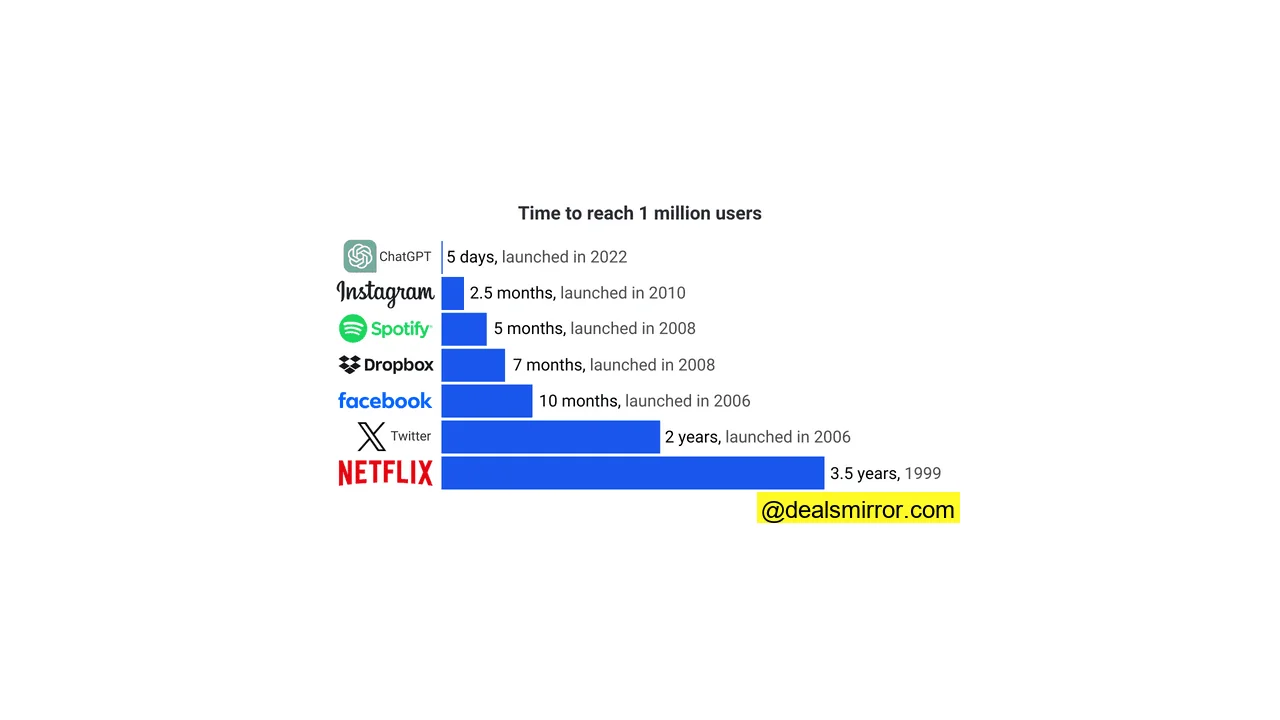
- Rapid User Acquisition: ChatGPT reached 1 million users on December 2, 2022, just five days after its launch. This was the fastest an online service had reached this milestone until Threads surpassed it by reaching 1 million users in one hour.
- Growing User Base: By 2023, ChatGPT’s user base expanded to 180 million, up from 100 million users in January 2023.
- Travel Planning Potential: Approximately 32% of American travelers are likely to use ChatGPT for planning their upcoming trips.
ChatGPT Usage Statistics in Marketing, Ecommerce, and Healthcare
- Marketer AI Adoption: 45.15% of marketers integrate AI into their marketing processes, while 25.61% do not.
- Primary Marketing Applications: The top three ways marketers utilize AI are data analysis (60%), generating written text and images (51%), and personalization (42%). While AI excels at text generation, proofreading, fact-checking, and editing are always crucial.
- Most Popular AI Tools: Based on user adoption, ChatGPT is the most popular AI tool among marketers at 71%, followed by Grammarly (34%) and Google Gemini (33%).
- Healthcare Sector Adoption: Over 10% of healthcare professionals currently use AI technologies, including ChatGPT, with about half planning to use them for work in the future. The leading applications for ChatGPT in medical practice are data entry (52%), appointment scheduling (42%), and medical research (38%).
- Ecommerce Productivity Boost: 83% of ecommerce marketers report increased productivity due to AI, with 84% also noting a performance improvement. Many ecommerce platforms already incorporate AI for content generation, product recommendations, and chatbots.
- Desired AI Capabilities in Ecommerce: Ecommerce marketers express a strong desire for AI to perform marketing analytics (49%), analyze company performance against competitors (49%), and predict customer behavior and attributes (47%).
- AI for Strategic Focus: 84% of ecommerce marketers state that AI handles routine tasks, allowing them more time to concentrate on higher-value work.
- Key Benefits of AI for Ecommerce: The top three benefits of AI cited by ecommerce marketers are improved quality and accuracy (41%), enhanced ideation gathering (36%), and improved decision-making and planning (36%).
- Predominant AI Types in Ecommerce: The most frequently used AI types by ecommerce marketers are generative (56%), predictive (53%), and conversational (53%).
ChatGPT App Statistics
- iOS App Launch Success: The ChatGPT iOS app, launched in May 2023, garnered 500,000 downloads within six days on the Apple Store, signifying one of the most successful new app releases.
- High iOS App Rating: The ChatGPT iOS app holds the second position in the Apple Store’s Productivity category and boasts an impressive 4.9/5.0-star rating from over 803,700 reviews.
- Subscription Model: While the app is free to download, ChatGPT Plus is available for a monthly subscription of $19.99.
- Android Rollout: The Android version of ChatGPT launched in July 2023 across the US, India, Bangladesh, and Brazil.
- Android App Performance: The Android app has been downloaded over 50 million times and maintains a strong 4.6/5.0-star rating from more than 573,000 reviews.
- Total Mobile Downloads: As of December 2023, ChatGPT has accumulated 110 million downloads across iOS and Android, making it the leading generative AI app.
- Mobile Revenue: ChatGPT’s mobile apps alone have generated approximately $28.6 million in revenue.
- Revenue Comparison: Despite its substantial revenue, ChatGPT ranks second to Ask AI in mobile app revenue, attributed to Ask AI’s earlier market entry and more varied, affordable premium features.
- OpenAI Valuation: OpenAI, the artificial intelligence company behind ChatGPT, is estimated to be worth $80–$90 billion, placing it among the highest-valued startups alongside ByteDance and SpaceX.
- Microsoft’s Stake in OpenAI: Microsoft holds a 49% stake in OpenAI, though this does not grant it influence over OpenAI’s board of directors.
- Operational Costs: OpenAI incurs daily operating costs of $694,444 to run ChatGPT, equating to approximately $0.36 per query.
- ChatGPT Enterprise Launch: OpenAI introduced ChatGPT Enterprise, which offers enhanced performance (twice as fast), handles inputs four times longer with its 32k context feature, and provides unrestricted access to powerful data analysis tools for various professionals.
ChatGPT Traffic and Monthly Visitor Statistics
- Monthly Visitors: In February 2024, ChatGPT recorded 1.7 billion visitors, a 1.97% increase from the preceding month.
- Bounce Rate: The ChatGPT website maintains a bounce rate of 33.68%.
- Pages Per Visit: On average, a ChatGPT visitor views 3.95 pages per session.
- Average Visit Duration: Users spend an average of 5 minutes and 17 seconds on the ChatGPT website before leaving.
- User Demographics (Age): The largest age demographic for ChatGPT users is 25-34 years old (33.16%), followed by 18-24 (28.18%) and 35-44 (18.37%).
- Traffic Sources: The majority of ChatGPT’s traffic is direct (84.54%), with organic search accounting for the second-largest portion (14.25%).
- Social Media Referrals: Significant social media traffic comes from Twitter (13.72%) and Facebook (7.55%).
- Organic Search Keywords: People use 171,000 keywords to access ChatGPT through organic search. The top three keywords are “chatgpt” (50 million searches), “chat gpt” (34.3 million), and “gpt” (2.7 million).
Country Statistics
- Top Traffic-Generating Countries: The United States leads in desktop traffic to ChatGPT at 16.58%, followed by India (7.38%), the Philippines (3.55%), Colombia (3.45%), and Canada (3.1%).
- Countries Where ChatGPT is Banned: ChatGPT is currently banned or unavailable in five countries: China, Iran, Cuba, North Korea, and Syria.
Awareness Stats
- AI Tool Usage and Awareness in US: A survey indicates that 32% of 1,000 US adults have never used AI tools, and 29% use them infrequently. Regarding ChatGPT specifically, 54% have not heard of it, and 34% have heard a little. Additionally, 40% have never used or seen anyone use ChatGPT, while 38% have seen others use it but haven’t tried it themselves.
- Business Owner Sentiment: 97% of business owners believe ChatGPT will positively impact their operations. Their top three planned uses are generating customer responses (74%), summarizing information (53%), and improving decision-making (50%).
- Perceived Business Impacts: The top three positive impacts business owners anticipate from ChatGPT are faster content generation (70%), creating personalized customer experiences (58%), and increasing web traffic (57%).
- Workplace Productivity Perception: Almost a third of consumers globally believe AI systems enhance workplace productivity. This sentiment is strongest in India (67%), Indonesia (65%), UAE (62%), Hong Kong (54%), and Singapore (53%). In contrast, only 17% of the US market shares this view.
- Healthcare AI Awareness: 66% of medical professional respondents are aware that AI technologies are utilized in healthcare.
- Reasons to Use AI-Enabled Healthcare: The top three reasons people would visit a healthcare provider that uses AI technology are faster medical care (52%), reduced risk of human error in medical decision-making (47%), and remote access to healthcare (telemedicine) (42%).
- Hesitations Towards AI-Enabled Healthcare: The top three reasons people would not visit an AI-enabled healthcare provider are the belief that AI cannot fully replace human expertise (53%), concerns about AI diagnosis reliability (47%), and a preference for human interaction and a personal touch (43%).
- AI Use Among US Professionals: A survey of 1,200 full-time US professionals found that 56% use AI, with 41% being women and 47% being men.
- Perceived Value of AI in Work: Out of the 72% who believe AI offers value to their work when used appropriately, 76% were men compared to 68% of women.
- Employer-Provided AI Resources: 51% of professionals report that their employers did not provide resources on how to use AI for work. Among those who did receive resources, 39% failed to utilize them.
- Organizational AI Readiness: 51% of professionals believe their organization will fall behind competitors if it fails to adopt AI. Conversely, 52% express strong concerns about AI posing dangers that could negatively impact their organization’s safety.
- Senior vs. Junior Professional AI Adoption: Senior professionals in upper management and top leadership positions are more likely than junior-level individuals to be provided with AI by their employers (68% vs. 36%), use employer-provided resources (48% vs. 25%), confidently explain their AI use for work (81% vs. 48%), and believe AI has positive, long-lasting effects on their industry (39% vs. 20%).
Education and Exam Statistics
- Teen Familiarity with ChatGPT: 67% of teens aged 13-17 are familiar with ChatGPT. Familiarity varies by racial group: white (72%), Hispanic (63%), and black (56%). Household income also influences teen familiarity.
- ChatGPT Use for Homework: 19% of teens have used ChatGPT for homework. Usage increases with grade level: 12% in grades 7 and 8, 17% in grades 9 and 10, and 24% in grades 11 and 12.
- Acceptable Uses of ChatGPT for Teens: 69% of teens agree that using ChatGPT for researching new topics is acceptable. However, only 39% believe it’s acceptable for solving math problems, and 20% for writing essays.
- Undergraduate AI Usage: 43% of undergraduates have experience using ChatGPT and similar AI applications. Of these, 39% use ChatGPT for personal projects, and 22% use it to complete assignments, as opposed to 57% who do not.
- Perception of Cheating: 51% of students agree that using AI tools like the ChatGPT app to complete assignments constitutes a form of cheating, while 20% disagree.
- School Bans on ChatGPT: As of February 1, 2023, eight schools and districts had banned ChatGPT, with New York City Public Schools being the first in January 2023.
- Teacher Views on ChatGPT: 67% of teachers believe ChatGPT should not be banned in schools, and 57% think it makes their jobs easier. However, 72% of teachers have not received any faculty guidance on how to integrate ChatGPT into the classroom.
- Frequency of ChatGPT Use by College Students for Assignments: Among college students who use ChatGPT for assignments, 36.27% use it 25% of the time, 34.92% use it 50% of the time, and 20.34% use it 75% of the time.
- AI Readiness for College Graduates: 83% believe that college graduates must be prepared to use AI in their work, and 74% think students already possess AI experience before entering the workforce.
- Demand for AI Education: 88% advocate for colleges and universities to offer educational opportunities to help students learn AI and its basic applications. 65% believe that if US educational institutions fail to provide such opportunities, the country will lose its competitive edge globally.
FAQs about ChatGPT Statistics
How many people are using ChatGPT?
How much data was ChatGPT trained on?
GPT-3.5, with its 175 billion parameters, is impressive, but the OpenAI model GPT-4 goes far beyond with 1.7 trillion parameters. These parameters function like dials and switches that fine-tune the AI’s responses, influencing tone, style, and creative output.
How many users did ChatGPT reach after its launch in 5 days?
Is ChatGPT good at statistics?
A National Library of Medicine study evaluated ChatGPT’s proficiency with 10 biostatistical challenges. It found that GPT-3.5 and GPT-4 initially scored 5/10 and 6/10, respectively. When given two more attempts, GPT-3.5 correctly answered 7/10, an average outcome. GPT-4 improved to a perfect score within the same number of attempts.
What is a ChatGPT prompt?
Various prompt techniques exist to guide ChatGPT to your desired outcome. One method is to explicitly detail your requirements step-by-step. Another is the “few-shot” method, where you provide ChatGPT with examples of the desired output. Role-playing, where you assign ChatGPT a specific character, can also help it interpret your questions in a new light. If you’re unsure how to start, a ChatGPT prompt generator can offer assistance.
Who owns ChatGPT?
Microsoft’s substantial $13 billion investment is significant, but it does not equate to ownership of OpenAI. OpenAI also receives support from other major investors such as Khosla Ventures, Infosys, and Andreessen Horowitz.
What does GPT stand for in ChatGPT?
“Generative” refers to the AI’s capability to produce various forms of content, with ChatGPT specializing in text, but extending to images and audio. It is also “pre-trained” on a large dataset, enabling it to provide detailed and informed responses. Finally, a “transformer” signifies the underlying technology used to understand and process data.
How many questions can you ask ChatGPT in an hour?
The clarity of your questions is crucial; if ChatGPT struggles to understand your query initially, you’ll spend more time refining it. The complexity of the question also plays a role. Simple, direct questions receive quick responses, whereas detailed explanations or more intricate inquiries will naturally require more time for ChatGPT to formulate its reply.
Does ChatGPT have a word limit?
Does ChatGPT save data?
OpenAI has since introduced an option to turn off chat history, empowering users with greater control over their data. This change enhances privacy and also influences how the AI learns from its conversations.
Sources
ChatGPT User and Usage Statistics
1. Statista, “Threads Shoots Past One Million User Mark at Lightning Speed“
2. Reuters, “ChatGPT sets record for fastest-growing user base“
3. Longwoods Internation, “American Travel Sentiment Study – Wave 73“
ChatGPT Usage Statistics in Marketing, Ecommerce, and Healthcare
1-3. GetResponse, “The state of AI in marketing”
4. The Intake, “Perceptions of AI in healthcare: What professionals and the public think“
5-9. Klaviyo, “The AI Trends Report for Ecommerce Marketers”
App Stats
1. TechCrunch, “OpenAI’s ChatGPT app tops 500K downloads in just 6 days“
2-3. Apple Store, “ChatGPT”
4. TechCrunch, “ChatGPT for Android is now available in the US, India, Bangladesh and Brazil“
5. Google Play, “ChatGPT”
6-8. TechCrunch, “ChatGPT’s mobile apps topped 110M installs and nearly $30M in revenue“
9. The Wall Street Journal, “OpenAI Seeks New Valuation of Up to $90 Billion in Sale of Existing Shares“
10. The New York Times, “How Microsoft’s Satya Nadella Kept the ‘Best Bromance in Tech’ Alive“
11. SemiAnalysis, “The Inference Cost Of Search Disruption – Large Language Model Cost Analysis“
12. OpenAI, “Introducing ChatGPT Enterprise”
Traffic and Monthly Visitor Statistics
1-8. Similarweb, “OpenAI”
Country Statistics
1. Similarweb, “OpenAI”
2. PC Guide, “What countries is ChatGPT not available”
Awareness Stats
1. YouGov, “Daily Survey – ChatGPT”
2-3. Forbes Advisor, “How Businesses Are Using Artificial Intelligence In 2024“
4. YouGov, “Nearly a third of consumers think AI has improved workplace productivity“
5-7. The Intake, “Perceptions of AI in healthcare: What professionals and the public think”
8-12. Washington State University Carson College of Business, “American workers sound the alarm on AI workplace readiness“
Education and Exam Statistics
1-3. Pew Research Center, “About 1 in 5 U.S. teens who’ve heard of ChatGPT have used it for schoolwork“
4-5. BestColleges, “Half of College Students Say Using AI on Schoolwork Is Cheating or Plagiarism“
6-7. Study.com. “ChatGPT in The Classroom“
8. Intelligent, “Nearly 1 in 3 College Students Have Used ChatGPT on Written Assignments“
9-10. Washington State University Carson College of Business, “Workers sound the alarm on AI workplace readiness“