

Recent reports by Reuters indicate that Google is in discussions with advisors regarding a potential acquisition of HubSpot. Valued at an estimated $35 billion, such a move would mark Google’s largest acquisition to date and could profoundly reshape the marketing and advertising industry.
This potential acquisition raises critical questions for the MarTech landscape, particularly given advancements in generative AI, data utilization, platform evolution, and the changing nature of search. Key considerations include:
- How will current HubSpot users react to this development?
- What would be the broader implications for the marketing industry?
- What is the strategic rationale behind Google’s interest in acquiring HubSpot?
To explore these questions, research was conducted to gather insights from industry experts and HubSpot users.
The Impact of Google Acquiring HubSpot
In a survey conducted by Emailvendorselection.com, over 200 industry experts and HubSpot users shared their prospective actions should the acquisition proceed. Their responses provide a clear picture of potential shifts in the market:
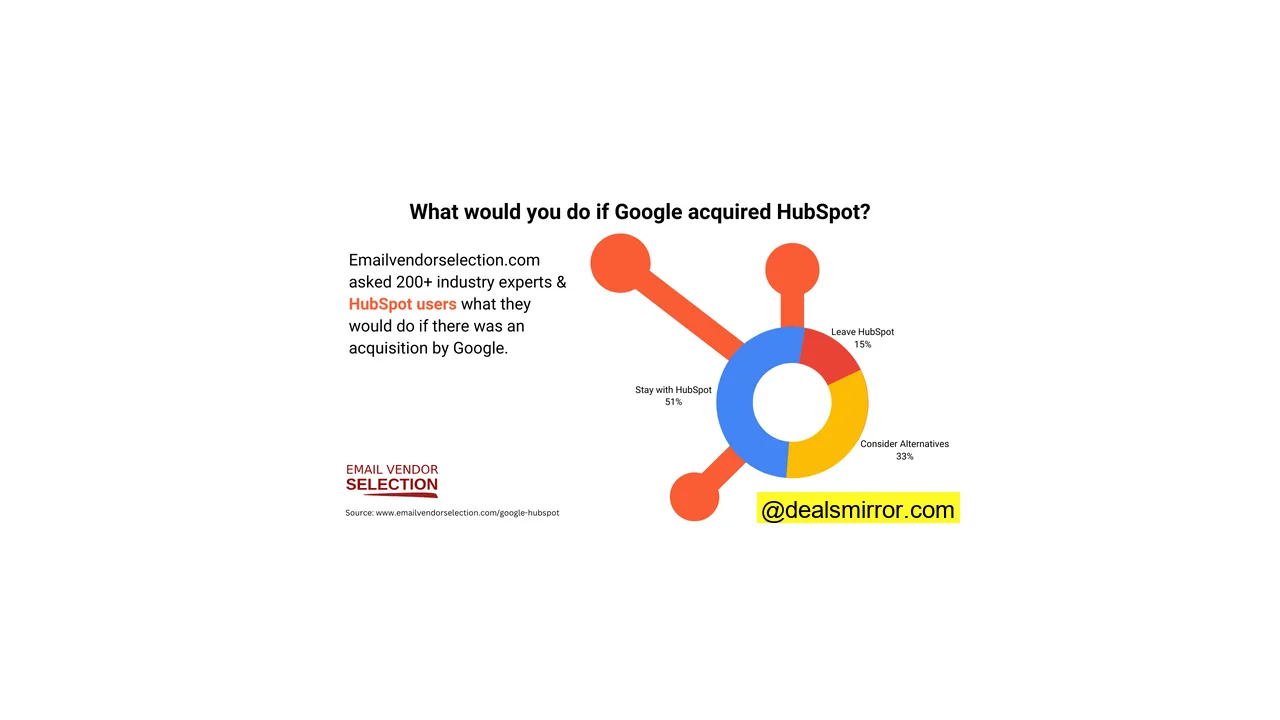
- 51% would remain with HubSpot, regardless of the acquisition.
- 33% would actively explore alternative platforms.
- 15% would likely depart from HubSpot.
Notably, a significant 48% of respondents indicated they would either consider alternatives or were already contemplating a move. The 15% expressing a likely departure is particularly impactful. Given HubSpot’s 2023 revenue of $2.17 billion, a loss of 15% to 48% of clients could translate into a substantial revenue impact ranging from $325 million to $1 billion.
While HubSpot has maintained high retention rates and CRM/site migrations are complex, the mere possibility of such a significant shift in user perception is remarkable. Conversely, a large segment (51%) of loyal HubSpot users expressed strong commitment, with some identifying as “HubSpot fanboys” or stating “We love HubSpot.” This group either doesn’t foresee major operational changes or anticipates potential upsides from the acquisition.
This acquisition would represent a pivotal moment in the CRM space, marking Google’s entry into marketing technology (MarTech) as a leading AdTech provider. This isn’t an entirely unprecedented direction; other major technology companies have previously acquired marketing platforms, including Salesforce, Microsoft, and SAP.
HubSpot serves over 205,000 clients, ranging from small businesses to large enterprises. Its comprehensive functionality spans across:
- CRM
- Sales
- Marketing
- Content
- Service
The platform is generally well-regarded within the industry.
Scenario Planning and Alternatives to Consider
If based on the survey data, 46% of HubSpot’s 205,000 customers were to explore competitors, this would mean approximately 94,000 companies evaluating new solutions. Given HubSpot’s market prominence, even a small percentage of additional companies comparing options would highlight the scarcity of specialized expertise in software selection.
What Should Users Do?
It is advisable for businesses to conduct a scenario planning exercise as part of their next marketing stack review. Scenario planning involves actively preparing for potential market changes, ensuring a clear plan is in place when shifts occur.
Many CMOs and marketing teams often lack extensive experience in software selection processes. This is where specialized selection professionals can provide crucial assistance. While Martech Ops teams are proficient in managing current stacks, CTOs must project 3-5 years ahead for architectural planning and maintain a high-level view of market trajectories.
“Wait and See” Isn’t an Option
Some industry experts suggest a “wait and see” approach for the acquisition’s outcome. However, this perspective overlooks the significant time required for software selection and migration, especially when contract renewal dates impose firm deadlines. While those not involved in the HubSpot ecosystem might observe the developments from a distance, mid-sized and enterprise HubSpot users do not have this luxury.
Additional Resources:
- HubSpot alternatives with pricing
- Email marketing tools and user ratings
- Understanding the HubSpot platform
Deal Rationale: Why Would Google Buy HubSpot?
Alphabet, Google’s parent company, reportedly holds a cash reserve of $110 billion. While investment is a natural objective, experts polled highlighted specific strategic reasons for considering the HubSpot acquisition:
- Proprietary data for training AI.
- Targeting information for Ads.
- Competitors and market positioning.
- Revenue and cross-selling opportunities.
1. Proprietary Data for Training AI
With generative AI at the forefront of tech discussions, Google has faced challenges, notably with the launch of Gemini (formerly Bard) and adapting its search product to the influx of AI-generated content and new AI-based competition. Experts believe a HubSpot acquisition would provide access to unique, proprietary data – specifically trend and profile data within the SMB market – invaluable for training Google’s AI models.
2. Adding to Targeting and Retargeting Pool for Ads
The impending phase-out of third-party cookies is shifting focus towards first-party data, as companies build their own datasets from direct audience interactions. HubSpot’s extensive first-party CRM data could significantly augment Google’s targeting, retargeting, and contextual advertising capabilities. This kind of data is crucial for creating lookalike audiences, similar to how LinkedIn and Facebook enable targeted advertising.
3. Moving into MarTech as a Strategic Move and Market Positioning
Industry observers point out that other major tech companies have already established strong MarTech presences through acquisitions. Microsoft Dynamics offers a comprehensive suite, and SAP acquired Netcore, following numerous acquisitions by Salesforce over the years. Google currently has a gap in its MarTech portfolio, making the acquisition of a leading marketing suite like HubSpot a logical strategic advancement.
4. Revenue and Access to the HubSpot Audience
As one of the largest CRM providers, HubSpot offers Google not only substantial revenue but also direct access to its vast customer base. This would open opportunities for cross-selling Google products like Google Workspace and Google Ads to HubSpot users, while also potentially leveraging Google’s reach to convert SMBs into HubSpot clients.
The Biggest Worries About the Acquisition
While the acquisition presents strategic advantages for Google, the panel of experts raised several common concerns. With a few exceptions, there’s a consensus that such acquisitions often lead to adverse outcomes for the end-users of the acquired company.
1. A Pricing Increase on the Horizon
Following acquisitions such as Intuit’s purchase of Mailchimp, users often worry about the future pricing of their marketing stack. Historical trends suggest that monetization models are invariably reviewed after an acquisition. HubSpot is already considered quite pricey for the mid-market, with numerous more affordable alternatives available. While an immediate price hike might not occur, common post-acquisition strategies include moving functionality into more expensive tiers, excluding newer features from legacy pricing, or altering the overall pricing model to recoup the significant investment.
2. Slowing of the Pace of Platform Development
A typical consequence of software acquisitions is a deceleration or even cessation of investment in software development, often resulting in the cancellation of certain projects. If the acquiring company attempts to integrate multiple tools – a challenging and often impossible task – development resources are frequently reallocated to integration projects, potentially stalling innovation.
3. Privacy and Data Concerns
Given that the market largely views data as a primary motivator for the acquisition, concerns are naturally raised regarding the use of this data and the associated privacy implications for users.
Preparations for Onboarding Agencies and Marketing Platform Users
The industry is actively preparing for potential shifts and events stemming from such an acquisition. Key actions and needs include:
- Actively updating HubSpot marketing and CRM agency lists. Following previous market insights, increased requests for platform advice are anticipated, necessitating a comprehensive and vetted list of specialized HubSpot onboarding agencies and experts.
- Updating expert lists for migration to alternative platforms. This includes researching costs, current client bases, and team sizes for services catering to small to enterprise-level migrations across various geographical regions.
- Identifying marketing platform customers in diverse industries for user interviews. Expert-led selection processes often involve interviewing current and potential customers. Compiling a list of companies available for interviews during selection and scenario planning exercises provides significant benefit.
Users of alternative platforms who have recently undergone a migration are encouraged to share their experiences to contribute to this preparation.
More Stats About HubSpot
- HubSpot’s revenue was $2.17 billion in 2023, representing a 25% year-over-year growth compared to 2022. Subscription revenue accounted for $2.12 billion, with professional services and other revenue at $46.8 million.
- HubSpot serves 205,000 customers across more than 135 countries, showing 23% year-over-year growth.
- HubSpot’s Average Subscription Revenue Per Customer was $11,365 in Q4 2023.
- 53% of HubSpot customers are located outside of the United States. These international customers generated approximately 47% of HubSpot’s total revenue in 2023.
- HubSpot employs 7,700 individuals.
Sources
- HubSpot “Reports on Q4 and Full Year 2023 Results” Feb 2024
- HubSpot “Overview of Q4 2023” Feb 2024
- HubSpot “Reports on Q4 and Full Year 2023 Results” Feb 2024
- HubSpot “Annual Report on Form 10-K” Feb 2024
- HubSpot “Overview of Q4 2023” Feb 2024