Marketing professionals continuously explore diverse tactics to achieve their goals. However, doing everything simultaneously can be challenging, especially for businesses with limited staff or budget to launch multiple campaigns.
With a robust marketing automation tool, businesses can significantly reduce their workload. This software handles repetitive, non-specialized tasks, freeing up marketers to concentrate on strategic initiatives. Furthermore, marketing automation software effectively lowers costs by decreasing the need for manual labor and boosting overall productivity.
The latest marketing automation statistics reveal how businesses are leveraging automation software to drive growth and why organizations are increasingly adopting it to engage with customers more effectively.
Top Marketing Automation Statistics
- 79% of marketing professionals automate the customer journey. This includes 10% fully automated, 25% mostly automated, and 44% partially automated. Only 21% do not automate their customer journey at all.
- 91% of organizations report an increasing demand for automation. Requests for more automation originate from marketing (26%), research and development (39%), administration and operations (38%), and customer service (33%).
- The top 10% of email workflows generate $16.96 in revenue per recipient, significantly higher than the average email workflow revenue of $1.94.
- 64% of marketing professionals already utilize automation and AI, with 62% considering it important for their marketing strategy.
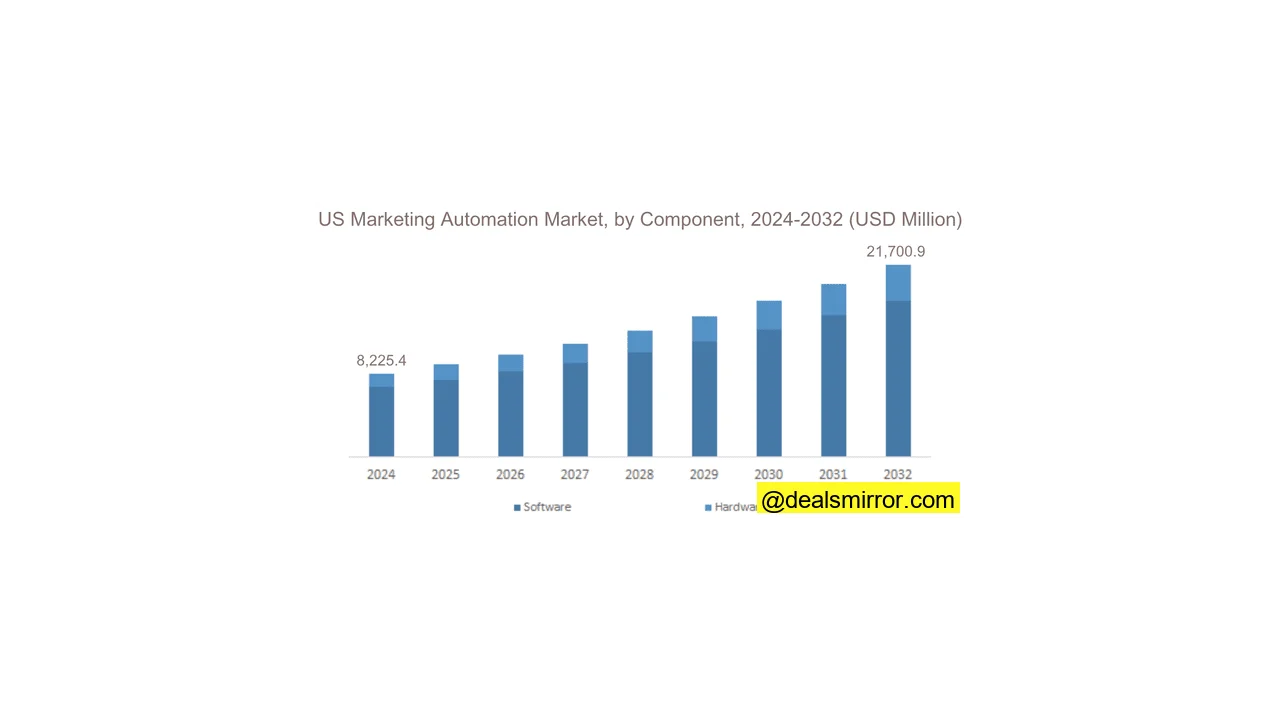
- The marketing automation market size is projected to reach $13.97 billion by 2030, growing at a compound annual growth rate (CAGR) of 12.8% from 2022 to 2030.
Marketing Automation Adoption Statistics
- 76% of marketers use marketing automation more than sales departments and 139% more than finance departments.
- A significant 79% of marketing professionals automate their customer journey. This breaks down to 10% fully automated, 25% mostly automated, and 44% partially automated, while 21% perform no automation in this area.
- 28% of marketers plan to integrate marketing automation into their email marketing efforts in 2024. Other areas targeted for automation include paid advertisements (29%), social media management (29%), and landing pages (21%). Less frequently mentioned areas for automation are dynamic web forms (14%), sales funnel communications (13%), and lead scoring (9%).
- Customer profile analysis shows the highest adoption rate for marketing automation, at 51.43%. Other marketing processes benefiting from automation include report generation (47.14%), social media tracking (44.26%), dynamic campaign control (42.86%), and market research (38.58%).
- 84% of businesses state that financial resources are not a constraint if marketing automation software proves its worth. However, 66% report that no existing tool in the market fully meets their specific requirements.
- The marketing automation market is forecast to hit $13.97 billion by 2030, demonstrating a projected compound annual growth rate (CAGR) of 12.8% from 2022 to 2030.
- Over 70% of users show a preference for cloud-based software. This trend is driven by the advantages of cloud computing technology, including extensive data storage, enhanced data access flexibility, and reduced IT expenses.
Industry-Specific Marketing Automation Statistics
- The top 10% of email workflows generate $16.96 in revenue per recipient, compared to an average of $1.94 for all email workflows. This clearly indicates that testing and optimizing email automations significantly boosts revenue.
- Abandoned cart workflows lead in revenue generation, bringing in $28.89 for the top 10% performers and an average of $3.65. This is followed by welcome flows ($21.18, average $2.65), abandoned browsing automations ($7.21, average $1.07), and post-purchase sequences ($5.14, average $0.41).
- The sporting goods (57.63%), food and beverage (55.52%), and automotive (55.1%) sectors exhibit the highest welcome workflow open rates. In contrast, specialties (53.64%), health and beauty (51.64%), and general merchandise (48.79%) have the lowest rates.
- Sporting goods (6.95%), automotive (6.67%), and toys and hobbies (6.60%) industries record the highest welcome workflow click-through rates (CTRs). Jewelry (5.56%), health and beauty (5.24%), and general merchandise (5.10%) show the lowest CTRs.
- Toys and hobbies (2.50%), apparel (2.46%), and food and beverage (2.46%) industries achieve the highest welcome workflow order completion rates. Jewelry (1.85%), electronics (1.82%), and general merchandise (1.79%) report the lowest rates.
- Food and beverage (52.16%), home and garden (51.74%), and sporting goods (51.69%) sectors lead in abandoned cart workflow open rates. Office supplies (49.08%), electronics (48.92%), and general merchandise (46.25%) register the lowest rates.
- The highest click-through rates (CTRs) for abandoned cart workflows are found in hardware and home (6.96%), sporting goods (6.95%), and home and garden (6.74%). Specialties (5.98%), health and beauty (5.68%), and general merchandise (5.41%) experience the lowest CTRs.
- Automotive ($5.47), hardware and home ($4.51), and sporting goods ($3.42) industries generate the highest revenue per email workflow recipient. Food and beverage ($1.60), office supplies ($1.54), and health and beauty ($1.32) have the lowest.
- Automotive ($6.29), hardware and home ($5.70), and sporting goods ($4.47) yield the highest revenue per recipient from welcome workflows. Sectors with lower revenues include office supplies ($2.05), food and beverage ($1.89), and health and beauty ($1.85).
- The automotive ($9.86), hardware and home ($9.63), and sporting goods ($6.73) sectors generate the most revenue per recipient from abandoned cart workflows. Food and beverage ($2.92), office supplies ($2.89), and health and beauty ($2.65) record the lowest.
- The global marketing automation market was valued at $7.3 billion in 2023. It is projected to grow at a compound annual growth rate (CAGR) of 12.74% between 2024 and 2032.
- 91% of organizations confirm that demand from business teams for implementing marketing automation has surged. These requests stem from research and development (39%), administration and operations (38%), customer service (33%), and marketing (26%) departments.
- 52% of marketers consider integrations to be crucial when selecting marketing automation software. Other significant factors include key features (45%), scalability (35%), ease of use (33%), price (27%), company reputation (27%), personalization (24%), customer support (16%), and implementation time (15%).
- The transportation sector boasts the highest degree of marketing automation, at 65%, with an anticipated increase of 21%.
- 31.25% of companies prefer their automation software to be managed exclusively by their employees. In contrast, 6.25% desire external consultants to manage their software, while 62.5% are open to shared management.
- 75% of businesses deemed marketing automation either very relevant or relevant in 2023. The percentage of companies reporting it as “very relevant” has sharply risen from 18% to 42% in just two years.
Email Marketing Automation Statistics

- 63% of marketers employ marketing automation for email marketing. Marketers also leverage automation for social media management (50%), paid advertisements (40%), content management (35%), landing pages (29%), and SMS marketing (28%).
- Automated workflows, such as abandoned cart or post-purchase messages, generate up to 30 times more revenue per recipient than traditional campaigns. This effectiveness is attributed to their timely and targeted nature.
- 31% of all email orders originate from automated messages, despite these messages accounting for only 1.8% of total email sends.
- 54.2% of e-commerce automation workflows are dedicated to abandoned cart recovery. Other common workflows include welcome emails (30.8%), customer onboarding (5.6%), and abandoned browsing sequences (3.6%).
- Recommendation and loyalty email campaigns achieved the highest click-through rates (CTRs) in 2023, at 25.15%. Other email types saw CTRs for welcome (24.46%), gift (23.05%), post-purchase (21.36%), abandoned cart (17.98%), birthday or anniversary (15.86%), abandoned browsing (15.09%), and customer win-back (7.21%).
- Birthday and anniversary emails recorded the highest open-click rates in 2023, reaching 24.43%. Open-click rates for other email types were: gifts (19.36%), welcome (17.51%), abandoned cart (17.17%), abandoned browsing (15.94%), recommendation or loyalty (14.84%), post-purchase (10.72%), and customer win-back (9.32%).
Marketing Automation Usage Statistics
- 64% of marketing professionals actively use automation and AI, with 62% considering these technologies vital for their marketing strategies.
- 43% of marketers utilize marketing automation software to optimize their overall strategy. They also employ automation to enhance data quality (37%), identify ideal customers (34%), and refine their messaging or campaigns (31%).
- 42% state that data management is the marketing area that benefits most from automation. This is followed by analytics (25%), content creation (23%), and communication (16%).
- Among marketing professionals who use automation, 50% report daily usage. Another 33.2% use it sometimes, while 16.8% use it intermittently.
Reasons to Utilize Marketing Automation
- 58% of marketers leverage marketing automation for task management. Other applications include content automation (42%) and chatbots (31%).
- 43% of marketers aim to enhance their marketing automation to optimize their overarching strategy. Additionally, 37% seek to improve data quality through automation, and 34% wish to better identify ideal or potential customers.
- 30% of marketing professionals indicated a desire to automate tracking and data entry. Lead management was cited by 28%, and project or task management by 25%. Many top-tier CRM software solutions offer features to automate these workflows.

Benefits and ROI of Marketing Automation

- 65% of marketing professionals consider their marketing automation strategy to be highly effective or extremely effective.
- 25% of marketers report achieving their objectives more successfully with their current marketing automation strategy. A broader 66% acknowledge experiencing some level of success from their implemented automation.
- 22% of marketing professionals state that marketing automation boosted their efficiency by over 35%. Furthermore, 39% saw efficiency increases between 15% and 35%, while 5% noted less than a 15% increase. Conversely, 5% reported no impact on efficiency, and 2% indicated a decrease in efficiency due to automation.
- 29% of B2B marketers assert that marketing automation significantly aided them in reaching their goals. 65% found it somewhat useful, while 6% reported no success.
- 27% of B2B marketers strongly agree that marketing automation streamlines the creation of effective customer journeys. 53% somewhat agree, 15% somewhat disagree, and 5% strongly disagree.
- 95% of marketers who employ AI or automation are more likely to report their marketing strategy as effective. Many marketing automation tools now integrate generative AI features.
- 34.8% of marketing professionals reported an increase in work confidence since adopting automation. Additionally, 34.4% received a salary increase, and 33.2% saw a reduction in work errors. Personal benefits included experiencing less burnout (48.8%), improved mood and overall happiness (37.2%), and reduced stress (34.8%).
Challenges in Marketing Automation

- 9% of marketing professionals report experiencing little to no success after implementing marketing automation.
- 11% of marketers anticipate a decrease in their marketing automation budget in 2024.
- 96% of organizations acknowledge that modifying and rebuilding automation presents a significant challenge, primarily due to evolving systems and business requirements.
- 73% of marketing professionals perceive marketing automation as challenging, with 41% finding it moderately challenging and 31% deeming it very challenging.
- 80% of organizations consider it highly probable or extremely probable that they will accrue technical debt when re-architecting applications and data environments to support automation initiatives.
- 36% of marketers state that it takes 6 months to implement their marketing automation platform, with the majority of this time dedicated to learning how to use the tool.
- 55% of organizations underutilize certain features of marketing automation tools due to insufficient staff to oversee them. Other reasons include not needing the features (31%), a lack of knowledge to use them (29%), or limited budget (15%).
- Analytics (31.62%), BI and Data Flows (44.12%), and Communication (27.94%) departments identify deprioritization as their primary challenge in marketing automation. Content creation teams also feel the impact of deprioritization (24.60%), but they highlight the lack of suitable software (27.21%) as their greatest concern.
- 72% of companies consider the lack of resources for marketing automation a major challenge for content marketing. This is particularly true for small businesses that struggle to create quality content and distribute it across multiple channels.
HubSpot Statistics
- HubSpot’s revenue reached $2.17 billion in 2023, marking a 25% year-over-year growth compared to 2022. Subscription revenue accounted for $2.12 billion, with professional services and other revenues contributing $46.8 million.
- HubSpot serves 205,000 customers across more than 135 countries, experiencing a 23% year-over-year growth in its customer base.
- The average subscription revenue per customer for HubSpot was $11,365 in Q4 2023.
- 53% of HubSpot’s customers are located outside the United States, generating approximately 47% of HubSpot’s total revenue in 2023.
- HubSpot offers over 1,500 integrations. Its Operations Hub alone features more than 110 tools designed for bidirectional, real-time data synchronization via its App Marketplace.
- 48% of HubSpot users would consider switching providers if Google acquired HubSpot. Among them, 33% would explore alternatives, 15% would abandon HubSpot altogether, while 51% would choose to remain.
- HubSpot customers report a 114% increase in web traffic and 129% more leads after using Marketing Hub for one year.
- HubSpot employs a workforce of 7,700 individuals.
The Undeniable Benefits of Marketing Automation

Implementing automation in your marketing and sales activities offers a multitude of advantages. Marketing automation users report increased ease in task execution, reduced stress, and greater job satisfaction, as highlighted by the statistics above. Let’s delve into compelling reasons to embrace marketing automation.
Marketing Automation Boosts Efficiency

A marketing automation solution handles time-consuming tasks far more rapidly and accurately than manual execution, leaving minimal room for errors. Exploring various marketing automation software options can help you find tools with the precise features needed to maximize your productivity.
Marketing Automation Enables Content Personalization

Marketing automation platforms excel at personalizing content, which is particularly impactful for email campaigns. By leveraging customer data, these platforms can tailor messages based on individual preferences and behaviors. Allocating a dedicated marketing automation budget is a worthwhile investment to re-engage lost customers and acquire new leads through highly personalized content.
Integrated Marketing Automation Offers Scalability

Marketing automation techniques and tools are inherently scalable. As marketers attract more qualified leads, they can easily adjust their automation strategy to support continued growth without encountering bottlenecks. Investing in automation software often proves more cost-effective than expanding your marketing department with new employees for manual tasks.
Automation Tools Enhance Customer Retention

As demonstrated by several marketing automation statistics, implementing marketing automation can significantly help in preventing customer churn. You can design targeted campaigns to rekindle interest in your brand and establish automated workflows to keep your customers engaged and loyal. This ensures you won’t lose customers simply because a follow-up email was forgotten.