
The internet is overflowing with statistics about ChatGPT, and for good reason. It has rapidly become one of the most popular applications of recent years. This post compiles the latest data on this transformative AI tool, offering insights into its user base, operational mechanisms, and diverse applications across marketing, e-commerce, healthcare, and education.
Top ChatGPT Statistics at a Glance
- Record-Breaking Launch: ChatGPT achieved the fastest launch in history, attracting 100 million users in just one month.
- Massive App Downloads: Since the launch of its iOS and Android applications, ChatGPT has accumulated over 110 million total downloads.
- High Monthly Traffic: The ChatGPT website receives approximately 1.7 billion monthly visits.
- Marketers’ Top AI Uses: The three primary ways marketers leverage AI are data analysis (60%), generating written text and images (51%), and personalization (42%).
- AI Disclosure Gap: A significant 69% of e-commerce marketers do not consistently disclose their use of AI to their superiors and colleagues.
ChatGPT User and Adoption Statistics
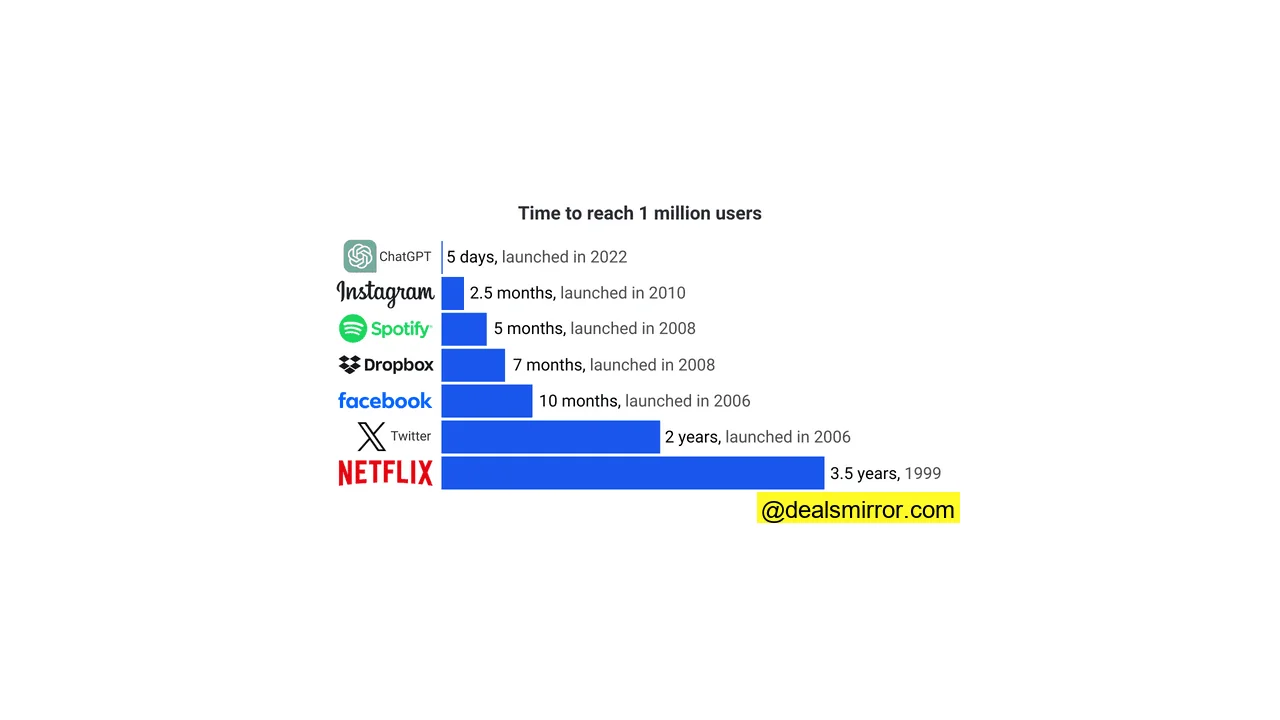
1. Rapid User Acquisition: ChatGPT hit one million users on December 2, 2022, just five days after its launch. This made it the fastest online service to reach this milestone until Threads surpassed it by reaching a million users in a single hour.
2. Growing User Base: The total number of ChatGPT users reached 180 million in 2023, a significant increase from 100 million users recorded in January 2023.
3. Travel Planning Integration: Approximately 32% of US travelers are likely to use ChatGPT to plan their upcoming trips, indicating a growing trust in AI for practical applications.
ChatGPT Usage in Marketing, E-commerce, and Healthcare
1. Marketer AI Adoption: A substantial 45.15% of marketing professionals incorporate AI into their marketing processes, while 25.61% do not.
2. Key AI Applications for Marketers: The three primary ways marketers utilize AI include data analysis (60%), generating written text and images (51%), and personalization (42%). While AI excels at text generation, content should always be proofread, fact-checked, and edited by a human.
3. Most Popular AI Tools: ChatGPT stands out as the most popular AI tool, used by 71% of marketers. It is followed by Grammarly (34%) and Google Gemini (33%).
4. Healthcare AI Integration: More than 10% of healthcare professionals already use AI technologies, including ChatGPT, with about half intending to use them in their work in the future. The top three uses of ChatGPT in medical practice are data entry (52%), appointment scheduling (42%), and medical research (38%).
5. E-commerce Productivity Boost: An impressive 83% of e-commerce marketers report increased productivity at work due to AI, with 84% also noting a boost in their overall performance.
6. Desired AI Capabilities in E-commerce: E-commerce professionals expressed a desire to use AI for marketing analysis (49%), comparing company performance against similar organizations (49%), and predicting customer behavior and attributes (47%).
7. AI for Efficiency in E-commerce: 84% of e-commerce marketers state that AI handles the heavy lifting, allowing them more time to focus on higher-value tasks.
8. Top Benefits of AI in E-commerce: The main benefits perceived by e-commerce marketers include improved quality and accuracy (41%), increased idea generation (36%), and enhanced decision-making and planning (36%).
9. Prevalent AI Types in E-commerce: The three most used types of AI by e-commerce marketers are generative (56%), predictive (53%), and conversational (53%).
Discover more insights into sales and marketing with our comprehensive collections of Sales Statistics and Marketing Statistics.
ChatGPT App Statistics
1. iOS App Launch Success: The ChatGPT iOS app, launched in May 2023, garnered 500,000 downloads within just six days of its release on the Apple App Store, marking one of the best new app launches ever.
2. High Ratings on iOS: The ChatGPT iOS app holds the second position in the Apple App Store’s Productivity category, boasting an impressive 4.9/5.0-star rating from 803,700 reviews.
3. Subscription Model: While the app is free to download, ChatGPT Plus, the premium version, costs $19.99 per month.
4. Android Rollout: ChatGPT also launched for Android in July 2023, initially available in the US, India, Bangladesh, and Brazil.
5. Android App Popularity: The Android version of the app has been downloaded over 50 million times, with a strong rating of 4.6/5.0 stars from over 573,000 reviews to date.
6. Dominance in Generative AI Apps: With a combined 110 million downloads across iOS and Android, ChatGPT was the leading generative AI application in December 2023.
7. Significant Mobile Revenue: ChatGPT‘s mobile applications alone have generated approximately $28.6 million in revenue.
8. Revenue Ranking: Despite its impressive revenue, ChatGPT ranks second behind Ask AI in terms of mobile app revenue, largely because Ask AI was available earlier and offered more affordable premium features.
9. OpenAI’s Valuation: OpenAI, the artificial intelligence company behind ChatGPT, is estimated to be valued between $80 billion and $90 billion, joining companies like ByteDance (owner of TikTok) and SpaceX as one of the most highly valued startups in history.
10. Microsoft’s Stake: Microsoft holds a 49% stake in OpenAI, although it does not influence its board of directors.
11. ChatGPT Operating Costs: OpenAI spends an estimated $694,444 daily, or $0.36 per query, to manage and operate ChatGPT.
12. ChatGPT Enterprise Features: OpenAI launched ChatGPT Enterprise, offering enhanced performance, operating twice as fast, and handling inputs or files four times longer with its 32k context feature. It also provides unrestricted access to powerful data analysis tools, beneficial for professionals ranging from financial analysts to data scientists.
ChatGPT Monthly Traffic and Visitor Statistics
1. Website Visitors: ChatGPT recorded 1.7 billion visitors in February 2024, marking a 1.97% increase from the previous month.
2. Bounce Rate: The ChatGPT website has a bounce rate of 33.68%.
3. Pages Per Visit: On average, a ChatGPT visitor navigates through 3.95 pages during each visit.
4. Average Visit Duration: Users spend an average of 5 minutes and 17 seconds on the ChatGPT website before exiting.
5. Demographics: The majority of ChatGPT users are aged between 25 and 34 (33.16%), followed by 18-24 (28.18%) and 35-44 (18.37%).
6. Traffic Sources: Most traffic to ChatGPT is direct, accounting for 84.54% of visitors who type the URL directly into their browsers. Organic search is the second-largest source at 14.25%.
7. Social Media Traffic: Social media traffic to ChatGPT is primarily driven by YouTube (57.4%), followed by Twitter (13.72%) and Facebook (7.55%).
8. Organic Search Keywords: People use 171,000 distinct keywords to access ChatGPT via organic search. The top three keywords driving traffic are “chatgpt” (50 million), “chat gpt” (34.3 million), and “gpt” (2.7 million).
ChatGPT Country Statistics
1. Top Traffic-Generating Countries: The United States sends the most desktop traffic to ChatGPT at 16.58%. Other significant contributors include India (7.38%), the Philippines (3.55%), Colombia (3.45%), and Canada (3.1%).
2. Prohibited Countries: ChatGPT is either banned or unavailable in five countries: China, Iran, Cuba, North Korea, and Syria.
ChatGPT Awareness Statistics
1. US Adult AI Familiarity: A survey of 1,000 US adults revealed that 32% have never used AI tools, and 29% stated they do not use them often. Furthermore, 54% had not heard of ChatGPT, and 34% had heard only a little about it. 40% of respondents had never used ChatGPT or seen anyone use it, while 38% had seen others use it but had not tried it themselves.
2. Entrepreneurs’ Positive Outlook: 97% of entrepreneurs believe ChatGPT will positively impact their operations. Their top three intended uses are creating customer responses (74%), summarizing information (53%), and improving decision-making (50%).
3. Business Benefits for Entrepreneurs: The three main positive effects entrepreneurs anticipate ChatGPT will have on their business are generating content quickly (70%), creating personalized customer experiences (58%), and increasing web traffic (57%).
4. Consumer Perception of AI Productivity: Nearly a third of consumers worldwide perceive an increase in workplace productivity thanks to AI systems. This sentiment is particularly strong in India (67%), Indonesia (65%), UAE (62%), Hong Kong (54%), and Singapore (53%). In contrast, only 17% of the US market believes AI systems improve workplace productivity.
5. Medical Professionals’ AI Awareness: 66% of surveyed medical professionals are aware that AI technologies are used in healthcare.
6. Reasons to Choose AI-Enabled Healthcare: The top three reasons people would visit a healthcare provider using AI technology are faster medical care (52%), reduced risk of human error in medical decision-making (47%), and remote access to healthcare via telemedicine (42%).
7. Reasons to Avoid AI-Enabled Healthcare: Conversely, the top three reasons people would avoid a healthcare provider using AI technology are the belief that AI cannot fully replace the expertise of human healthcare providers (53%), concerns about the reliability of AI diagnoses and treatments (47%), and a preference for human interaction and a personal touch (43%).
8. AI Use Among US Professionals: A survey of 1,200 US full-time professionals revealed that 56% use AI. This breaks down to 41% of women compared to 47% of men.
9. Perceived Value of AI by Gender: Of the 72% who believe AI offers value to their work when used appropriately, 76% were men, compared to 68% of women.
10. Lack of Employer-Provided AI Resources: 51% of professionals state that their employers have not provided them with resources on AI and how to use it at work. Another 39% received resources but did not utilize them.
11. Concerns About AI Adoption and Risks: 51% of professionals believe their organization will fall behind competitors if they refuse to adopt AI. However, a potential reason for their reluctance is that 52% strongly believe AI is likely to pose dangers that negatively affect their organization’s security.
12. Senior Professionals and AI Readiness: Senior professionals in high-level management positions are more likely than others to report that their employers have provided them with AI resources (68% vs. 36%), that they use employer-provided resources and mentors (48% vs. 25%), that they can confidently explain how they use AI at work (81% vs. 48%), and that they believe AI has positive and lasting effects on their industry (39% vs. 20%).
ChatGPT Education and Exam Statistics
1. Teenage Awareness of ChatGPT: Among teenagers aged 13-17, 67% are aware of ChatGPT. When broken down by racial groups, white individuals are the most familiar at 72%, followed by Hispanic at 63%, and the Black community at 56%. Family income also influences the extent to which teenagers are familiar with ChatGPT.
2. Homework Use Among Teens: 19% of teenagers have used ChatGPT for homework. This usage increases with grade level: 12% among 7th and 8th graders, 17% among 9th and 10th graders, and 24% among 11th and 12th graders.
3. Teens’ Acceptable Uses of ChatGPT: 69% of teenagers agree that researching new topics using ChatGPT is acceptable. 39% believe it is permissible to use it for solving math problems, and 20% agree with using ChatGPT for writing essays.
4. College Students’ AI Experience: 43% of university students have experience using ChatGPT and similar AI applications. Of these students, 39% use ChatGPT for personal projects, and 22% use it for coursework, compared to 57% who do not use it for this purpose.
5. Perception of Cheating with AI: 51% of college students agree that using AI tools like the ChatGPT app to complete assignments is a form of cheating, while 20% disagree.
6. ChatGPT Bans in Schools: As of February 1, 2023, eight schools and districts had banned ChatGPT, with New York City Public Schools being among the first in January 2023.
7. Teachers’ Views on ChatGPT: 67% of teachers believe ChatGPT should not be banned in schools, and 57% feel it significantly eases their workload. However, 72% of teachers have not received any guidance from faculty on how to integrate ChatGPT into their classes.
8. Frequency of ChatGPT Use in Coursework: Among college students who used ChatGPT for assignments, 36.27% use it 25% of the time, 34.92% use it 50% of the time, and 20.34% use it 75% of the time.
9. AI Readiness for Graduates: 83% believe today’s university graduates must be prepared to use AI in their work, and 74% think students already have experience with AI before entering the workforce.
10. Demand for AI Education: 88% assert that colleges and universities should offer educational opportunities to help students learn about AI and its basic uses. If US educational institutions fail to provide this, 65% believe the US will lose its competitive edge against other countries.
Frequently Asked Questions about ChatGPT Statistics
Now that we’ve covered all the key ChatGPT statistics, let’s address some of the most common questions about this groundbreaking software.
How many people use ChatGPT?
As of March 2024, over 180 million people use ChatGPT. This widespread adoption highlights the chatbot’s versatility for personal use and across various sectors, from generating content for blog posts to crafting outreach emails.
How much data was ChatGPT trained on?
ChatGPT was trained on more than 570 GB of text data, equivalent to 300 billion words. The initial raw data, before refinement, amounted to 45 TB of text, which was condensed to 570 GB after filtering. This refined dataset contains approximately 400 billion tokens, sourced from an extensive sweep of the internet, including platforms like Wikipedia and various books.
GPT-3.5, with its 175 billion parameters, might seem impressive, but OpenAI‘s GPT-4 model goes significantly further, featuring 1.7 trillion parameters. These parameters function like markers and switches that fine-tune the AI’s responses, shaping its tone, style, and degree of creativity.
How many users did ChatGPT have five days after its launch?
ChatGPT reached 1 million users within five days of its launch. This incredibly rapid adoption rate demonstrated immense public interest. It was the fastest online service to hit the 1 million-user mark until Threads achieved the same in just one hour.
Is ChatGPT good at statistics?
Yes, ChatGPT generally handles statistics well, capable of addressing statistical queries. However, it has been observed to make errors in simple calculations. A study by the National Library of Medicine assessed ChatGPT‘s proficiency with 10 biostatistical challenges. GPT-3.5 and GPT-4 initially missed the mark, scoring 5/10 and 6/10 on their first attempts, respectively. When given two additional chances, GPT-3.5 correctly answered 7/10 questions, which was considered an average result. GPT-4 corrected its errors to achieve a perfect score within the same number of attempts.
What is a prompt in ChatGPT?
A ChatGPT prompt, or instruction, is the input text you provide to generate an AI response or action, typically in the form of a question, statement, or request. Prompts are your communication method with ChatGPT, playing a crucial role in how effectively the AI understands and responds to user needs.
Various prompt engineering techniques exist to guide ChatGPT to your desired outcome. One method involves explaining your needs step-by-step. Another is the “few-shot” method, where you provide ChatGPT with examples of the expected output. Role-playing is also effective, where you assign ChatGPT a persona to help it understand your questions from a different perspective.
Who owns ChatGPT?
ChatGPT is owned by OpenAI, a San Francisco, California-based company renowned for its impressive AI research and development. Sam Altman serves as CEO, and Elon Musk is its most prominent co-founder. The core team includes Carlos Virella, Greg Brockman, Ilya Sutskever, John Schulman, and Wojciech Zaremba.
While Microsoft holds a significant $13 billion investment, it does not own OpenAI. OpenAI also receives support from other major investors such as Khosla Ventures, Infosys, and Andreessen Horowitz.
What does GPT in ChatGPT stand for?
“GPT” in ChatGPT stands for “Generative Pre-trained Transformer.” This describes a type of technology that creates new content after being trained on vast amounts of existing information. These models, known as large language models (LLMs), are adept at generating human-like text. Essentially, you provide ChatGPT with a question, and it responds by utilizing what it has learned from its training data.
“Generative” refers to the AI’s capability to produce various forms of content. ChatGPT specializes in text but can extend to images and audio. It is also “pre-trained” on a massive dataset, enabling it to provide detailed responses. Finally, a “transformer” is the underlying technology it uses to understand and dissect data.
How many questions can you ask ChatGPT in an hour?
You can theoretically ask ChatGPT up to 60 questions in an hour, assuming optimal conditions with half a minute for your query and another half for its response. However, this number can vary based on several factors.
The way you phrase your questions matters. If ChatGPT doesn’t immediately understand your query, you’ll spend more time clarifying. The complexity of the question also plays a role. The AI tool responds quickly to simple, direct questions, but if you’re seeking a detailed explanation or if the question is more intricate, ChatGPT will take longer to formulate its answer.
Does ChatGPT have a word limit?
Yes, ChatGPT has word limits. The most recent version, GPT-4 Turbo, has a limit of 96,000 words, while its predecessor, GPT-3.5, has a limit of 3,000 words. ChatGPT-4 comfortably sits in the middle with a 25,000-word limit. ChatGPT‘s ability to recall previous conversations allows you to cleverly navigate these limits. For instance, if you need a long article, ChatGPT can deliver it piece by piece, streamlining the process despite the inherent word constraints.
Does ChatGPT save data?
Previously, ChatGPT maintained a record of all interactions, enabling it to engage in detailed conversations and recall prior instructions, which helped shape its responses. This feature was crucial for managing multi-step tasks and refining the chatbot’s answers according to user preferences.
OpenAI has since introduced an option to disable chat history, empowering users to control their data. This change enhances privacy and influences how the AI learns from the conversations it conducts.
Sources
ChatGPT User and Usage Statistics
1. Statista, “Threads Shoots Past One Million User Mark at Lightning Speed“
2. Reuters, “ChatGPT sets record for fastest-growing user base“
3. Longwoods Internation, “American Travel Sentiment Study – Wave 73“
ChatGPT Usage in Marketing, E-commerce, and Healthcare
1-3. GetResponse, “The state of AI in marketing”
4. The Intake, “Perceptions of AI in healthcare: What professionals and the public think“
5-9. Klaviyo, “The AI Trends Report for Ecommerce Marketers”
ChatGPT App Statistics
1. TechCrunch, “OpenAI’s ChatGPT app tops 500K downloads in just 6 days“
2-3. Apple Store, “ChatGPT”
4. TechCrunch, “ChatGPT for Android is now available in the US, India, Bangladesh and Brazil“
5. Google Play, “ChatGPT”
6-8. TechCrunch, “ChatGPT’s mobile apps topped 110M installs and nearly $30M in revenue“
9. The Wall Street Journal, “OpenAI Seeks New Valuation of Up to $90 Billion in Sale of Existing Shares“
10. The New York Times, “How Microsoft’s Satya Nadella Kept the ‘Best Bromance in Tech’ Alive“
11. SemiAnalysis, “The Inference Cost Of Search Disruption – Large Language Model Cost Analysis“
12. OpenAI, “Introducing ChatGPT Enterprise”
ChatGPT Monthly Traffic and Visitor Statistics
1-8. Similarweb, “OpenAI”
ChatGPT Country Statistics
1. Similarweb, “OpenAI”
2. PC Guide, “What countries is ChatGPT not available”
ChatGPT Awareness Statistics
1. YouGov, “Daily Survey – ChatGPT”
2-3. Forbes Advisor, “How Businesses Are Using Artificial Intelligence In 2024“
4. YouGov, “Nearly a third of consumers think AI has improved workplace productivity“
5-7. The Intake, “Perceptions of AI in healthcare: What professionals and the public think”
8-12. Washington State University Carson College of Business, “American workers sound the alarm on AI workplace readiness“
ChatGPT Education and Exam Statistics
1-3. Pew Research Center, “About 1 in 5 U.S. teens who’ve heard of ChatGPT have used it for schoolwork“
4-5. BestColleges, “Half of College Students Say Using AI on Schoolwork Is Cheating or Plagiarism“
6-7. Study.com. “ChatGPT in The Classroom“
8. Intelligent, “Nearly 1 in 3 College Students Have Used ChatGPT on Written Assignments“
9-10. Washington State University Carson College of Business, “Workers sound the alarm on AI workplace readiness“