

“Micro-targeting,” “hyper-personalization,” “individualized insights,” and “one-to-one marketing” are more than just buzzwords in the realm of big data email marketing—they represent a powerful shift towards more effective communication. Personalized emails, on average, achieve a remarkable 6x higher transaction rate. The secret to scaling this level of individual relevance for hundreds or even thousands of subscribers lies in a sophisticated tool: the Recommendation Engine.
This article will illuminate the critical aspects of this technology, helping you understand its potential and how to make informed decisions:
- The impact of relevance and personalization on email engagement and conversions.
- How Recommendation Engines operate, including the current state-of-the-art algorithms and methods.
- Key criteria for evaluating predictive recommender technology for your email marketing program.
This information is vital for Chief Marketing Officers (CMOs), agency executives focused on client growth, and all email marketers who will inevitably encounter the transformative power of recommendation engines.
The Growing Demand for Email Relevance
Email marketing consistently delivers impressive returns, generating approximately $38 for every dollar invested. It’s the preferred channel for 72% of consumers who wish to receive information from brands, as surveyed by MarketingSherpa.
However, the digital landscape is saturated with information, presenting significant challenges for email marketers. One critical effect is a drastic reduction in human attention span, nearly halved over the last decade. This manifests in an ongoing decline in click rates, as people have less time, less patience, and quickly scan content in search of immediate value.
Recommendation Engines Optimize Email Results
A powerful solution to filter out irrelevant content and deliver truly personalized emails is a Recommendation Engine. This technology enhances relevance to achieve several crucial marketing objectives:
- Increase conversions
- Improve customer retention
- Foster referral marketing
- Extend the lifetime value of subscribers
- Increase the ROI for marketing efforts
While email personalization isn’t new, modern recommender technology offers capabilities far beyond simple custom text. For instance, integrating predictive recommendations into emails has shown an overall average lift in CTOR (click-to-open rate) of 73% compared to emails without such content.
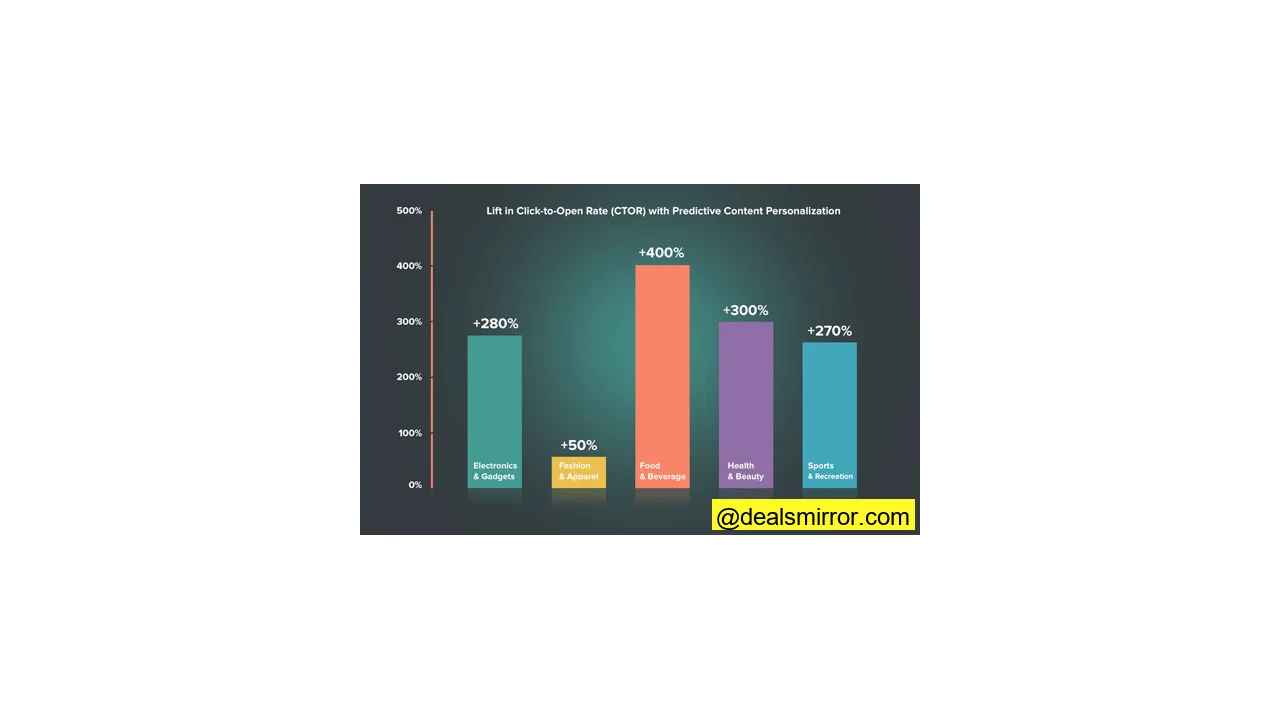
Specific industries have seen even more dramatic improvements:
- Electronics and gadgets: +283%
- Fashion and apparel: +49%
- Food and beverage: +399%
- Health and beauty: +296%
- Sports and recreation: +265%
Beyond these metrics, Experian has highlighted additional benefits for subscribers receiving more relevant content:
- 29% higher open rates
- 51% higher click rates
- 6x increase in transactions
Conversely, neglecting personalization leads to negative outcomes. Lower open, click, and transaction rates are common, and over 50% of people unsubscribe from email lists due to irrelevant or overly frequent content. In a world of information overload, generic emails often fail to capture attention, becoming invisible to desensitized consumers.
Subscribers Willing to Share Data for Relevance
Thanks to industry leaders like Amazon and Netflix, online consumers are increasingly familiar with the concept of personalization. They understand that customized experiences aren’t accidental and recognize the value in being better understood. This understanding translates into a willingness to share information, much like interacting with a shop assistant to find a suitable solution.
Consider these compelling statistics on consumer willingness:
- 80% of Americans who read promotional emails find product recommendations based on past purchases helpful (sharing transactional history).
- 71% desire recommendations based on their online browsing behavior (sharing website visit data).
- 82% of consumers admit they would buy more items via emails featuring better personalization (sharing profile information for tailored offers).
- 82% stated that if emails were more relevant, more could be sent each week (indicating openness to real-time, relevant updates).
When handled securely and legally, subscribers are prepared to share more data, even knowing it might encourage them to spend more. This underscores the extremely high perceived value of personalized email content for consumers.
Automated Relevance: The Only Scalable Solution
The importance of email marketing continues to grow, with nearly 70% of marketers reporting increased usage. Businesses worldwide are intensifying efforts to improve and send more emails, leading to an overwhelming volume of content in every inbox. Standing out requires exceptional relevance, a challenge perfectly addressed by Recommendation Engines.
The core objective of a Recommendation Engine is to facilitate customized, one-to-one interactions that genuinely surprise and delight, all while being scalable. The end consumer experiences the added value and personalized feeling, often unaware of the underlying technology.
Imagine a single email marketer reaching 100,000 customers with one send, yet each recipient feels the message is uniquely for them. This is automated relevance, and it’s indispensable for a successful email marketing program.
Diverse Online Content Fuels Recommendations
Modern Recommendation Engines are more advanced and intelligent, constantly pushing boundaries to meet consumer demands for richer, more relevant content. To grasp their functionality, it helps to focus on their output.
Recommendation Engines generate a specific set of “items”—the recommendations—deemed appropriate for a small, well-defined audience, often a micro-cluster of customers. With advanced systems, these recommendations can be precise enough for an audience of one.
The recommendations themselves can encompass nearly any type of online content, including:
- Products in e-commerce shops
- Articles, infographics, and slide decks from brand publishers
- News articles from media outlets
- Brochures for different insurance types
- Online educational materials for university students and alumni
This recommended content is then delivered via channels like email campaigns or website displays. Depending on the business, potential targets can range from users, consumers, and visitors to prospects, subscribers, and customers—essentially, anyone engaging with information and brands online.
Behavioral Data Predicts Interest
The science behind predicting what people want is deeply rooted in data. For a Recommendation Engine, this data can be acquired through various methods, including manual upload, FTP batch data, or API connectors.
A more dynamic, real-time approach involves embedding a small snippet of code into your website’s header. Tools like Google Tag Manager offer excellent capabilities for this, capturing all necessary personal behavioral and content information in real-time and continuously feeding it to the engine for analysis.
Particularly valuable data includes items viewed together, content downloaded in the same session, and browsing behavior before and after a purchase. Algorithms are specifically designed to identify these relationships and patterns, recognizing their significance in predicting future interest.
Predictive Algorithms Uncover Relationships
Numerous algorithmic methods (mathematical instructions for problem-solving) are used to generate recommendations, each with its unique approach:
- Item Hierarchy: (e.g., “You bought a set of golf clubs, therefore you also need golf balls.”)
- Attribute Based: (e.g., “You like action-packed, non-violent, science-fiction movies with a strong female hero.”)
- Collaborative Filtering with User-User Similarity: (e.g., “People like you who bought opinionated t-shirts also bought fashionable combat boots.”)
- Content-Based Filtering with Item-Item Similarity: (e.g., “Kill Bill” is similar to “12 Monkeys,” therefore you will like watching it.)
- Social+Interest Graph Based: (e.g., “Your friends like Angry Birds so you’ll like Angry Birds.”)
- Model Based: (pattern recognition for implicit behaviors combined with machine learning.)
Collaborative Filtering and Content-Based Filtering Demystified
Understanding these predictive algorithms is key to making smarter business decisions and profitable investments. Let’s delve into two primary methods with practical examples.
Collaborative Filtering (Behavioral Clustering)
Collaborative filtering constructs a data model based on an individual’s past behavior and similar historical activities of other users. This includes items previously browsed, searched, clicked, “liked,” downloaded, purchased, and preference ratings. The core principle assumes that consumers will enjoy items similar to those they’ve already engaged with and will exhibit patterns consistent with individuals they are “most like.”
Consider a simple e-commerce example with three visitors:
- Jake got a beach ball and sunglasses
- Funmi got a bikini
- Nick got a beach ball
What else would Nick want? Based on this data, Nick’s behavior aligns more closely with Jake’s. The Recommendation Engine would likely suggest sunglasses to Nick in his next email. It doesn’t need to know Funmi’s gender; the data patterns alone reveal the best item.
The complexity rapidly increases with more data. For instance, adding another person-scenario:
- Joanna got a beach ball and a bikini
One might guess Joanna’s next email would contain a bikini, assuming a gender-based pattern with Funmi. However, it’s also possible Joanna is more similar to Jake because they are both from Australia, and store data reveals Australians frequently purchase green shades. The engine must consider myriad products, customers, and intricate online behaviors, all assessed and updated continuously in real-time.
Collaborative filtering is an algorithmic method capable of reverse-engineering and understanding your customers at an individual level. The behavioral patterns of your website visitors are an invaluable source of insight into customer identity and preferences.
Content-Based Filtering (Product Clustering)
Content-based filtering utilizes specific characteristics of an item—such as tags, categories, pricing, and other attributes—to identify and recommend additional items with similar properties. For example:
- Items categorized as “male” are more likely to be recommended with other “male” items.
- Clothes tagged as “red” will more likely appear with other red items.
- Premium-priced items will be grouped with other premium products.
While seemingly straightforward, the complexity arises in scaling this across a vast inventory. Content-based filtering is crucial for ensuring the data model maintains a comprehensive view of your entire product or content catalog. Both collaborative and content-based filtering have a long history and remain fundamental to producing effective recommendations. The true “magic” often occurs when these two methods are combined.
Hybrid Recommendation Engines: The Path to Deeper Personalization
Effective Recommendation Engines strive for the highest degree of personalization, ideally assembling any mix of items on a website into a tailored set for a single individual. To approach this ideal, “hybrid” systems combine multiple algorithmic methods.
Many methods, especially collaborative filtering and content-based filtering, work exceptionally well in tandem, processing diverse data streams. Additionally, various other conditions and variables are layered into the algorithms, fine-tuning recommendations for specific verticals or business needs.
The Mysterious “Black Box” of Recommendation Engines
Vendors often refer to the unique, variable components of their technology as “the secret sauce,” usually proprietary and not openly detailed. This means a top-tier Recommendation Engine involves more than just accurate predictions; these “other variables” are critical.
The necessity for hybrids and proprietary “secret sauce” stems from the ongoing challenge of information overload. Not only has content permeated every aspect of the consumer experience, but its quality has also significantly improved across the board. Marketers are excelling at content creation, making it increasingly difficult to pinpoint the “perfect” set of recommendations.
Today, dozens of items could be well-received. How do different companies differentiate their recommendations? The answer lies in blending models, adding proprietary enhancements, and making recommendations more relevant and, consequently, more performant. When discussing technology with vendors, even if “black box” details are proprietary, marketers should feel empowered to inquire about the industry-unique aspects their data model is designed to address.
Machine Learning: Essential for Marketing Sanity
Machine learning is a hallmark of the best Recommendation Engine systems. When implemented effectively, it provides feedback loops that enable the predictive model to learn from how subscribers react (or don’t react) to recommendations. This continuous learning is a significant advantage.
Marketers should care about machine learning because it’s the component that automatically optimizes content down to the individual level, at scale. Advanced computing power means data analysis that once took days can now be completed in seconds in the cloud, starkly contrasting the resource drain of traditional A/B testing.
Furthermore, machine learning often means the data model benefits from information processed across multiple businesses and individual websites. It identifies which algorithms are more or less effective for specific scenarios or verticals, continuously fine-tuning itself to become more brand-customized. A Recommendation Engine that learns directly from businesses and customers across various website and email touchpoints evolves into a “customized algorithm,” constantly improving its ability to drive success.
Advice for Buying Recommendation Engine Technology
Recommendation Engines can dramatically boost campaign performance, and numerous commercially available systems are designed to optimize email programs. Options vary:
- Some email service platforms offer native functionality directly integrated ($$$).
- Other email and marketing automation companies partner with specialists in predictive and contextual intelligence, providing technology as an add-on software service ($–$$).
- For those who prefer coding and customization, open-source recommender technologies offer flexible implementation ($–$$$$).
Regardless of budget or business needs, marketers should ask critical questions concerning data, model design, speed, onboarding, simplicity, and industry relevance. Specifically, some important factors to consider when evaluating vendors include:
- The use of both implicit and explicit data as a foundation for predictions.
- A hybrid approach to algorithmic methods that considers both subscriber behavior patterns and relationships between content items.
- Real-time data capture, continuously updated recommendations, and the speed of delivering fresh content into an email.
- Manageable integration requirements in terms of resources, time, and cost.
- An intuitive and easy-to-use interface with a quick learning curve.
- Case studies and data that demonstrate proven results in your specific vertical.
The Future of Email Marketing is Personalized
Recommendation Engines were developed to cut through digital clutter, helping people find exactly what they want, while enabling marketers to deliver hassle-free and enjoyable content experiences at scale. This technology is in its early stages of widespread adoption but is poised to dramatically transform email marketing.
According to the Econsultancy and Adestra Email Marketing Industry Census, 78% of marketers predicted that within five years, all email would be integrated and personalized. The report also noted that “one in three companies are already engaging in content personalization, a 27% increase from last year, with 37% planning to include this as part of their email marketing activities.”
Therefore, CMOs and email marketers should actively consider email content personalization and how to integrate a Recommendation Engine into their programs. While initially daunting due to the advanced math and analytics involved, this complexity should not sideline marketing perspectives in critical technology decisions. The business insights and customer knowledge from marketing teams are crucial inputs for evaluating and purchasing new email technologies.