

The marketing technology (martech) landscape is undergoing a profound transformation. The days of simply implementing a platform and expecting instant results are long gone. Today, organizations are strategically integrating their martech and marketing automation platforms, meticulously crafting mature martech stacks, assigning distinct roles to each platform, and fundamentally rethinking their design.
This evolution is shifting the central software point that integrates with more than half of the stack. Recent data reveals a dynamic movement in the “center of the stack,” particularly concerning Customer Relationship Management (CRM) and Marketing Automation Platforms (MAPs). Envision your martech ecosystem as a solar system, where a “sun” anchors the core. Our updated research indicates that various other software solutions are increasingly taking on this central, gravitational role.
The martech landscape itself has expanded exponentially, growing more than 100x since 2011. It saw a 9% increase last year alone, now boasting a staggering **15,384 software tools**. This immense growth signifies a crucial period for companies and their stacks, as new AI-native tools emerge and previous generations consolidate. Most importantly for marketers, the types of software at the core of these stacks are decidedly shifting.
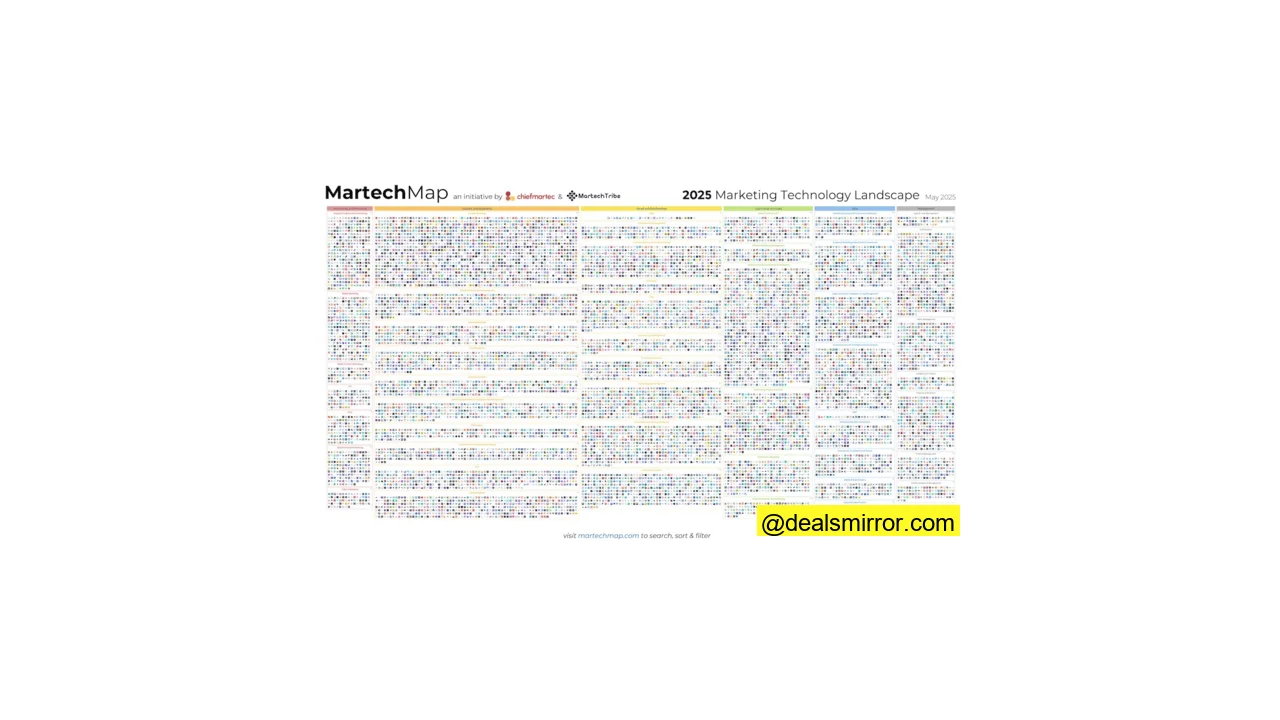
The 2025 Marketing Technology Landscape. Read the full report here
In some industries, Customer Relationship Management (CRM) tools and Marketing Automation Platforms (MAPs) have firmly established themselves as the central platforms. In others, they now orbit around a Customer Data Platform (CDP) or Cloud Data Warehouse (CDW). For instance:
* Professional Services and Technology Providers cite CRM as their central platform twice as often as other systems.
* Conversely, in Consumer Products or Banking & Financial Services, Data Warehouses and Customer Data Platforms are mentioned twice as often compared to systems like CRM.
A striking outcome of recent research highlights the divergent trajectories for B2B versus B2C companies. In B2B environments, CRMs maintain a stable central position while MAPs are retreating. In the B2C sector, CDPs are losing ground as the stack’s core shifts towards innovative dual-core setups, built around Cloud Data Warehouses and MAPs.
B2B Martech Stacks: From Consolidation to Customization
In B2B marketing technology stacks, the CRM remains steadfastly at the center. Its dominance as the gravitational core of B2B stacks is unparalleled, slightly increasing its centrality from 41.6% to 42% year-over-year. This stability underscores CRM’s continued role as the anchor for comprehensive customer data and engagement across all channels. However, while CRM holds its ground, other components of the B2B stack are in active motion.
Marketing Automation Platforms (MAPs), once co-stars with CRMs, are experiencing a decline in centrality. Their reported position as the stack’s core dropped from 30.7% to 26%, suggesting that B2B organizations are re-evaluating placing automation at the absolute heart of their infrastructure. This shift indicates a move away from rigid, process-driven stacks toward more agile and customizable infrastructures.
This architectural evolution is most evident in the significant rise of Digital Experience Platforms (DXPs) and custom-built solutions. DXPs increased their centrality from 5% to 8%, while custom-built platforms remarkably doubled, soaring from 5% to 10%. This dramatic surge signals a growing appetite for composable architectures, precisely tailored to unique customer journeys, specific use cases, and distinct business models.
Meanwhile, Customer Data Platforms (CDPs) and Cloud Data Warehouses (CDWs) maintain a smaller presence in B2B environments, each accounting for only low single-digit adoption as core systems. Rather than consolidating on generic data layers, B2B companies are opting to assemble highly purpose-built ecosystems designed for their specific needs.
It appears B2B martech stacks are entering an exciting phase of architectural experimentation. Anchored by robust CRMs, they are expanding outwards with modular and custom components. This strategic move from platform consolidation to stack customization reflects a broader industry shift toward enhanced flexibility and greater control over their marketing technology investments.
B2C Martech Stacks: The Great CDP Redistribution
Customer Data Platforms (CDPs) are not vanishing; rather, they are undergoing a significant evolution. Once a prominent central hub for many B2C and hybrid martech stacks, CDPs have witnessed a redistribution of their core functions and responsibilities.
In just a single year, CDPs saw their reported position as the “center” of the stack decrease from 27.3% to 17.4%. This trend does not signify irrelevance, but rather a profound reconfiguration of the B2C martech architecture.
Key CDP functions are now being absorbed in two distinct directions:
* **Upstream:** Cloud Data Warehouses (CDWs) have significantly grown, achieving 23.9% adoption as the stack’s center. They are increasingly taking over the foundational role of storing and unifying customer data.
* **Downstream:** Marketing Automation Platforms (MAPs) have surged to 26.1%, becoming the primary platforms for activating that unified data through targeted messaging and impactful campaigns.
The culmination of this shift is the emergence of a **dual-core stack architecture**: one core is meticulously optimized for robust data management, while the other is dedicated to efficient data activation. While CDP-like capabilities remain absolutely essential, they are no longer centralized within a single, all-encompassing platform.
Meanwhile, CRM in this segment experienced a modest increase in centrality from 18.2% to 19.6%, indicating it still plays an important supporting role compared to the rising influence of MAPs and CDWs.
This “unbundling” phenomenon reflects a broader industry movement toward composable stacks: decoupled, modular architectures where no single tool attempts to fulfill every function. For B2C and hybrid organizations, the objective is not to eliminate the CDP, but rather to right-size its deployment and strategically redistribute its immense value to where it performs most effectively within the modern martech ecosystem.
AI: The Stack Catalyst
Artificial intelligence is not just another tool; it’s a powerful catalyst accelerating this entire transformation in two primary ways:
* **Inside-Out:** AI is being integrated by adding new Generative AI (GenAI) native tools and by embedding advanced AI capabilities directly into existing SaaS solutions, enhancing their core functionalities.
* **Outside-In:** AI is being introduced through external orchestration layers, large language models (LLMs), AI agents, co-pilots, and Multi-Cloud Platforms (MCPs). These layers are designed to seamlessly connect disparate tools and systems, requiring a flexible and adaptable foundation.
**The Role of AI in Powering the LEGO-like Composability of Your Stack**
AI, coupled with rapidly evolving buyer expectations, is significantly accelerating the fundamental changes in how martech stacks are constructed. AI is the driving force behind the underlying composability of modern martech. Composability refers to the ability to assemble tools and features, much like LEGO blocks, into highly tailored and dynamic customer experiences.
This concept isn’t entirely new; software has always been built with modularity in mind. Behind the scenes, software applications are constructed from components, libraries, plug-ins, objects, and classes. However, the critical change now is that this modularity is no longer confined solely within individual applications. These powerful components are now accessible and interoperable across the entire company marketing stack. Composability has ascended a level, transitioning from mere software architecture to a transformative stack architecture.
Stack Smart, Not Hard
The recent shifts in central martech platforms – with CRMs holding steady in B2B, and CDPs giving way to MAPs and CDWs in B2C – signal more than just a change in preferred tools. They reveal a fundamental redefinition of what a martech stack truly is.
Martech stacks are no longer rigid systems centered around a single, all-encompassing core platform. Instead, they are rapidly evolving into modular, composable, and inherently adaptable ecosystems. These modern stacks are meticulously shaped around how companies need to operate today, not dictated by how software was sold yesterday.
The rise of custom-built core systems in B2B and the adoption of dual-core models in B2C are both clear symptoms of this sweeping transformation. Instead of relying on a single point of gravitational pull, modern stacks now effectively orbit multiple specialized systems. This distributed approach makes them significantly easier to reconfigure, optimize, and swap out components as business needs and technological advancements evolve.