

Evaluating an email service provider (ESP) goes beyond just its sending capabilities; marketers must critically assess the platform’s email reporting features and how effectively they align with their analytical needs. Robust analytics are fundamental for measuring the true success of any email program aiming to boost ROI, impressions, reach, and engagement. This makes a thorough evaluation of an ESP’s reporting suite absolutely crucial.
Don’t Navigate Email Marketing Blindly
The world of email marketing can often feel like a journey without a map, echoing the famous admonition: “It doesn’t matter which way you go, if you are not sure where you are going.” Email marketing presents many unknowns, potentially leading marketers down an unclear path. However, email analytics can transform this uncertainty by providing deep insights into your program’s performance, guiding you toward the most effective strategies.
Marketers need clear data on who interacted with their emails, when, and how. This insight allows for timely adjustments, tweaks, adaptations, and ultimately, improvements to capitalize on successes and mitigate challenges.
Marketers Demand Comprehensive Reporting Insight
Modern marketers increasingly recognize that insightful reporting isn’t merely a desirable feature but an absolute necessity. Insights from various research studies, including those utilizing tools like the ESPinator tool, consistently highlight this growing demand.
In response, ESPs are actively enhancing their analytics offerings, either by integrating advanced features directly into their platforms or by partnering with third-party vendors to supply sophisticated capabilities.
An Actionable Email Marketing Analytics Example
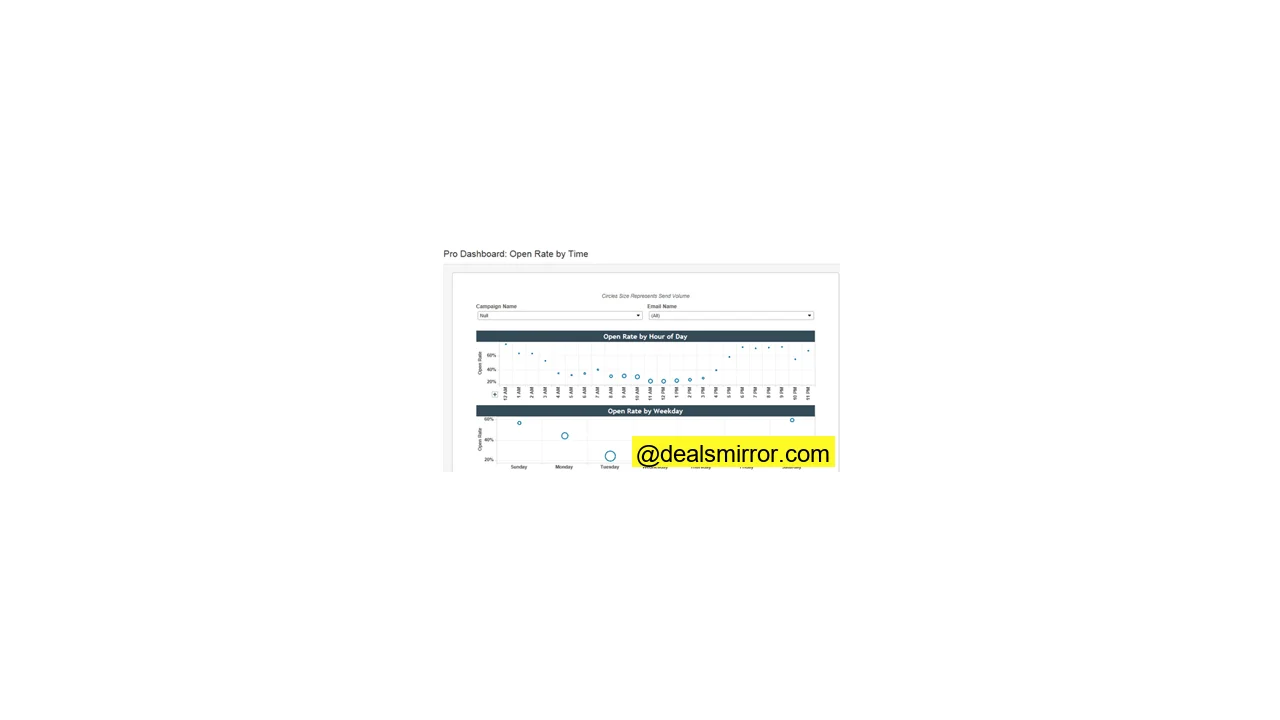
Consider the dashboard illustration above, which visually represents audience engagement with email content. This view can be applied across an entire account, a specific series of messages, or even a single email.
* The **X-axis** displays time (Hour of the Day, Day of the Week).
* The **Y-axis** represents the open rate (though this could be adapted to Click-Through Rate (CTR), Click Rate, Conversions, or any other relevant metric).
* The **size of the circle** indicates the sending volume for that specific time slot.
From this visualization, it’s clear that this particular client predominantly sends messages during the middle of the day and from Tuesday to Friday. Yet, based on when their audience actually interacts with the content, they should consider optimizing their sending schedule to include **Friday, Saturday, & Sunday** – specifically between **4 PM and 3 AM**. This type of actionable insight becomes evident simply by observing the dashboard.
Several powerful platforms can help uncover such patterns in email performance data, including Klipfolio, DOMO, Tibco, and Tableau Software. The example provided utilizes eMVision, a solution developed using Tableau Software for platforms like Salesforce Marketing Cloud and other ESPs.
Choosing the Right Email Marketing Analytics for Your Team
While email reporting has long existed, there’s a concerted push to make these tools more user-friendly. This evolution is vital given the complexities of cross-channel marketing and the immense volume of data companies now collect and attribute to their email programs.
The chart above compellingly demonstrates this need: **78.54% of respondents** who rated “an interface that requires very little training” as a “must-have” also considered robust reporting and analysis tools to be equally essential.
Easier-to-use versions of analytics suites are increasingly available, often featuring intuitive data visualization that simplifies complex information, enabling marketers to make informed decisions faster.
However, choosing email analytics shouldn’t solely depend on ease-of-use. Every marketer has unique measurement priorities, and what’s valuable to one may not be to another. The analytics offered must align directly with a team’s specific goals and metrics to be truly useful. But even then, there’s a critical caveat: ensuring marketers can effectively leverage the reporting tools provided.
The Downside of More Powerful Analytics
The adage, “Give a man a fish and he eats for a day. Teach a man to fish and he eats for a lifetime,” holds profound relevance for email reporting. Experience shows that, generally, many email marketers struggle to effectively utilize large datasets.
Marketers may not know how to put sophisticated data to practical use, no matter how good the analytics might be. Providing them with advanced email analytics tools without adequate training is akin to handing someone a fishing pole without teaching them how to fish. They might figure out something, but they won’t fully harness the tool’s potential.
As data sources (email, ERP, CRM, POS, DSP) and volumes expand, and analytics tools grow in complexity to offer deeper insights, we must remember that these powerful tools risk being underutilized if we don’t:
- **Keep them user-friendly.**
- **Teach marketers how to utilize them effectively.**
Even highly powerful and user-friendly tools often require training to be used to their fullest extent, leading some providers to develop comprehensive user guides. Think of these as practical manuals for investigating and spotting critical patterns that can be acted upon to increase ROI. While it sounds straightforward, if you ask nine top marketers what email metrics that matter and why, you’ll likely receive nine distinct answers. With an almost infinite array of possibilities to examine and measure, it’s vital to employ a sound methodology to achieve desired outcomes.
Selecting an Email Marketing Tool and Reporting
When evaluating ESPs and their reporting capabilities, marketers must recognize that usability is paramount, not just sheer power. Beyond test-driving the tools, prospective users should ask detailed questions about available training and support to ensure they can learn to leverage the full spectrum of features, not just the basics.
From an industry perspective, as the analytics market expands and more ESPs and their partners offer advanced solutions, developers of these tools should prioritize the usability and learning curve of their offerings. It’s not enough to simply provide a tool; we must also ensure users know how to master it, because without proper utilization, even the most comprehensive data in the world remains useless.