
Email remains a powerful channel for connecting with your audience, fostering loyalty, and driving conversions. However, building a robust, engaged email list from scratch can be a slow and resource-intensive process. This often leads businesses to consider alternatives like email list rental. But is it a viable strategy, or a shortcut with hidden dangers?
In this comprehensive guide, we’ll take a deep dive into:
- What email list rental entails and how it operates.
- The crucial differences between buying and renting email list data.
- Whether renting email lists is a recommended practice, or if superior marketing options exist.
- The long-term implications for your business, especially when considering purchasing email lists.
Let’s start by defining exactly what email list rental means.
What is Email List Rental and How Does It Work?
Email list rental occurs when you arrange for your promotional message to be sent to a list of email addresses managed by another company or provider. Typically, this is a paid, one-time arrangement, though some providers allow rental for multiple send-outs.
Imagine you have an upcoming major event or a groundbreaking new product launch. You’ve been diligently cultivating your in-house email lists, but their growth isn’t keeping pace with your ambitions. How can you rapidly expand your reach to new customers without waiting for organic list growth?
This is where the idea of renting an email list with thousands of contacts might appeal. Sending your message to new consumer or business inboxes through a rented list can feel like the digital equivalent of a cold call.
However, is email list rental truly the silver bullet for rapid audience expansion? Often, it’s fraught with challenges and potential pitfalls, which we’ll explore in detail throughout this article.
Email List Rental vs. Buying Email Lists: Key Differences
It’s important to understand the significant distinction between purchasing email lists and renting them.
When you purchase email lists, you gain ownership of the data. This means you receive all the contained email addresses and associated information, allowing you to market to them as often as you wish. You would have complete control over individual email addresses and their usage.
While this might sound appealing, it’s often too good to be true. Buying an email list can be disastrous for your email marketing efforts. Purchased lists are frequently of very low quality, riddled with outdated addresses, and can even contain spam traps designed to identify spammers. There’s also no guarantee how many other marketers have bought the exact same list before you. Most critically, the recipients on these lists have not explicitly opted in or given permission to be contacted by you specifically.
When you rent email lists, you do not receive direct access to the email addresses themselves. Instead, your data provider sends your email promotion on your behalf, using their own sending infrastructure. This acts like an in-email advertisement. Your marketing team can often design and create the entire message, and once the campaign concludes, the email list provider will furnish you with the results.
Since you don’t get direct access to the email data when renting, you won’t see a list of names and email addresses. Instead, you’ll receive data cards detailing information about the list you’ll be sending to. These cards offer insights into potential performance and associated costs. If these rented subscribers convert into leads and become your customers, they would then be legitimately added to your own, in-house email list.
The Potential Benefits of Renting Email Lists
While email list rental is generally approached with extreme caution, and many email service providers explicitly disallow it, there are a few theoretical advantages if done with meticulous care and from a highly trustworthy source. However, it’s crucial to acknowledge that these benefits often come with significant risks that can outweigh the perceived advantages.
1. Get Results, Fast
Building an organic, in-house email list takes considerable time and effort. You need to consistently provide value to potential subscribers and earn their trust before they share their email addresses. Email list rental, conversely, can deliver results much faster. While it’s no substitute for your own permission-based list, a list rental campaign can be conceptualized and launched within days, as opposed to months of list-building efforts.
Measuring the results of your campaign is paramount. Reputable rental email list brokers will provide comprehensive marketing data from the campaign, including metrics for your open and click-through rates, as well as soft and hard bounces. This analytics can help you adjust content and refine your target audience for potential future campaigns, aiming for improved outcomes. A reliable email broker should offer more data than you might initially expect, though you may need to proactively request additional insights.
2. Target Your Audience with Personalization
Every reputable email list publisher should adhere to international data privacy laws. This means that legitimate “data collection” does not involve scraping addresses indiscriminately. Often, the contacts on these lists include profile, business, and preference information, allowing you to segment your list effectively. Choose opt-in email lists where recipients have previously shown interest in similar products or operate within your chosen industry or area of expertise. This level of targeting allows for a degree of personalization even with a rented list.
3. Unlock New Conversions and Fresh Audiences
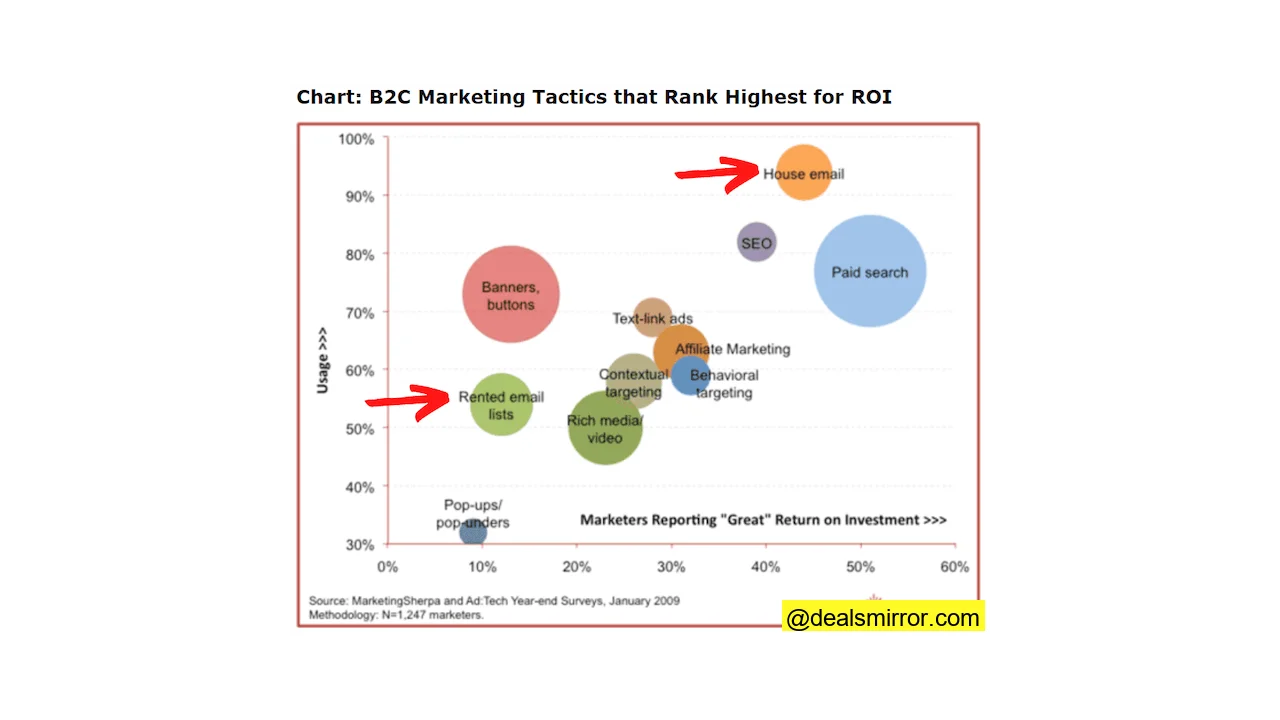
It’s widely accepted that email marketing offers great ROI, and it remains a preferred contact method for many customers.
Renting an email list can be relatively inexpensive, sometimes costing just a few hundred dollars, depending on list size, region, demographics, and targeting. This affordability might allow you to tap into an audience segment you haven’t reached before. Even a rented list of “cold” leads could yield new customers, and if you can convert these initial engagements into repeat customers, your return on investment significantly increases.
4. Delivery Managed by the Provider
Unlike purchasing a list, where you handle the sending yourself, the publisher or broker typically carries out the email delivery on your behalf. This practice helps them keep their proprietary list data secure. While it alleviates one concern on your end, it also means you have less direct control over the final appearance and nuances of the email delivery process.
Maximizing Your Success with a Rented Email List: 5 Essential Tips
If you decide to engage in a one-time delivery to an email broker’s list, it’s crucial to optimize every aspect to achieve the best possible results. Here are five tips to maximize your return from list rental:
1. Focus on B2B & B2C Lists with Proven Interest
Always inquire with your list provider if they have previously collaborated with brands similar to yours. If they have, there’s a higher likelihood that their audiences will have a stronger affinity for your product or service. Confirming that recipients have agreed to receive content from a similar business increases the chance of a match with your offering. Furthermore, understand the subscription source of these recipients. Knowing how those emails were collected is vital for crafting relevant and effective content.
2. Craft Content Specifically for Cold Leads
When reaching out to cold leads, your subject lines and creative content must be exceptional. It’s far more challenging to impress someone who has never heard of you compared to engaging your regular newsletter subscribers. This audience lacks familiarity with your brand and products, requiring an extra effort to convert them. Always deliver on the promises made in your subject line to build trust. A catchy subject line can help you stand out in a crowded inbox, but compelling email content or an irresistible offer is necessary to convert the lead once the email is opened.
Pro tip: Test your campaigns on your organic audience first! If your rented list’s demographics align with your existing subscribers, validate your email campaign ideas with your engaged audience. There’s a high chance that similar content will resonate with the new audience. Measure both open rates and click rates to gauge the effectiveness of your subject line and email content.
3. Utilize Dedicated Landing Pages Optimized for Conversion
Your landing page must seamlessly match the value proposition presented in your email. Ensure visitors are driven directly to your call to action with minimal distractions. Using a dedicated landing page builder like Unbounce can be handy to quickly create high-converting pages based on pre-made templates. Getting your audience to click is only half the battle; the next crucial step is securing a sale or conversion. Dedicated landing pages are far more effective in achieving this singular goal.
4. Implement Remarketing and Track for Smart Follow-Up
Don’t let a visit from a rented list go to waste. Implement cookies for remarketing through ad networks and social media platforms. Even better, encourage them to sign up for your newsletter or a special offer to organically add them to your in-house email lists. Whether you choose to remarket via email addresses or cookies, having a strategy to continuously present yourself to these newly acquired leads is essential. Build separate landing pages or use UTM parameters to track each campaign’s performance effectively.
5. Prioritize Conversions and Data Acquisition
Ultimately, the primary goal of this exercise is to generate conversions and boost sales. You can A/B test different email content and landing pages to identify the best performers and those that drive the highest conversion rates. Understanding your ideal customers and their needs is critical. It allows you to highlight how your product or service uniquely solves their problems. Use engaging content and compelling images, presenting your product as an irresistible solution to their pain points.
The Major Drawbacks and Risks of Renting Email Lists
Despite the potential benefits, email list rental comes with numerous pitfalls. Email deliverability experts strongly advise against it due to the significant risks it poses to your brand reputation and the potential for legal consequences. If you do consider renting an email list, selecting a highly reliable email list broker becomes absolutely essential.
1. Prevalence of Unreliable and Low-Quality Providers
Unfortunately, the market is saturated with email list providers selling poor-quality lists. These often contain outdated, non-existent, or illegally scraped addresses acquired without the recipients’ consent. Delivering email campaigns to such illegally sourced addresses can result in hefty fines and severe legal repercussions. It is crucial to be fully aware of the regulations in your region, such as the CAN-SPAM Act in the United States, which governs commercial email. Adhering to local legislation is paramount for best-practice delivery.
2. Irrelevant Subscribers Can Harm Your Brand and Deliverability
While reputable rental list providers offer segmentation options, sending emails to recipients with no genuine interest in your product or industry can severely damage your brand. Such campaigns will inevitably suffer from low open rates, abysmal click-through rates, and a high complaint rate. Not only does this waste your time and money, but it also erodes your sender and brand reputation, making it harder to reach even your legitimate subscribers in the future.
3. Risk of Using Shared Lists with Competitors
It might seem unlikely, but it’s entirely possible that your competitors’ marketing teams have explored similar options to expand their reach. If both you and your rivals are sending to the same rented lists, many recipients may already be fatigued or have blocked similar messages. If their inboxes are already flooded with comparable offers, will your message capture their attention? Moreover, if your competitors have already engaged these contacts, your target audience might no longer need or be interested in your product by the time your email arrives.
4. High Probability of Being Reported as a Spam Sender
It’s crucial to verify how the email list provider delivers your campaign. If they don’t follow email sending best practices, they could significantly damage your sender reputation. A high spam complaint rate is detrimental to your email deliverability. Numerous spam reports, along with too many hard bounces and low click rates, will negatively impact your sender score, potentially leading to your emails being flagged as spam by internet service providers (ISPs) and email clients.
How to Rent an Email List Responsibly: 5 Critical Steps
There are numerous vendors and email list brokers eager for your business. The challenge lies in identifying a reputable and truly worthwhile provider. How can you distinguish the good from the bad? Here’s a list of essential checks to perform before committing to a list rental service:
1. Check for Sender IP Blacklist Status
Most providers won’t voluntarily disclose critical information. You’ll need to ask or do your own research. A key area to investigate is whether their sending IPs are regularly or have recently been blacklisted. Utilize a reliable blacklist check tool to perform IP address research on any potential providers you’re considering.
2. Investigate Email Abuse Groups and Forums
Email marketers frequently discuss industry practices and report abuses on specialized groups and forums. These platforms are rich with information regarding email sending ethics and potential issues. If any providers you’re considering are mentioned in these discussions, thoroughly investigate the reasons. While there might be a legitimate explanation for a past misstep, where there’s smoke, there’s often fire.
3. Inquire About IP Address Switching Frequency
It’s common for email providers to operate using several IP addresses, and switching IPs isn’t automatically a sign of irresponsible or illegitimate activity. Some complaints are inevitable. The critical questions are: how many complaints, and why? If a vendor demonstrates a reasonable frequency of IP address switches, it could indicate transparency. However, if they claim to have never switched IP addresses or appear suspiciously “squeaky clean,” there might be something hidden from view.
4. Demand Transparency on Data Collection Methods
Reputable email list providers should be fully transparent about their data collection practices. They should readily answer questions about where their data originates and how it is gathered. This is straightforward when dealing directly with a publisher. If this information isn’t clear on their data cards or website, they should have no problem explaining it upon request.
5. Verify Compliance with Data Collection & Delivery Regulations
Ensure your provider can demonstrate their adherence to international data collection rules and confirm that each delivery meets the necessary standards for compliance. Failure to do so is a significant red flag concerning their entire operation. Ask to see examples of their capture forms and review their opt-in flow to ensure all processes are legitimate and compliant.
Understanding Different Types of Email List Rental
There are a few distinct types of email list rental or similar arrangements you might encounter:
- Renting Email Lists: As discussed, this involves a third-party sending your message to their proprietary list on your behalf, without you directly accessing the email addresses.
- Newsletter Advertising: Some organizations offer advertising slots within their regular email newsletters. This can be an affordable and relatively low-fuss way to leverage a publisher’s existing email campaigns and audience.
- List Swapping and Sharing: This common method involves partnering with a business that complements your product or service. A common variant is co-promoting a webinar or whitepaper and then collectively following up on the newly generated leads.
Effective Alternatives to Email List Rental
Given the inherent risks and complexities of email list rental, many marketing experts advocate for more sustainable and compliant alternatives. Here are several options to consider for growing your audience and generating leads:
1. Build Your Email List In-House
This is universally recognized as the most acceptable, profitable, and best-practice method in email marketing. By growing your own email list, you ensure that recipients have explicitly opted in and already show a genuine interest in your offerings. This organic approach is the best bet for repeat sales and expanded marketing opportunities. Common methods include sign-up forms, pop-ups on your website, and gated content.
You can attract visitors with enticing incentives such as discounts, exclusive offers, valuable downloadable content (e.g., e-books, guides), or anything else that provides clear value to your potential subscribers.
2. Partner with a Lead Generation Agency
Hiring a specialized lead generation agency can be a highly effective alternative. These agencies are experts at driving targeted traffic and identifying (and nurturing) hot leads who have demonstrated interest in your product or service. Lead generation agencies help fill and build your database with qualified contacts. They also make strategic use of specific tools and can support you in creating entire campaigns, from compelling content to high-converting landing pages, offering the expertise of specialists.
While potentially more expensive than simply renting a list, the value of the acquired recipients and the long-term ROI are significantly higher.
3. Leverage Email Finder Tools for B2B Prospecting
If you have a clear profile of your Ideal Customer, you can use Hunter.io, Snov.io, or Prospect.io. An email finder tool can enrich web page URLs or company names with relevant personal or business email addresses. These services primarily assist in gathering emails for your cold email campaigns, particularly in B2B prospecting.
Note: Since individuals obtained through email finder tools have not opted in, it is typically not legal to subscribe them directly to your newsletter in most countries. Such emails are best used for targeted, personalized cold outreach.
Pro tip: While some email finder services check data validity, others might provide outdated information. Always verify your emails before sending to maintain high deliverability rates. Email verification services like Debounce or ZeroBounce will identify invalid emails on your list. A clean, verified list is crucial for protecting your sender reputation. After verification, send your cold emails using a reliable email sending service like MailerLite.
4. Consider Purchasing Email Lists (with Caution)
Instead of renting an email list for a single campaign, you might encounter discussions about outright buying email lists. Many email list rental providers also offer the option to purchase the entire list. When you buy a list, you gain unlimited use of the addresses. However, purchasing an email list can be as damaging, if not more so, than email list rental for your email deliverability and sender reputation.
5. Acquire a Newsletter or Complete Company
Another strategic way companies acquire email lists is by purchasing an entire newsletter, website, or even a complete business. Such a transaction can include the existing email list as a valuable asset that can then be legitimately used for marketing purposes, as the new owner.
6. Implement a Universal Opt-In Strategy
Establishing partnerships with companies that complement your product or service can be an excellent way to grow your email list. This involves finding partners who are willing to include an opt-in for your newsletter on their own sign-up forms. A “universal opt-in” scenario is where a user signs up for one brand but implicitly opts into newsletters from all its sister or partner brands.
7. Explore Solo Ads
Solo ads are conceptually similar to renting an email list but with a few operational differences worth exploring in more detail.
Deep Dive into Solo Ads: An Alternative Approach
So, what exactly is a solo ad? Solo ads are a form of one-off advertisement sent via email to an established, highly targeted audience. They represent another method of introducing your product or service to a market known to be receptive to affiliate-friendly offers. For more insights on this, you might find an affiliate marketing guide helpful.
With solo ads, marketers often work directly with the list owner, rather than selecting recipients from vast, generic email rental databases. This direct relationship can grant you access to a particularly well-targeted audience. Because of this, it becomes even more critical to confirm that the list owner’s subscribers are genuinely opt-in. Only legitimate collection methods will yield valuable recipients.
Running Pay-Per-Click Solo Ad Blasts
A key difference between solo ad campaigns and traditional email list rentals often lies in the payment structure. Solo ad providers frequently operate on a cost-per-click (CPC) basis, much like platforms such as Google Ads and most social media advertising. In this model, your solo ad blast emails will continue to be sent until you achieve the number of clicks you’ve paid for.
Selecting a solo ad provider demands the same rigorous care and due diligence you would apply when choosing an email list rental provider. Customer testimonials and reviews are invaluable for gaining insights into their services, the level of detail they provide, their process, rates, ratings, communication style, and overall transparency.
Choosing the Best Solo Ad Marketplace
A simple Google search will reveal various marketplaces dedicated to solo ad vendors. Always conduct thorough research to identify the most reliable and best-fit partners for your specific needs and business objectives. Some websites serve as directories, offering marketers a platform to connect and discuss potential partnerships, often providing ratings for their members. Use these filtering options to pinpoint the best potential vendors that meet your essential requirements.
What Are the Costs Associated with Renting Email Lists?
According to research from CostOwl and PriceComparisonAdvisor, the average cost of renting email lists can vary significantly. Factors such as geographical region, industry, and specific practices will impact pricing. Their reported overall cost per thousand impressions (CPM) is:
- US $400–$800 for targeted B2C lists ranging from 2,500 to 5,000 names.
- US $500–$1000 for targeted B2B lists ranging from 2,500 to 5,000 names.
Beyond these base rates, there are often additional costs associated with renting email lists for extra features. Services like data tracking, advanced segmentation, and campaign management might be charged as add-ons, potentially costing an extra $500 to $3,500.
Your specific list rental costs will differ based on several key factors:
- The type of industry you are targeting.
- The total number of email addresses you wish to reach.
- The number of email sends or campaigns included in the rental agreement.
- The level of segmentation required, based on additional data points (e.g., gender, location, job title, interests).
- Any additional features or managed services requested.
Prices will also vary depending on whether the list is rented for a one-time use only or for multiple campaigns over a period. Some providers may also have a minimum purchase requirement, often around 5,000 emails.
Top Platforms and Brokers for Email List Rental
While caution is advised, many legitimate businesses, particularly publishers, do offer email list rental services. There are numerous email brokers to choose from, offering databases potentially reaching millions of records, along with extensive data points and services. Selecting the right one for your specific needs requires diligent time and careful research.
Some providers may focus solely on the data aspect, offering multiple datasets simultaneously. Among the largest and most recognized names in this space are ZoomInfo, Stirista, and UK Data house. When evaluating these, examine their past client lists, which often feature household names and major organizations. You’re looking for providers that consistently receive high ratings and positive reviews from their customers – this signals the kind of trust and reliability you need, even if their data comes at a higher price point than smaller, less acclaimed providers.
How to Vet Email List Brokers and Rental Providers Effectively
When searching for a list broker, asking the right questions is paramount to making an informed decision. Here are five key questions you must ask:
1. Are the Lists Business or Consumer-Based? (B2B or B2C)
Choosing the correct type of user list is fundamental. You need to delve into the demographics and firmographics to ensure the list aligns perfectly with your ideal customer profile. Misalignment here will render your campaign ineffective.
2. How Frequently Are Lists Updated and Verified?
Outdated lists are detrimental to deliverability. If lists aren’t updated and validated at least once a month, you should seek other providers. Ask your email list rental provider about their data validation frequency and the specific tools or processes they employ. If their data is truly high quality, they should be transparent and happy to share this information. Always request a final check before delivery to ensure the highest possible list quality.
Pro tip: Test the quality of the list! Run a small, similar test campaign with a few different providers on a limited sample. Measure the engagement rates (opens, clicks). If the metrics on these rented or purchased sample emails are significantly lower than your industry average, consider it a red flag. The data might be invalid, outdated, or poorly targeted.
3. Is the Data Compiled or Responsively Opt-In?
Understand the source of the data. Compiled lists are generally gathered through publicly available information, which often lacks explicit consent. Responsive list data, conversely, is typically volunteered by the user, signifying an opt-in list. Opt-in data is almost always preferable for higher engagement and compliance.
4. What Guarantees Are Offered on List Delivery?
While no precise guarantees can usually be made on email deliverability, open rates, or click-through rates, most reputable brokers will offer acceptable ranges, often guaranteeing over 90% for deliverability. Be wary of providers who promise overly high engagement rates; these are likely unrealistic. A common tactic for such brokers is to simply send to a much larger file to artificially achieve the promised engagement numbers, which can lead to other issues for your campaign.
5. What’s Included in the Cost, and What are the Necessary Extras?
When evaluating brokers, many focus solely on the base cost. However, not all rates are structured equally. Many brokers might present an attractively low base rate but then charge significant extras for essential additions, potentially doubling their initial quoted price. You must obtain a clear, itemized breakdown of all costs. Furthermore, critically assess how relevant their data is to your lead generation goals. What makes their addresses particularly suitable for your specific search? How do they gather and categorize their demographics, and how directly do these align with your product or industry? The more insight you have into your data’s sourcing and categorization, the better equipped you’ll be to track and reach your ideal customer.
In Conclusion
Let’s be clear: email list rental is rarely the wisest choice for a long-term, sustainable email marketing strategy. It often bypasses crucial steps in building genuine relationships and can lead to a jarring subscriber experience. We strongly recommend exhausting other, more compliant channels before even considering renting or purchasing an email list.
If you genuinely believe that renting an email list is the only feasible way to generate leads for your business, proceed with extreme caution. The most critical aspect of this process is finding a truly reliable provider. This holds true whether you are renting or buying email addresses, or utilizing solo ads. In all cases, robust email verification tools are an absolute must-have.
Ensure you ask all the necessary questions to get transparent and truthful answers. Prioritize keeping your domain, brand, and sender reputation clean and professional at all times. Your long-term success depends on it.