

Amazon SES (Simple Email Service) is a powerful, cost-effective bulk email platform built on Amazon’s vast cloud infrastructure, specializing in scalable sending with virtually no upper limits. However, its developer-centric design, limited direct support, and lack of native email creation or marketing tools mean it’s not the perfect fit for every business.
Many organizations seek an Amazon SES alternative for a more hands-on, user-friendly experience, better support, or a single platform to manage both transactional and marketing emails. While Amazon SES excels at sending, it offers minimal in-house options for designing email campaigns beyond basic transactional templates.
This article explores 10 of the best Amazon SES alternatives. We’ll delve into what each platform offers, highlighting their unique advantages in areas like ease of use, email creation capabilities, customer support, and, in some cases, superior deliverability, to help you find the perfect solution for your needs.
10 Best Amazon SES Alternatives Overview
Here’s a summary of what these top alternatives offer:
| Amazon SES Alternative | Best For | Free Plan? | Starting Price |
| SMTP2GO | Deliverability Reporting and Testing | Yes | $15/mo |
| Brevo | Free Marketing & Transactional Emails | Yes | $9/mo |
| MailerSend | Low-cost Sending for Teams | Yes | $7/mo |
| Moosend | Value for Small Businesses | Yes, 30 days | $9/mo |
| SMTP.com | High volume senders | No | $25/mo |
| ActiveCampaign Postmark | Automation & transactional emails | Yes | $15/mo |
| Google (Gmail) | Free bulk sending through Gmail | Yes, w/ Workspace | $6/mo |
| Mailgun | Integrating into any platform | Yes, 30 days | $35/mo |
| SendGrid | Cost-effective deliverability | Yes | $19.95/mo |
| Elastic Email | User-friendly Interface | Yes | $9/mo |
What is Amazon SES?
SES stands for Simple Email Service, which might bring to mind Simple Mail Transfer Protocol (SMTP). SMTP is the industry standard for sending emails in bulk quantities between mail servers.
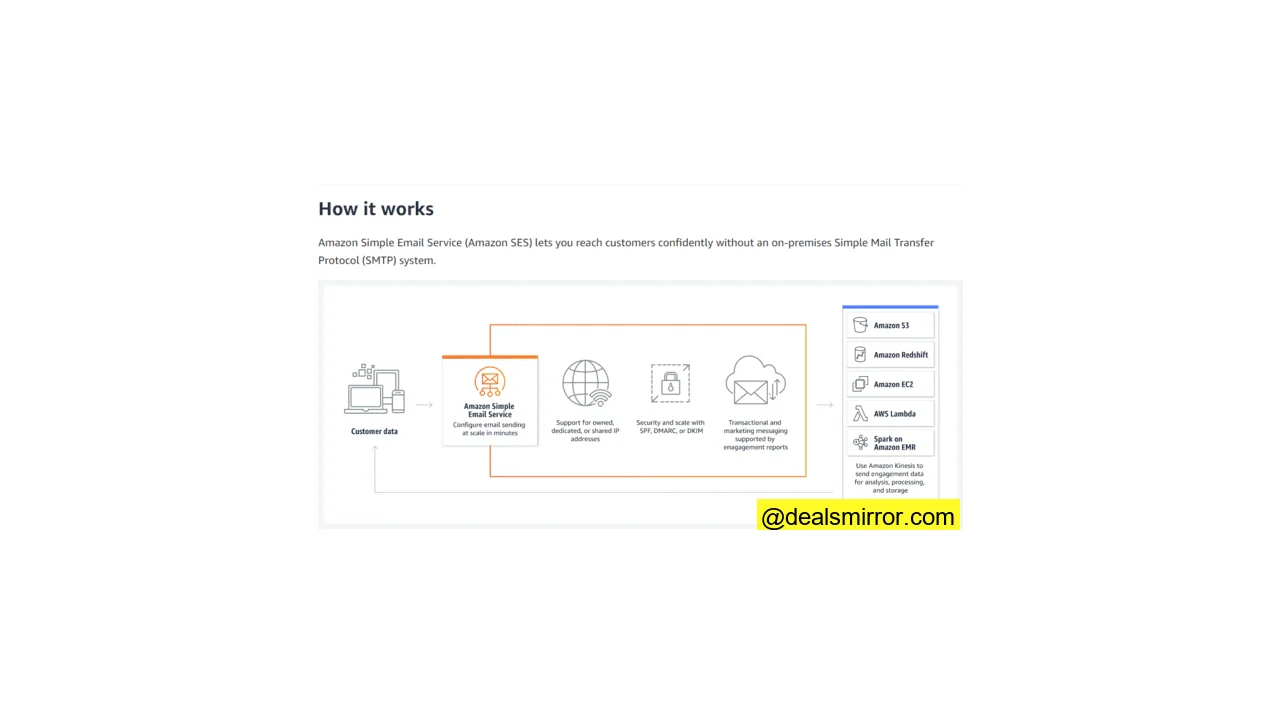
SMTP servers are known for their reliability and speed. When managed correctly, they are also highly effective at protecting sender reputation, particularly at high volumes. This is crucial for convincing email service providers and ISPs that your emails are not spam, which directly translates to better deliverability.
Many providers today offer cloud-based SMTP services or access to an SMTP server via the cloud, often referred to as SMTP relays. Amazon SES is more than just an SMTP relay service; it’s a comprehensive cloud-based email service built on Amazon’s proprietary technology. However, it fully supports SMTP and functions much like an SMTP relay. It also provides an API, allowing developers to integrate email-sending capabilities into other services and applications.
The primary benefit of Amazon SES is its unparalleled scalability. Leveraging the Amazon cloud, it boasts virtually limitless sending capacity, often exceeding what standard SMTP relays can achieve. Its pay-as-you-go pricing model ensures you only pay for what you use. Furthermore, Amazon SES offers robust tools for send optimization, sender reputation management, and advanced testing. Users also have the option to purchase a dedicated IP address for enhanced control over their sender reputation.
On the downside, new users may find Amazon SES challenging to navigate due to its steep learning curve. Even its pricing structure can be complex, charging $0.10 per 1000 emails sent, plus an additional $0.12 per GB of attachments.
10 Best Amazon SES Alternatives
The following 10 Amazon SES alternatives offer a diverse range of services. Some function as SMTP relays and APIs, others are specialist transactional email services, and some are comprehensive email marketing platforms. Many even offer a blend of these functionalities.
Each of these alternatives provides unique advantages over Amazon SES. Here’s what you need to know:
1. SMTP2GO
SMTP2GO is a leading cloud SMTP service provider, highly regarded for its specialization in bulk email sending and consistently high deliverability rates.
This platform dedicates significant effort to protecting your sender reputation. It features tools that authenticate email addresses and check blocklists, actively working to keep bounce rates low. SMTP2GO also helps you steer clear of sending to blacklisted or ‘spam trap’ email addresses, which can quickly flag you as a ‘spammy’ sender and severely damage your reputation.
Additionally, SMTP2GO allows you to preview how your emails will appear in over 40 different email clients. This crucial feature gives you the opportunity to fine-tune designs and resolve any display issues before sending, further reducing the risk of emails landing in junk folders. After your emails are sent, detailed activity reports provide fine-grained insights into deliverability and engagement, helping you track outcomes precisely.
SMTP2GO Pros
- Excellent deliverability
- Automated spam detection and monitoring
- Testing for 40 email clients
- Event reporting for every email sent
SMTP2GO Cons
- No option to create emails or manage email campaigns
SMTP2GO pricing starts at $15 a month for 40,000 emails. A free plan is available, offering up to 1,000 emails per month.
2. Brevo
Brevo (formerly Sendinblue) is a comprehensive email marketing and CRM platform that also includes a robust SMTP relay for transactional emails. This dual functionality provides a significant advantage over Amazon SES, as you can create, design, and send HTML emails directly within the Brevo platform.
Users can choose from over 40 professionally designed email templates and easily customize them using a user-friendly drag-and-drop editor. Another major benefit of Brevo is its powerful email automation capabilities, available for both marketing campaigns and transactional emails. The platform features a simple workflow editor for building automated sequences, complemented by automation templates to accelerate the process.
Brevo provides clear and concise guidance for SMTP server configuration. Additionally, an API is available for direct connection of your website to the server, enhancing integration flexibility.
Brevo Pros
- Design and send HTML emails from one integrated tool
- Full suite of email marketing tools
- Automate sending of marketing and transactional emails
- Send up to 300 emails a day for free
Brevo Cons
- Higher per-email cost, though justified by the comprehensive feature set
Brevo pricing starts at $9 for 5,000 emails. It offers a generous free plan that allows you to send up to 300 emails per day.
3. MailerSend
MailerSend is a specialized transactional email service provider developed by the creators of MailerLite. It focuses on facilitating the sending of critical communications such as receipts, password resets, and order and shipping confirmations.
MailerSend supports bulk sending for businesses of all sizes. Its SMTP relay includes a convenient plug-and-play option for WordPress websites, offering easier integration compared to using its API. For agencies, MailerSend allows for the management of multiple domains under a single account, and you can opt for a dedicated IP address for enhanced control over your sending reputation.
A distinctive feature of MailerSend is its capability to design HTML emails directly within the platform. While transactional email design is often overlooked, MailerSend provides a drag-and-drop email builder and editor. You can utilize pre-made templates to quickly start your designs, and all templates support dynamic content, enabling personalization for every email.
Recently, MailerSend introduced an email verification tool. This allows you to upload email lists as CSV files for verification, checking if addresses are active and genuine. This feature helps prevent damage to your sender reputation by significantly reducing bounce rates.
MailerSend Pros
- Drag-and-drop editor for easy transactional email design
- Dynamic templates for personalization
- Bulk email list verification
- Low-cost team accounts
MailerSend Cons
- No option to automate email sending
MailerSend pricing starts at $7 a month for 5,000 emails, which also includes 100 email verifications. A free plan is available, allowing you to send up to 500 emails per month.
4. Moosend
Moosend is primarily known as an intuitive email marketing service, but it also provides a robust cloud-based SMTP service tailored for high-volume sending. Moosend has earned a reputation as a great value platform for small businesses.
When comparing Moosend to Amazon SES in terms of cost, there are two key perspectives. All Moosend’s plans allow for unlimited email sending. Starting at just $9 a month, Moosend often comes out ahead in terms of per-email pricing. However, Moosend imposes limits on the number of contacts you can have (starting at 500), whereas Amazon SES does not. Therefore, determining the best value depends on your specific business needs and contact volume.
Moosend enables you to send both promotional and transactional emails from a single, integrated platform. It offers easy-to-use tools for designing high-quality HTML emails and boasts excellent automation options to save you time.
E-commerce businesses can seamlessly connect Moosend directly to their online stores. Its site tracking feature allows you to trigger automated, personalized emails based on visitor behavior on your site. The platform includes an AI tool for targeted product recommendations, and you can effortlessly drop product listings directly into your email campaigns.
Moosend Pros
- Manages all email needs from one integrated platform
- Low cost with no email sending limits
- Easy email automation and personalization
- Send promotional and transactional emails directly from your ecommerce store
Moosend Cons
- A free forever plan would be a welcome addition
Sign up for Moosend and get a 30-day free trial. Pricing starts at $9 a month for 500 contacts, unlimited emails, and all features included.
5. SMTP.com
SMTP.com is a robust bulk email delivery platform designed for high-volume senders, with custom service options starting at a staggering minimum of 250 million emails per month. It also provides a flexible range of plans, beginning from 50,000 emails a month, catering to various scales of business.
Like most services on this list, SMTP.com combines a reliable cloud SMTP relay with a powerful API. For developers, it promises simple and fast integration, and migration templates facilitate an easy switch from other relays or APIs.
A significant advantage of SMTP.com is its comprehensive deliverability features. Its standout Reputation Defender is an advanced validation tool that automatically scans for ‘bad’ emails in your list in real-time, effectively catching potential bounces before they occur. This intelligent tool streamlines list hygiene and sender reputation management, alleviating the burden on businesses.
For those seeking a fully managed solution, SMTP.com also offers a complete sending service, taking care of all your email delivery needs.
SMTP.com Pros
- Designed for high-volume, scalable sending
- Automated list hygiene and sender reputation management
- Exceptional deliverability rates
- Easy API integration
SMTP.com Cons
- While the Reputation Defender tool is highly effective, it’s a paid add-on, and SMTP.com’s plans are not the cheapest to begin with.
Essential plans start at $25 a month for 50,000 emails. All plans from Starter up include a dedicated IP. There is no free plan or trial available.
6. ActiveCampaign Postmark
The highly-regarded transactional email service Postmark was acquired by ActiveCampaign in 2022. While ActiveCampaign is known for its email marketing and CRM platform, Postmark serves as its dedicated transactional email offering. When you integrate the transactional email ‘app’ within ActiveCampaign, you connect directly to Postmark.
Becoming part of the ActiveCampaign family has significantly expanded Postmark’s capabilities. As stated on its website, “Postmark is no longer just for transactional email only.” It is now strategically positioned for email marketing as well. Previously, sending promotional emails through Postmark was not possible. The service also functions as a mailbox for inbound emails.
This integration has led to an evolution in Postmark’s email infrastructure. Postmark offers the standard SMTP relay and email API, but it now features distinct ‘messaging streams’ for inbound, transactional, and marketing emails. Users can even create custom streams. The core idea behind these streams is to safeguard sender reputation across different email types. If marketing emails happen to be flagged as spam, it will not impact the deliverability of transactional emails, and vice versa.
Postmark includes templates specifically for transactional emails, eliminating the need to use a separate platform for email creation—a key advantage over Amazon SES. For email marketing needs, there’s a direct connection to ActiveCampaign. Furthermore, Postmark offers significantly better customer support than Amazon SES, with a support team accessible via phone and live chat.
ActiveCampaign Postmark Pros
- Protected ‘streams’ for sending marketing and transactional emails
- Direct integration with ActiveCampaign for email marketing
- Transactional email templates
- Telephone and live chat support
ActiveCampaign Postmark Cons
- Doesn’t have any built-in list cleaning tools
Postmark pricing starts at $15 a month for 10,000 emails. Dedicated IPs are available as a paid add-on for accounts sending above 300,000 emails per month. A free trial is offered, allowing you to send 100 emails.
7. Google
Google, renowned as the world’s largest search engine, also dominates the email client landscape with Gmail. It offers a comprehensive suite of email services, including free personal webmail and an almost identical, paid-for business email service.
While Gmail isn’t purpose-built for bulk email sending in the same way Amazon SES is, it still provides the capability. Users can leverage its own SMTP relay and API. Alternatively, for those who prefer a simpler approach, Gmail’s Multi-Send Mode, accessible directly from your standard Gmail Compose screen, automatically personalizes greetings for each contact.
Both of these bulk-sending options are included with Google Workspace subscriptions. For personal use, they are completely free. However, the term ‘bulk’ in Gmail comes with certain limitations. As an email client, Google is highly protective of its sender reputation and imposes strict sending limits on public accounts. The trade-off for these limits is Gmail’s exceptionally high deliverability.
Multi-sending is capped at 1,500 recipients per day, which, over a month, can amount to a substantial volume. With the SMTP relay and API, you are restricted to 100 recipients per message and a total of 10,000 recipients per day (allowing you to send 100 messages to 100 different people daily). These limits are considerably lower than the virtually open-ended sending capacities of Amazon SES. For businesses requiring greater volumes, these limitations can be removed with a Gmail Enterprise account, which provides a unique domain, granting you full control over your sender reputation.
Google Pros
- Free with Google Workspace accounts
- Multiple bulk sending options available for Gmail users
- High deliverability
- Automatic personalization
Google Cons
- Lower send limits compared to dedicated bulk senders
8. Mailgun
Mailgun is a powerful transactional email service specifically designed for developers. Similar to Amazon SES, it combines an SMTP relay service with a robust email API, enabling seamless integration of email-sending capabilities into virtually any platform or application.
Mailgun doesn’t aim to compete with Amazon SES on price alone; it typically works out to be at least seven times more expensive per email sent. Instead, Mailgun distinguishes itself by offering a much more complete and developer-friendly all-round service.
While Amazon SES integrates easily with websites hosted on AWS (Amazon Web Services), Mailgun prides itself on making its API hassle-free to connect to *any* platform. It offers multiple REST APIs tailored for different environments, frameworks, and programming languages, accompanied by detailed, user-friendly documentation for each. Furthermore, Mailgun provides 24/7 customer support, a significant advantage over the more self-service approach of Amazon SES.
Mailgun matches Amazon SES in terms of sender reputation management, deliverability, and testing tools. Where it surpasses SES is with advanced features like send time optimization and email verification. An AI tool identifies when contacts are most likely to be active in their inbox, automatically sending emails at optimal times. Additionally, you can run comprehensive checks on your email lists to filter out defunct or fake addresses, ensuring better list hygiene.
Mailgun also excels in handling multiple domains. For agencies managing separate domains for their clients, each domain is treated independently. This means a dip in sender reputation on one domain will not affect deliverability on another, unlike Amazon SES, which groups multiple domains on the same account together.
Mailgun Pros
- Excellent option for agencies managing multiple email domains for clients
- High levels of support tailored for developers
- Robust email verification capabilities
- Advanced send time optimization
Mailgun Cons
- On the more expensive side, especially for small businesses.
Mailgun pricing starts at $35 a month for 50,000 emails. A dedicated IP costs an additional $50 a month. While there is no free plan, you receive a one-month free trial with a 5,000 email limit.
9. SendGrid
SendGrid is a comprehensive business email service offering a cloud SMTP relay, an email API, and a suite of email marketing tools. This allows businesses to manage promotional email campaigns and transactional emails from a single platform, with robust support for high sending volumes.
Deliverability is a core strength of SendGrid, which boasts sending over 100 billion emails every month. All new accounts undergo an essential process called IP warmup. This system gradually increases send volumes according to a fixed schedule, allowing ISPs and email clients time to ‘get used’ to your IP sending large quantities, thereby preventing immediate flagging as spam.
Beyond IP warmup, your IP address configuration is optimized based on monthly send volumes. SendGrid authenticates domains and IP addresses using industry standards like SPF, DKIM, and reverse DNS. It provides in-depth reporting to help maintain a positive sender reputation, including blacklist monitoring. Additionally, you can validate emails before sending to significantly lower bounce rates.
SendGrid functions more effectively as a bulk email-sending platform than as a pure email marketing tool. While it performs a decent job of running email campaigns, offering responsive templates and a simple-to-use editor, and allowing for basic automations to save time, its email marketing features are less extensive and sophisticated compared to platforms like Brevo or Moosend.
SendGrid Pros
- Excellent deliverability rates
- Offers transactional emails and email marketing in a single platform
- Reliable email validation API
- In-depth email analytics
SendGrid Cons
- SendGrid’s email marketing options are useful but can be basic for advanced users
SendGrid pricing starts at $19.95 a month for up to 50,000 emails. Pro plans include a dedicated IP. There is a free forever plan that allows sending 100 emails per day.
10. Elastic Email
Elastic Email is a versatile platform offering both email marketing and email delivery services, which are available as separate, distinct offerings.
The bulk-sending option is delivered through an API and includes a range of crucial deliverability features, such as email verification. For enhanced control and performance, purchasing a private domain unlocks additional deliverability features, including IP warm-up.
Supporting its robust deliverability tools, Elastic Email provides in-depth analytics. Reporting covers standard metrics like delivered, opened, clicked, and unsubscribed rates, along with valuable insights into the reasons why contacts unsubscribe.
For email marketing, Elastic Email provides all the expected tools: a drag-and-drop email builder with pre-made templates, campaign automation (including send time optimization), landing page and form builders, personalization, contact segmentation, and dynamic content capabilities.
A notable point is that these services are not available as a single, combined bundle; you must subscribe to the email marketing tools and transactional emails separately. However, the email builder and templates are included with an Email API account, enabling you to design visually appealing transactional emails that align perfectly with your brand identity.
Elastic Email Pros
- Advanced features for reliable email delivery
- In-depth analytics and reporting
- Drag-and-drop builder for designing transactional emails
- Comprehensive email marketing tools
Elastic Email Cons
- SMTP relay API and email marketing are only available as separate plans.
The Elastic Email API plan starts at $9 a month for 10,000 emails. The email marketing plan also begins at $9, allowing up to 60,000 emails a month to 2,000 contacts. Both services offer a free version, limited to 100 emails a month. Custom plans are available for users sending 100 million or more emails per month.
Amazon SES Alternatives: Which is the Best?
You’ve now explored 10 of the best Amazon SES alternatives. Determining the “best” choice ultimately depends on your specific business needs. Many businesses prioritize an all-in-one solution that seamlessly integrates all their email requirements. If this resonates with you, consider platforms that combine both email marketing and transactional email capabilities.
Alternatively, if your primary focus is solely on sending transactional emails in high volumes, then selecting a service that offers the optimal balance of deliverability and ease of use will be key.
Best for email marketing and transactional email combined:
| Best For | Free Plan? | Starting Price | |
| Brevo | Free email marketing & transactional emails | Yes | $9/month |
| Moosend | Value for small businesses | Yes, 30 days free | $9/month |
Best Amazon SES alternatives for transactional emails only:
| Best For | Free Plan? | Starting Price | |
| SMTP2GO | In-depth reporting and testing | Yes | $15/month |
| MailerSend | Low-cost sending for teams | Yes | $7/mo |
| SMTP.com | High deliverability rates at very high send volumes | None | $25/month |
FAQs about Alternatives to Amazon SES
Is Amazon SES expensive?
However, Amazon SES does charge extra for various features. This includes sending attachments at a rate of $0.12 per GB, and the Virtual Deliverability Manager costs an additional $0.07 per 1,000 emails. Some users find this layered pricing structure confusing.
If you’re looking for an alternative to Amazon SES with clearer pricing or more bundled features, consider Brevo, MailerSend, Moosend, SMTP.com, or SendGrid.
Is Amazon SES an MTA?
Does Amazon SES work with Gmail?
What are the best Amazon SES Alternatives?
If you’re seeking a platform for bulk email marketing campaigns alongside transactional emails, check out Brevo or Moosend. Brevo has a great free plan that lets you build and send 300 emails a day at no cost. Moosend has valuable automation tools for email marketing.
For bulk sending at very high volumes, SMTP.com and Mailgun both offer better support than Amazon SES. For users who prioritize an intuitive interface over developer-level complexity, SMTP2GO is much easier to use for non-developers.