While ClickFunnels has promised to revolutionize online selling for many entrepreneurs, its unique approach isn’t always a perfect fit for every business. Many users explore alternatives due to various factors: its specific suitability for certain products and services, a steep learning curve despite its feature richness, and its often high cost for smaller enterprises.
The market offers a diverse range of alternatives, each with its own strengths. This guide explores top platforms that provide comparable or superior experiences, catering to different business needs and priorities.
What is ClickFunnels?
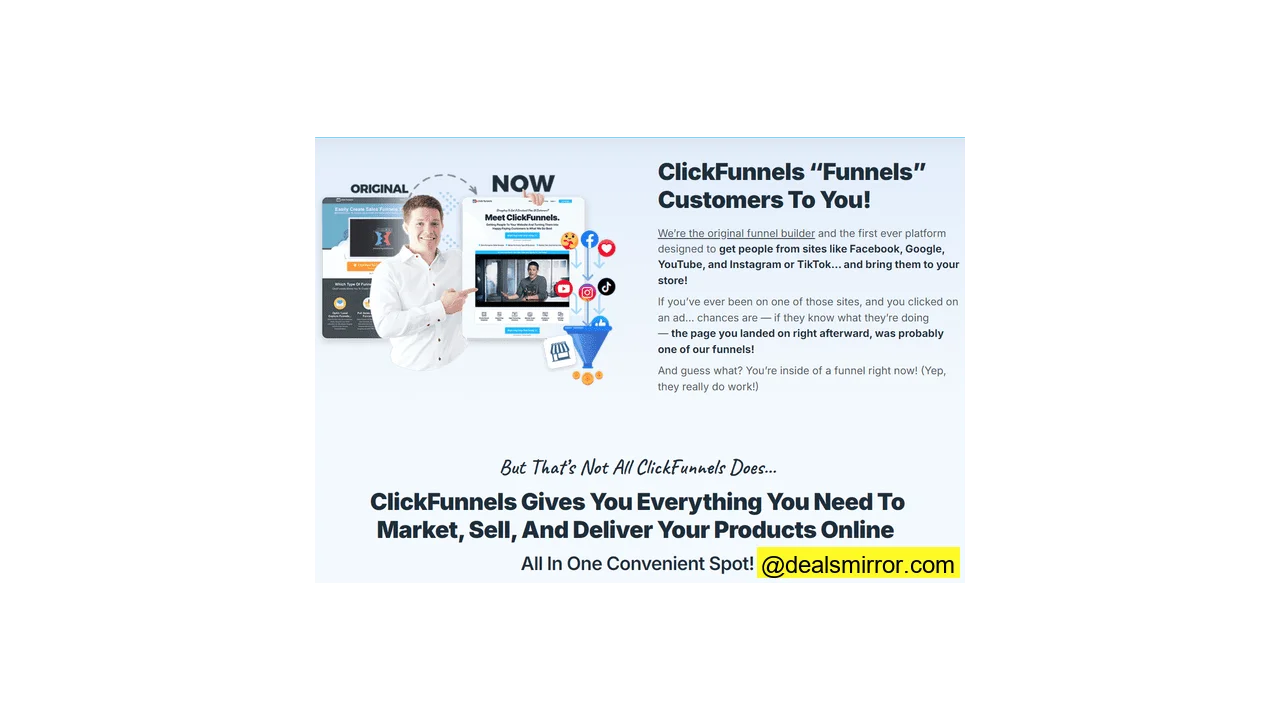
ClickFunnels is a widely recognized sales funnel builder, focusing on lead capture, nurturing, and conversion. Its core value proposition lies in simplifying the creation of these sales funnels, notably with its “squeeze funnels” concept.
The platform’s methodology involves constructing a landing page with a capture form, followed by offering an incentive for sign-ups. This process then enables direct selling to new leads, creation of digital products and online courses, or integration into email marketing contact lists.
With over 100,000 customers, ClickFunnels is particularly favored by consultants, coaches, educators, and influencers who appreciate its streamlined approach. While it aims for speed and simplicity, covering sales funnels, email marketing, CRM, website building, and automation, its ‘all-in-one’ nature can sometimes spread features too thin, leading to a less robust experience in certain areas like dedicated CRM or advanced marketing automation.
The 10 Best ClickFunnels Alternatives Overview
Here’s a summary of top platforms that offer a compelling alternative to ClickFunnels, chosen for their superior experience in various aspects:
| Best For | Free Plan/Trial | Starting Price | Score | |
| Sales & Marketing Automation | Yes, 14 days | $15/mo | ||
| All-Round CRM | Yes | $20/mo | ||
| eCommerce Marketing | Yes | $13.30/mo | ||
| Small Business Marketing | Yes | $9/mo | ||
| Affordable Email Marketing | Yes | $9/mo | ||
| Free CRM | Yes | $12.74/mo | ||
| CRM for Small Businesses | Yes | $11/mo | ||
| All-Round Business Software | Yes | $14/mo | ||
| CRM for Consultants | Yes, 14 days | $249/mo | ||
| Landing Pages | Yes | $29/mo |
What’s Wrong with ClickFunnels?
While ClickFunnels addresses many sales and marketing needs, its “squeeze” approach can result in certain tools feeling underdeveloped. Furthermore, the user interface can sometimes be clunky and confusing. Here are some of its primary drawbacks:
- Confusing Navigation: A common issue with feature-rich software, finding specific tools within ClickFunnels can be challenging. Although version 2.0 attempts to mitigate this by offering features as optional ‘apps,’ many tools remain difficult to locate.
- High Learning Curve: The complex navigation contributes to a significant learning curve. While individual tools may be straightforward, mastering the platform as a whole takes considerable time.
- Limited Email and No Automation Templates: Despite its robust drag-and-drop editing for websites, unlimited pages, broadcast emails, and automation workflows, ClickFunnels lacks sufficient pre-made templates for all tasks. It provides numerous funnel templates but offers no automation templates and only 37 email templates.
- Some Features Lack Flexibility: ClickFunnels heavily emphasizes lead capture, but only allows sign-up forms to be embedded within new landing pages, without the option to integrate them into existing webpages.
- Few Integrations: Efficient business processes often rely on software integration. ClickFunnels provides only 20 direct integrations, requiring developer expertise to utilize its API for any other connections.
- It’s Expensive: With an entry price of $81 per month, ClickFunnels is costly for small businesses. Hidden charges, such as $0.675 per 1,000 emails, are not clearly advertised. There is no free plan, only a 14-day free trial.
What to Look For in a ClickFunnels Alternative
When seeking an alternative to ClickFunnels, prioritize platforms that offer robust core features like lead capture, marketing and nurturing tools, and comprehensive sales pipeline and CRM functionalities. Additionally, consider the following qualities shared by the best sales and marketing software for SMEs:
- Ease of Use: Opt for user-friendly software with ample support resources to minimize technical challenges.
- Affordability: Evaluate value based on features received, not just the lowest price. Transparent pricing plans help maintain budget control.
- Flexibility: Choose software that can adapt and scale with your business’s evolving needs and growth.
- Personalization: Select applications that support personalization, segmentation, tagging, and dynamic content to cater to individual customer expectations.
- Integrations: Ensure new apps integrate seamlessly with your existing tools to optimize time, cost, and effort.
- Support: Reliable customer support is essential for resolving issues and maximizing platform benefits.
No single platform is ideal for everyone. The following overviews highlight unique features, key advantages, and potential drawbacks, identifying the best fit for different users.
1. ActiveCampaign – Best for Sales & Marketing Automation
ActiveCampaign has become a leading all-in-one sales and marketing platform, trusted by over 180,000 global customers for its powerful automation capabilities.
Automation is ActiveCampaign‘s defining strength, featuring one of the most sophisticated yet user-friendly workflow editors available. Customization is virtually limitless, allowing users to build complex workflows with numerous conditions and variables. With a vast selection of triggers and actions, and the ability to connect workflows, its flexibility is unmatched. The platform further supports users with over 900 automation templates, a stark contrast to ClickFunnels, which offers none.
Another key differentiator from ClickFunnels is ActiveCampaign‘s seamless integration of sales and marketing efforts. While ClickFunnels offers limited integration through its funnels, ActiveCampaign fosters closer collaboration between teams. Web tracking triggers workflows based on contact page visits, and lead scoring identifies the best prospects for sales pipelines. Dedicated ‘sales engagement’ templates streamline these processes.
The excellence extends across ActiveCampaign‘s other features. Its email builder is versatile and user-friendly, offering over 240 pre-made templates compared to ClickFunnels‘ 37. Lead capture, analytics, and segmentation tools are equally flexible and comprehensive. Users can create and send transactional emails via ActiveCampaign Postmark and integrate directly with over 900 other platforms. For a deeper analysis, compare ActiveCampaign to ClickFunnels.
ActiveCampaign Pros
- Advanced marketing automation
- Integrated marketing and sales functionality
- In-depth website tracking and lead scoring
- 900+ integrations
ActiveCampaign Cons
- The advanced features, while a strength, can present a learning curve for some users.
The Starter plan for ActiveCampaign begins at $15 per month, providing email marketing and automation tools for 1,000 contacts and 10,000 emails. More details are available in the ActiveCampaign pricing guide.
Active Campaign vs ClickFunnels Verdict: ActiveCampaign stands out as the premier alternative to ClickFunnels for enhancing sales and marketing efficiency. Its extensive and high-quality features cater to ambitious, growing businesses, especially those with prior experience in sales and marketing automation.
2. HubSpot – Best for Customer Relationship Management
HubSpot is the preferred CRM software for over 200,000 companies globally, aiming to help businesses attract and engage customers, similar to ClickFunnels. However, HubSpot offers a significantly broader range of tools and greater flexibility.
It provides comprehensive solutions for lead generation, email campaigns, marketing automation, sales pipelines, deals management, and analytics. Beyond these, HubSpot features six distinct ‘Hubs’: Sales, Marketing, Service, Commerce (for B2B), Content (for creation and delivery), and Operations (for data analytics and automation).
HubSpot‘s modular design allows users to customize tool bundles or opt for the ‘all-in-one’ Customer Platform, which also comes in a smaller SME version. A free CRM tier offers basic tools across its product range. Furthermore, HubSpot integrates with over 1,200 third-party applications. To explore similar tools, consult this review of HubSpot alternatives.
HubSpot Pros
- Six Hubs cover most needs for marketing, sales, and service teams
- Most tools are user-friendly with a quick learning curve
- The free plan includes essential tools from all Hubs
- 1,500+ third-party integrations
HubSpot Cons
- Higher send limits and more email templates would be beneficial.
- Plans above Starter become significantly expensive.
Pricing for HubSpot for SMEs starts at $20 per month but can quickly exceed $1,000 a month for higher plans with five seats. For detailed pricing information, explore HubSpot’s pricing structure.
HubSpot vs ClickFunnels Verdict: HubSpot is the top alternative to ClickFunnels for larger businesses seeking a versatile, feature-rich CRM. Small businesses and solopreneurs can also initiate their CRM journey effectively with the free tier.
3. GetResponse – Best for eCommerce Marketing
GetResponse is primarily a marketing platform, differentiating itself from ClickFunnels. Its pricing tiers are structured to support business growth through various marketing stages: beginning with affordable Email Marketing for audience growth, advancing to Marketing Automation for event-based automation, and culminating in Ecommerce Marketing. The top tier integrates web stores to boost sales, featuring sales-focused analytics, customer tracking, promotion capabilities, personalized product recommendations based on tracking data, transactional emails, unlimited web push notifications, and webinar creation and sales—a feature also found in ClickFunnels.
While sharing similarities with ClickFunnels, GetResponse recently introduced a ‘Content Monetization’ plan specifically for marketing and selling courses, aligning with ClickFunnels’ domain. However, GetResponse excels if email marketing is a priority, offering superior support with email and automation workflow templates. It allows for embeddable lead capture forms on any page and boasts over 170 integrations, significantly more than ClickFunnels’ 19.
GetResponse is also the preferred choice for driving e-commerce sales. While ClickFunnels includes ‘store funnels,’ GetResponse’s e-commerce integrations streamline the process for web store owners.
GetResponse Pros
- Advanced marketing automation
- Affordable email marketing with 150+ templates
- Suitable for most companies from small businesses to enterprises
- 24/7 chat and email support
GetResponse Cons
- CRM features are on the basic side
Pricing for GetResponse starts at $13.30 a month with a 2-year commitment, offering 1,000 contacts and no email sending limit. A free plan is available, including 2,500 emails per month. Detailed information on all GetResponse plans is available.
GetResponse vs ClickFunnels Verdict: GetResponse is the optimal alternative to ClickFunnels for eCommerce businesses. It also offers a cost-effective and user-friendly solution for those looking to begin with email marketing.
4. Brevo – Best for Small Business Sales and Marketing
Brevo, an email marketing and CRM platform, stands out against ClickFunnels primarily for its affordability. It offers separate pricing for its sales and marketing platforms, yet their combined cost remains lower than ClickFunnels. Brevo also provides an excellent free tier, granting access to essential email marketing and CRM tools.
Originating as a specialized email marketing platform, Brevo excels in this area. Its drag-and-drop email and automation workflow editors are exceptionally user-friendly. Users can integrate SMS, WhatsApp messages, and push notifications into their workflows, and configure the Messaging API for multichannel transactional messages.
While Brevo’s CRM tools are more basic, they are solid. Lead capture is supported through sign-up forms and landing pages, though direct sales functions are not built-in. Users can customize pipelines for clear sales process oversight and leverage sales automation tools to streamline deal progression. Shared inboxes and meeting scheduling features enhance team organization. Brevo also offers robust customer support, including phone support for lower plans, 24/7 email ticketing, and chatbot assistance. It supports over 150 third-party integrations.
Brevo Pros
- Free email marketing and CRM
- Multichannel marketing and transactional messaging
- Sales and marketing automation
- User-friendly drag-and-drop email editor and automation workflow builder
Brevo Cons
- More email templates would enhance the offering.
Marketing Platform plans for Brevo begin at $9 per month, including 5,000 emails and 500 contacts. The Sales Platform starts at $12 per user per month. The free tier provides unlimited contacts and 300 emails daily. Full pricing details for Brevo plans are available.
Brevo vs ClickFunnels Verdict: Brevo is the ideal alternative to ClickFunnels for SMEs seeking to integrate sales and marketing. Its affordability and generous free tier make it highly accessible, coupled with its ease of use.
5. MailerLite – Best for Affordable Email Marketing
MailerLite is a comprehensive email marketing service offering automation and lead generation tools. Similar to ClickFunnels, it enables the creation and sale of digital products, alongside a website builder and blogging capabilities.
While ClickFunnels provides decent email building and automation, these are often supplementary to its core features, and can be costly for businesses primarily needing a robust email marketing solution. MailerLite delivers essential features affordably.
MailerLite‘s email editor is exceptionally user-friendly, offering over 90 templates and 20 pre-designed modules for quick and appealing email creation.
The automation workflow editor in MailerLite is equally intuitive, with surprisingly advanced tools for its price point. It offers a wide range of triggers, including click tracking, multiple triggers per workflow, and conditional logic to split paths based on user actions like email opens and clicks.
Additional advantages include an outstanding free plan with generous send limits and over 150 direct integrations, particularly strong in eCommerce. This makes MailerLite an excellent choice for promoting online stores.
MailerLite Pros
- Affordable pricing, starting at $9/month
- Excellent free plan for starting email marketing
- User-friendly email marketing and automation tools
- Robust landing page and website builder
MailerLite Cons
- While digital products can be sold, MailerLite does not offer CRM tools.
MailerLite‘s pricing starts at $9 per month, including 3 users, unlimited emails, and 500 contacts. The Free plan supports 1,000 contacts and 12,000 emails monthly. For detailed plan inclusions and costs, refer to MailerLite’s pricing page.
MailerLite vs ClickFunnels Verdict: MailerLite is the ideal alternative to ClickFunnels for effective and affordable email marketing, particularly for businesses selling digital products or managing an existing web store.
6. EngageBay – Best Free CRM
EngageBay is an ‘all-in-one’ CRM platform, structured with separate ‘Bays’ for sales, marketing, and customer service, along with an ‘All-in-One Suite’ and a highly competitive free tier.
The most striking difference between EngageBay and ClickFunnels is cost. While ClickFunnels targets sales and marketing teams with multi-user pricing, EngageBay is designed for microbusinesses, startups, and solopreneurs with smaller contact lists. Although additional contacts and features are available through paid upgrades, the platform remains highly accessible.
The trade-off for its affordability is that some tools are more basic, but their simplicity and convenience, especially for a free offering, are significant advantages. EngageBay’s free tier allows users to manage customers, send emails, track sales deals, and handle customer inquiries from a single, user-friendly interface—perfect for those just starting out.
The primary limitation of the free tier is a 250-contact cap, which increases to only 500 on the cheapest paid tier. However, paid plans unlock email templates, tag management for list segmentation, and lead scoring for targeted sales pipelines. Other features include social media tools, SMS marketing, and third-party integrations.
EngageBay Pros
- Complete CRM suite available for free
- All-in-one marketing, sales, and support platform
- Free live chat and help desk tools
- Free email validation
EngageBay Cons
- Some template designs appear slightly dated.
The All-in-One Suite from EngageBay starts at $12.74 per user per month, including 500 contacts. The Marketing and Sales ‘Bays’ begin at $11.04 per user per month, while the Service Bay is perpetually free.
EngageBay vs ClickFunnels Verdict: EngageBay is the premier alternative to ClickFunnels for startups and solopreneurs seeking a free CRM solution.
7. Freshsales – Best CRM for Small Businesses
Freshsales is a user-friendly sales CRM designed with core features such as flexible pipelines, efficient deal management, sales-focused analytics, automation, and diverse tools for managing and sharing customer data.
Freshsales distinguishes itself from ClickFunnels in several ways. Firstly, its starting price is considerably lower. Secondly, its sales CRM features are significantly more comprehensive, delving deeper into prospecting, account management, AI-powered lead scoring, and multichannel engagement, whereas ClickFunnels focuses primarily on basic pipeline management.
As part of the larger Freshworks business software suite, Freshsales offers additional tools for marketing, help desk management, IT support, and chatbots. The Freshsales Suite combines sales and marketing functionalities, providing workflow templates for both marketing and sales process automation.
Multichannel communication options include email, SMS, chatbots, Zoom, Facebook Messenger, and WhatsApp, allowing for versatile engagement with leads across campaigns and pipelines. Analytics, powered by Freshwork’s ‘Freddy’ AI, are integrated throughout the platform. Lead scoring incorporates intent and sentiment analysis to predict conversion likelihood from subtle language and behavioral cues. AI chatbots automatically analyze and feed information into the CRM.
Freshworks also offers high-quality service CRM products, with separate solutions for help desk, IT ticket support, and chatbots. See where Freshsales ranks among top CRMs.
Freshsales Pros
- Affordable, feature-rich sales CRM
- Multichannel communications including email, SMS, chatbots, and integrations with Zoom, WhatsApp, and Messenger
- AI-powered prospecting and lead scoring
- Sales and marketing automation.
Freshsales Cons
- The overlap between various plans can be confusing.
Freshsales plans start at $11 per month. A 21-day free trial is available, but there is no free plan for the sales CRM. However, users can utilize Freshmarketer to send emails for free, though this free plan is limited to 100 contacts and 500 emails per month.
Freshsales vs ClickFunnels Verdict: Freshsales is the optimal alternative to ClickFunnels for small businesses seeking a high-value sales CRM. Its extensive and quality features are excellent for the price, with options to integrate marketing and service tools, sometimes at no additional cost.
8. Zoho CRM – Best for All-Round Business Software
One of ClickFunnels’ key attractions is its ability to centralize multiple functions on a single platform. However, the breadth of capabilities offered by Zoho CRM far surpasses it.
Zoho CRM is merely one product within Zoho’s extensive suite of over 40 business applications, and one of nine specifically listed as sales tools. Zoho offers software for virtually any business process or function. This allows for two perspectives on Zoho CRM: as a powerful standalone sales-focused CRM, or as an integral component of a vast business software ecosystem. Regardless, the sheer scope of Zoho CRM is immense, positioning it as one of the most feature-rich CRMs available.
A notable highlight is its automation of lead, deal, and account management. Users can map out customer journeys, convert them into funnels and pipelines, and automate every stage of engagement. A standout feature of Zoho CRM is its high degree of customization, including Kiosk Studio, a no-code UI builder.
Zoho CRM also provides a comprehensive array of performance analytics and reporting options. AI is woven into many processes to forecast outcomes and deliver recommendations.
Despite its extensive size and scale, which typically suit larger enterprises, Zoho CRM remains attractively priced, even for SMEs.
Zoho CRM Pros
- Extensive collection of quality CRM tools
- The CRM integrates into a vast business software suite, including marketing, service, and finance applications
- Advanced AI for enhanced analytics and automation
Zoho CRM Cons
- The sheer volume of choices can make it challenging to identify the best app or suite for specific needs.
- Customer support is limited.
Zoho CRM starts at $14 per user per month. A free tier offering basic pipeline tools is available, and all paid plans include a 15-day free trial.
Zoho CRM vs ClickFunnels Verdict: Zoho CRM is the optimal alternative to ClickFunnels for larger businesses aiming to foster growth. However, harnessing its full potential requires experience with advanced sales and marketing tools.
9. Keap – Best CRM for Consultants and Coaches
Keap is positioned as a sales and marketing CRM tailored for small businesses, sharing many similarities with ClickFunnels. Both platforms offer substantial value for coaches, consultants, and online business owners.
With Keap, users benefit from an equal distribution of sales and marketing tools. It features a familiar drag-and-drop editor for creating and sending email marketing campaigns, alongside a similar tool for building and editing sales pipelines. Automation workflows can be developed for both campaigns and deals management.
For lead capture, Keap includes landing page and sign-up form builders. A shared characteristic with ClickFunnels is the utilization of ‘lead magnets’—incentives to encourage sign-ups and information sharing. Users can also create and save lead magnet ‘blueprints’ for reuse, akin to ClickFunnels’ sales funnels.
While Keap does not allow for building digital products like courses or e-guides directly, it provides checkout and payment processing tools to facilitate their sale and payment collection. Its invoicing features are a significant advantage for businesses offering services.
Keap’s primary strength over ClickFunnels is its broader appeal to various business types, offering diverse methods for lead capture and nurturing. For instance, Keap enables users to solicit reviews and referrals from existing customers. Additionally, its appointment scheduling is two-way, allowing both customers and teams to book appointments.
Keap Pros
- Sales and marketing automation
- Incentivized lead capture
- Automated review and referral requests
- Two-way appointment scheduling.
Keap Cons
- Despite being marketed for SMEs, Keap’s high starting price of $249 per month presents a barrier to entry.
Keap simplifies its pricing with a single tier that grants access to the entire platform. This plan costs $249 per month for 2 users and 1,500 contacts, making it a considerable investment.
Keap vs ClickFunnels Verdict: Keap is the optimal alternative to ClickFunnels for consultants and coaches seeking a more robust selection of CRM tools.
10. Landingi – Best for Landing Pages
Most platforms on this list surpass ClickFunnels in aspects of CRM, sales and marketing automation, or integration. However, Landingi stands apart as a specialized landing page builder.
While ClickFunnels can create general landing pages, its primary focus is on building lead capture pages as integral parts of sales funnels, often with embedded forms. In contrast, Landingi offers broader scope and greater choice for creating landing pages for all purposes.
This begins with its extensive template library, featuring over 400 customizable landing page templates. These are organized across 15 industries and categorized by purpose, allowing users to find specific templates for events, webinars, newsletter sign-ups, ebook downloads, coupons, or product sales pages.
Landingi also provides more options for sign-up forms, including over 80 pop-up form templates, a feature less prominent in ClickFunnels, which primarily offers embedded forms.
In terms of landing page builders, both Landingi and ClickFunnels offer intuitive no-code editors that are rich in features. Both provide ample support through pre-formatted elements and fully customizable templates, enabling users to create impressive pages quickly, even without extensive web design experience.
Landingi gains an edge in support and flexibility, with tailored building options for desktop, landing, and microsite pages. Its Smart Sections feature allows for clever customization of reusable blocks that can be automatically applied to multiple pages, ensuring design consistency and efficiency for large numbers of pages.
Landingi also integrates generative AI tools for content writing and SEO optimization, while its EventTracker tools provide in-depth analytics on all on-page interactions.
Landingi Pros
- 400+ fully customizable landing page templates
- Semi-automated bulk building capabilities
- AI content creation and SEO features
- In-depth analytics
Landingi Cons
- Unlike ClickFunnels, Landingi does not support the creation of checkout pages.
Landingi pricing starts at $29 per month, allowing for 10 pages and 5,000 page visits monthly. The Professional plan, priced at $69 per month, includes funnels and unlimited landing pages. A free plan is available, offering one page and 500 visits per month.
Landingi vs ClickFunnels Verdict: Landingi is the premier alternative to ClickFunnels for users seeking enhanced flexibility and options with landing pages.
ClickFunnels Alternatives: Which is the Best?
ClickFunnels, while effective, has its limitations. Its specialized approach to sales funnels is well-suited for coaches and consultants, but its features can feel constrained for other users. The software’s navigation can be challenging, contributing to a notable learning curve, and its pricing may not be ideal for small businesses, including solopreneurs and startups.
For those seeking alternatives, it’s advisable to broaden your search beyond just “sales funnels” to include customer relationship management (CRM) or sales and marketing automation platforms. All the recommended alternatives offer robust sales funnel building capabilities. Here’s a recap of the top ClickFunnels alternatives:
| Best For | Free Plan/Trial | Starting Price | Score | |
| Sales & Marketing Automation | Yes, 14 days | $15/mo | ||
| All-Round CRM | Yes | $20/mo | ||
| eCommerce Marketing | Yes | $13.30/mo | ||
| Small Business Marketing | Yes | $9/mo | ||
| Affordable Email Marketing | Yes | $9/mo |
Frequently Asked Questions about ClickFunnels Alternatives
Is there anything better than ClickFunnels?
ActiveCampaign is a top-tier marketing and sales automation platform, offering significantly more automation options compared to ClickFunnels. Brevo presents a slightly more affordable alternative. For low-cost email marketing, MailerLite and Brevo are excellent choices. GetResponse is also highly recommended for eCommerce marketing. If your focus is on building sales funnel pages, explore Landingi.