Email marketing, coupled with powerful CRM and automation, is crucial for modern marketers. By automating repetitive tasks, businesses can significantly boost productivity and achieve exceptional ROI. Email marketing with CRM offers a multitude of benefits, but selecting the right platform is key.
This guide explores the best CRM tools that offer integrated email marketing functionality. We’ll define key terms, highlight top software options, and discuss essential factors for making an informed decision.
What is Email Automation?
**Email automation** involves sending timed or action-triggered emails. Whether the goal is to nurture new leads, deliver blog updates, or send personalized birthday wishes, email automation ensures campaigns are relevant and efficient.
It differs from email blasts or broadcast messages, which are manually sent to subscribers. Email automation helps businesses stay connected to subscribers and increase engagement through timely responses. Common examples include welcome emails for new subscribers or abandoned cart reminders. Once set up, email automation efficiently handles repetitive tasks with minimal ongoing effort.
5 Statistics Highlighting Email Automation’s Effectiveness:
- Automated emails achieve 70.5% higher open rates compared to generic emails.
- Companies utilizing email automation software are twice as effective in lead generation than those relying solely on blast email software.
- Nurturing leads with automated emails can increase generated revenue by 10% or more.
- Personalized automated email messages experience a 46% higher open rate compared to traditional marketing messages.
- 55% of e-commerce marketers leverage software for email marketing automation. (Emailmonday)
Email automation is incredibly effective, but how does CRM integrate into this picture?
What is CRM Email Marketing?
**CRM (Customer Relationship Management)** is a strategy for managing a company’s interactions with leads and customers. It involves using CRM software to organize, automate, and synchronize sales and marketing processes.
**CRM email marketing** combines customer relationship management software with email marketing to improve personalization and enhance direct communication with customers and prospective clients. It focuses on the individual recipient rather than a general audience. With CRM email marketing, businesses can personalize each message, understand customer buying habits, and even anticipate future purchases.
Discover the Best Email Marketing Services with CRM
Here’s a list of the top CRM platforms that include robust email marketing functionality:
- Brevo (most affordable email software with CRM)
- ActiveCampaign (best small business marketing automation CRM)
- Benchmark Email (easiest email marketing tool with built-in CRM to get started with)
- Keap (best email CRM for advanced automation)
- Engagebay (best email CRM for tracking and analytics)
- Hubspot (best CRM software with a full platform of apps)
- Freshworks (best CRM for managing buyer journeys)
- Pipedrive (best easy-to-use CRM with email marketing)
- Zoho CRM (best CRM for medium-sized businesses)
- Salesforce (best for scaling businesses)
- Thryv (best CRM with email marketing and invoicing)
- Netsuite (best enterprise CRM with marketing automation)
- Monday.com (best CRM with email marketing and project management)
13 Best Email Marketing Software with Built-in CRM
1. Brevo
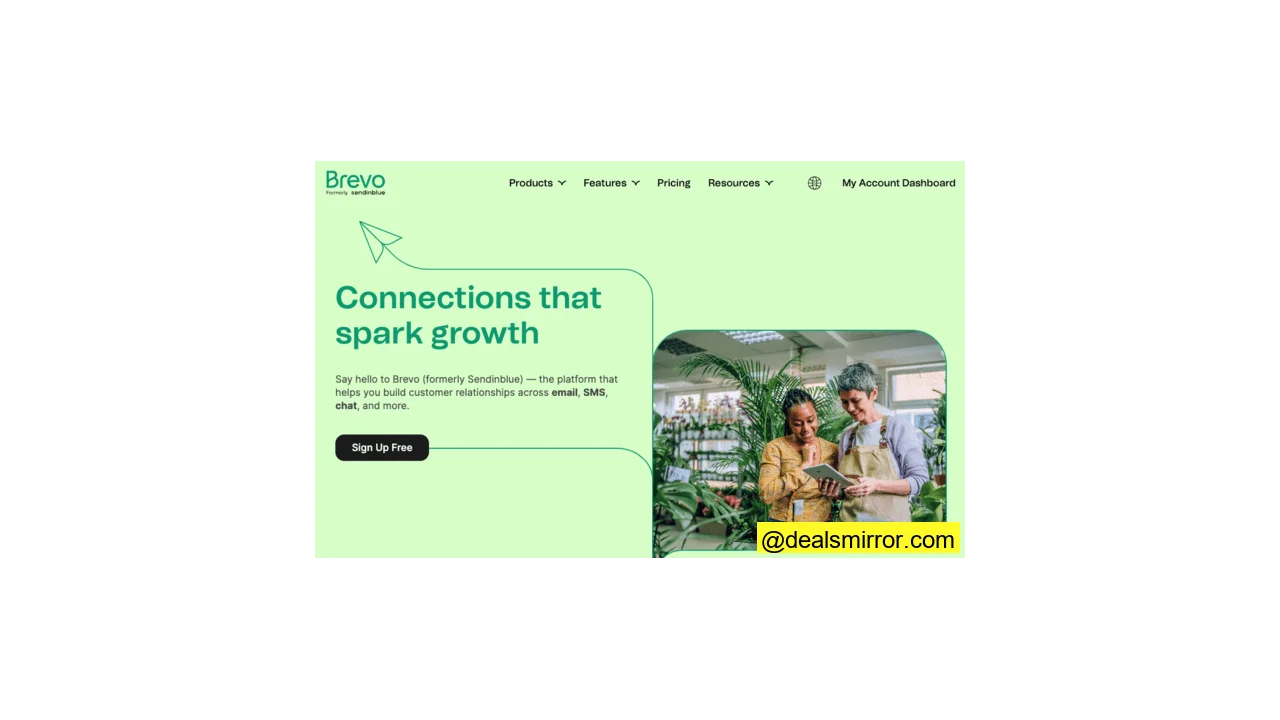
Brevo enables businesses to build and grow relationships through email campaigns, transactional emails, and sophisticated email automation. This software includes email automation for personalizing workflows, accurately managing contact lists, and sending emails based on page visits.
With Brevo, users can automatically resend campaigns to contacts who didn’t open them the first time. It also offers advanced email marketing functionalities, such as send-time optimization. This feature uses an algorithm to determine the best time to send email newsletters, helping to increase open rates.
Brevo also provides over 40 email templates and 8 automation blueprints to optimize workflows. It seamlessly connects to CMS platforms, eCommerce tools, and other business applications.
Brevo Pricing
Their free plan is generous, allowing 300 emails per day and supporting up to 100K contacts. Paid pricing starts at $9/month for 5,000 emails, A/B testing, and advanced statistics.
2. ActiveCampaign
ActiveCampaign is an all-in-one marketing automation platform with a built-in CRM. It facilitates automated email marketing campaigns, contact management, and optimized post-sale processes. Over 150,000 businesses worldwide utilize the ActiveCampaign platform.
What sets ActiveCampaign apart is its intelligent feature combination. Email and messaging are deeply integrated with its CRM functionalities and automation capabilities. The platform monitors activities across multiple touchpoints by tracking different marketing channels, enabling users to create multichannel marketing workflows and automate follow-up sequences.
ActiveCampaign integrates with over 870 apps, covering analytics, eCommerce platforms, and accounting tools. This includes integrations with WordPress, Shopify, Google Analytics, Jotform, and Pipedrive, among many others.
Within ActiveCampaign, users can personalize email content for each contact using conditional content. For example, different images or blocks of text can be displayed in an email depending on the pages a contact views on a website. If running a sales promotion, conditional content can display only products the subscriber has previously interacted with.
Many users find visual automation campaign builders challenging. ActiveCampaign addresses this with an intuitive and easy-to-understand drag-and-drop flowchart tool for creating automation workflows.
ActiveCampaign also provides split-testing capabilities to optimize subject lines and email content.
ActiveCampaign Pricing
They offer a 14-day free trial and four different plans to support business growth. The Pro plan starts from $79/month for 1000 contacts, 3 users, email marketing, CRM, site tracking, and reports.
3. Benchmark Email
Benchmark Email is a straightforward email marketing platform with a lightweight CRM. It features a drag-and-drop email editor, email templates, forms, landing pages, and automation tools. Its ease of use and excellent customer support are standout features.
Users can integrate Benchmark Email with over 1500 business tools, including LiveChat, Stripo, Shopify, and WooCommerce. Its WordPress plugin simplifies adding forms to sites without coding. Shopify store owners will find its Shopify app particularly useful.
Benchmark Email uses triggers to send automated email sequences, such as a welcome email upon subscription. The app offers several templates to help convert subscribers into customers.
The tool also includes a lightweight customer relationship management system with contact profiles that feature email engagement data. Other notable features include A/B testing, contact list management, real-time reports, polls, surveys, and social media integration.
Benchmark Email Pricing
The free plan supports 500 contacts and 3500 emails per month, allowing users to design emails, create sign-up forms, and track email performance. The Lite plan starts at $9.99/month for 500 contacts and 3500 emails, offering email scheduling, landing pages, and unlimited gallery storage.
4. Keap (Infusionsoft)
Keap (formerly Infusionsoft) is an all-in-one CRM platform with robust automation functionality, suitable for SMS, email, landing pages, and payments. Keap has over 20 years of experience, serving more than 200,000 customers who value its ability to keep customer data organized.
Users can capture and convert leads by designing funnels, creating segments, and automating marketing campaigns. Keap excels at bottom-of-the-funnel activities, allowing users to leverage invoice payment automation to streamline payments. A key benefit of Keap is its ability to consolidate all customer data into a single dashboard.
Keap‘s sales and marketing automation features are powerful, designed to save time and automate routine tasks. Users can send reminders, create drip email series, and automate post-purchase follow-ups. All these messages can be personalized using segmentation and automation conditions.
Keap also provides a strong reporting and analytics dashboard with various reports for sales, marketing, eCommerce, and revenue. These data visualizations offer valuable insights to monitor operations.
Keap Pricing
A 14-day free trial is available to test the system. All paid plans include 24/7 support, unlimited emails, and access to 1:1 coaching. Pricing scales with the size of the contact list.
5. Engagebay
Engagebay is an all-in-one business platform offering four core functionalities: CRM, marketing automation, helpdesk software, and live chat software. Users can opt for the complete package or select specific functionalities. This review focuses on its CRM and marketing automation features.
Launched in 2018, Engagebay serves over 12,000 customers. It reduces the need for multiple software tools for marketing, sales, and support, and offers many features for free. It has a short learning curve and facilitates smooth migration from other tools.
Engagebay includes a **free CRM** with features such as workflow automation, targeted marketing, email templates, pipeline visualization, and automated data entry. Paid plans unlock more capabilities like multi-currency support, sales automation, contact management, and custom reports, making it easy to organize and act on contact details.
The marketing automation features enable automation of tasks, emails, workflows, lead generation, and lead nurturing. Automation workflows are easy to design with the drag-and-drop builder, allowing quick setup of powerful workflows by simply selecting and moving elements. Engagebay also comes with predictive lead scoring and smart customer segmentation.
Engagebay Pricing
Engagebay offers a free plan supporting 500 contacts and 1000 emails. Pricing starts at $11.99 per month for 1000 contacts and 3000 emails. All plans include email and chat support.
6. HubSpot
HubSpot is an all-in-one CRM platform that integrates marketing automation, CMS, and sales functionalities, eliminating the need for third-party software. However, its pricing can become substantial as email lists and needs grow, leading many users to seek HubSpot alternatives.
With HubSpot’s marketing automation, creating integrated workflows is simple. It provides email drip marketing automation for automated email campaigns designed to guide prospects through the marketing and sales funnel.
A significant advantage of HubSpot is its extensive task automation capabilities. Users can leverage workflow templates to easily manage bulk data, send emails, create tasks, score leads, and more. HubSpot also offers in-depth analytics to track and report on each marketing channel and customer segment.
HubSpot Pricing
The free HubSpot plan allows storing 1,000,000 contacts and sending 2000 emails per month. Paid pricing starts at $50/month for 1000 contacts, including marketing, CRM, CMS, service, and operations tools.
7. Freshworks
Freshworks is a cloud-based software provider offering solutions for various business functions. Their CRM platform, Freshsales, is a sales force automation platform designed primarily for medium-sized businesses, known for its ease of use and competitive pricing. Founded in 2010, Freshworks now serves over 50,000 customers globally.
The CRM is customizable to fit specific business needs and customer buying journeys. Users can set up custom lifecycle stages and build email automation to nurture leads automatically. Freshsales is particularly well-suited for international sales teams, supporting 10 languages and over 150 currencies.
Automation features include workflows, sales sequences, task management, and auto-assignment rules. These enable automatic lead assignment to the correct salesperson, provide task and appointment reminders, and help close deals faster.
Freshsales Pricing
Freshsales offers a free plan for up to 100 contacts. Paid pricing starts at $15 per month for 750 emails/day.
8. Pipedrive
Pipedrive is an intuitive and powerful sales CRM tool that assists businesses in planning sales campaigns, building customer relationships through email marketing, monitoring sales performance, predicting sales, and generating reports. Workflow automations help reduce manual effort for repetitive tasks.
Campaigns by Pipedrive is their email marketing software, designed to be as simple and intuitive as their CRM. Users can create templates using the drag-and-drop editor and easily send campaigns, choosing from over 40 professionally designed templates. Campaigns also feature segmentation and analytics, integrating seamlessly with the CRM.
Pipedrive boasts over 250 integrations for landing page builders, marketing platforms, email marketing tools, scheduling apps, and lead generation software. Its user-friendly interface makes it easy to get started. It was recognized as the top CRM for small businesses in 2022.
The app is available in 19 languages, and mobile apps for iOS and Android cater to salespeople on the go, offering features like caller ID, call tracking, search, and organization tools.
Pipedrive Pricing:
A 14-day free trial is available for new users to test all features. The essential plan costs $14/month, including 3000 active deals, customizable pipelines, 30 custom fields, 5 reports, and contact management. Campaigns by Pipedrive is an add-on feature, priced at $16/month for 1000 contacts.
9. Zoho CRM
Zoho CRM is an email marketing CRM well-suited for small to mid-sized businesses, particularly for lead management, workflow automation, and marketing automation. Zoho serves 250,000 customers across 180 countries and supports 28 languages.
Users will find it easy to track and close deals with Zoho’s sales automation features. From the top of the funnel, Zoho helps capture and score leads. Automations can then be set up to send lead nurturing emails, and analytics track lead engagement. Deal management features allow tracking customer stages in the buyer’s journey, enabling sales reps to reach out at optimal times.
Useful features also include customer segmentation for precise and targeted campaigns. Integration with Google Ads allows users to compare sales against campaigns to identify what works and what needs improvement.
Zoho CRM Pricing
Zoho CRM offers a free plan and 15-day free trials for paid plans. Prices start at €14/month for 100 emails per user.
10. Salesforce

Salesforce is a leading name in CRM software, offering an extensive product suite covering sales, marketing, customer service, and e-commerce. It is also a pioneer in applying AI and data analytics to business operations.
This commitment is evident in Salesforce’s marketing software. Its Marketing Cloud suite unifies customer data management, analytics, AI, and automation, making it ideal for integrating marketing campaigns across various channels. It provides a single repository for all data, while its data and AI tools aid in decision-making, personalization, and automation.
Email campaigns are a core part of Salesforce’s ‘engagement marketing’ offering, focusing on managing customer communications across different channels and leveraging automation for efficiency. Specific email tools include building options with templates for transactional and promotional emails. AI can be used to personalize emails with dynamic content. Salesforce also manages sender reputation, which is vital for large-scale campaigns.
Salesforce primarily serves enterprise-level companies and professional agencies but also offers a small business plan. This plan covers marketing, sales, and service CRM tools, with email marketing as a core marketing feature. However, it lacks the advanced automation tools found in higher-tier plans.
Salesforce Pricing:
The Starter plan for small businesses begins at $25 per user per month. A 30-day free trial is available, though it only includes the sales and service products.
11. Thryv

Thryv is a comprehensive software platform for small businesses, covering communications, CRM, payments, invoicing, and marketing.
A major draw of Thryv is its all-in-one capability, which saves small business owners time and money. This principle extends to its marketing features, which heavily emphasize online advertising but also support email marketing, SMS, and social media campaigns. It includes a landing page builder with templates and tools for managing online business listings and reviews.
Automation is central to all marketing tools. Users can schedule sequences of emails and SMS messages or trigger sending based on contact actions. Automations are easy to build and edit, with five customizable workflow templates for welcome sequences, messages for lapsed customers, and thank-you messages.
Thryv offers numerous email templates, as well as templates for SMS and social media posts. While email templates are basic, images can be added. The ease of customizing Thryv campaigns is another advantage, and its mobile app is clean and user-friendly for business professionals on the go.
For more advanced email marketing tools, Thryv accounts can be connected to Mailchimp or ActiveCampaign.
Thryv Pricing:
Thryv’s email marketing features are part of the Business Center suite. Costs start at $199 per month per location, with a limit of 5,000 emails per month.
12. Netsuite

Netsuite is a significant player in the business software landscape, offering solutions across CRM, ERP, accounting, HR, and eCommerce.
Netsuite’s CRM excels at integrating marketing, sales, and customer service. From lead capture onwards, automation tools support all customer contact points. Sales funnels and marketing campaigns operate in tandem, ensuring campaigns align with sales goals and sales efforts focus on the most promising marketing leads.
Marketing automation encompasses email, social media, events, and more. Automation and analytics are Netsuite’s key strengths as an email marketing platform. Tracking tools capture lead and customer data, feeding into automated segmentation and sending. Tracking also allows for precise attribution, meaning if an email leads to a click-through and then a sale, that data is captured. This enables calculation of ROI on email campaigns and setting benchmark targets based on sales goals.
One drawback of Netsuite is the lack of built-in options for creating HTML emails. To send a newsletter, users must design it in an external HTML editor and then import it as a template. Netsuite also supports integrations with some of the best email marketing software, such as Mailchimp, ActiveCampaign, and Constant Contact.
Netsuite Pricing:
Netsuite’s pricing is custom-based.
13. Monday.com

Monday.com is a workflow management platform that offers shared digital workspaces, or ‘boards,’ for teams to visually plan and manage tasks. It provides hundreds of pre-formatted boards categorized for work and project management, CRM, and IT development.
Boards facilitate tracking task progress, creating automations, and serving as collaboration spaces. Communication tools have long been integrated into the CRM boards, with email marketing being a recent addition. The existing email options in the Email & Activities app now include mass email sending. This app is available only on higher tiers of the sales CRM product, not the marketing CRM, and can be accessed on any sales CRM board with an email column.
While this allows sending email campaigns directly from a Monday board, the options are basic, featuring only simple text-based templates. Contacts also need to be manually selected for sending, making it less ideal for very large recipient lists.
More advanced email marketing tools are available through integrations. Monday.com has a direct plug-in for Mailchimp, enabling users to manage Mailchimp campaigns from any monday.com CRM board.
Pricing:
CRM pricing starts at $12 per user per month. A 14-day free trial is available.
9 Factors to Consider When Choosing a CRM Email Marketing Platform
Thorough research is essential before selecting a CRM with email marketing capabilities. Here are key factors to consider when choosing an email automation software:
1. Email Marketing Features
These are fundamental features every email marketing software needs. Look for the following in an email marketing CRM tool:
- Drag-and-drop email builder, responsive for mobile
- Advanced list management
- Customer support via chat or email
- Segmentation and personalization
- CAN-SPAM / GDPR-compliant web forms
- Easy integrations with other tools
- A/B testing
If email marketing features are your primary focus, specialized tools like ActiveCampaign or Hubspot often provide the best customizable email templates, user-friendly workflows, and robust email automation builders.
2. Cost of the Tool
Initially, email automation tools may appear affordable, especially with a small number of subscribers. However, when choosing an email marketing tool, consider its long-term pricing as your email lists grow. Some tools might offer a cheap marketing automation platform at the start, then exponentially increase prices as you upgrade. It’s crucial to invest in a tool that won’t significantly impact your profits as your business scales.
For budget-conscious considerations, a tool like Brevo is noteworthy. It is among the most affordable on this list and offers a free plan that includes 100K contacts and up to 300 emails per day.
3. CRM and Email Automation Features
CRM platforms and email automation are complementary, working together to deliver value to customers and foster lasting relationships. CRM and email marketing enable personalized content for each contact, helping businesses understand their names, needs, and situations, and easily anticipate customer interest.
For software with the strongest CRM and email automation tools, Hubspot is a strong contender. It offers a comprehensive range of CRM tools that minimize reliance on other software, coupled with marketing automation features like drip campaigns, custom workflows, and smart segmentation.
4. Ease of Use
An intuitive email automation tool is crucial. A user-friendly CRM with email marketing should not take more than 2-3 hours to get comfortable with. If a tool has a steep learning curve or requires hiring a consultant for basic usage, it may not be the best choice for your business. While many marketing tools advertise easy-to-use interfaces and great drag-and-drop builders, actual user experience can vary significantly.
If ease of use is a priority, consider Benchmark Email. It features a straightforward, easy-to-navigate interface that guides users through campaign creation. The dashboard often includes helpful videos, and phone support is available for additional assistance.
5. Email Tracking and Analytics
Consistent analysis of marketing campaigns is vital to ensure progress. Without data, optimizing efforts becomes challenging. Many marketing tools fall short in providing in-depth analytics and reporting. Before choosing a tool, verify that it offers all the necessary metrics and presents data in an easily understandable format.
For detailed, actionable, and easy-to-understand reports, Engagebay is a strong option. Its reports are highly customizable, featuring visual components and simple filtering, making it an excellent email marketing CRM for tracking and analytics.
6. Deliverability
It’s crucial that your email marketing automation tool successfully delivers messages to the inbox, avoiding the spam folder. Without quality email deliverability, even well-crafted sales emails will be ineffective if they go unseen.
7. Third-Party Integrations
CRM email marketing tools are frequently used in conjunction with other platforms, as no single tool can fulfill every need. To avoid the hassle of manual copy-pasting between multiple tools, your email marketing solution should integrate seamlessly with your other business applications. This includes easy connections to CMS platforms, eCommerce platforms, and other business apps like Drupal, WordPress, Shopify, and Google Analytics.
Distinguish between native integrations and connections made with Zapier alternatives. Native integrations are typically easier to set up, offer deeper functionality, and usually incur no extra cost. Setting up connections via Zapier can be more complex and may involve additional expenses.
For extensive integration with your martech stack, Hubspot is a top choice. Its App Marketplace offers over 1000 direct integrations with various other applications.
8. Security & Compliance
Given that sensitive customer data is often captured from subscribers, it is essential for companies to have robust security protocols in place to protect both users and subscribers from hackers and scammers. Your email marketing and marketing automation tool should also adhere to compliance standards such as GDPR, HIPAA, and ISO.
9. Customer Support
Even with an effective marketing system, the need for efficient customer support with fast response times is paramount. When help is needed, a responsive support team makes a significant difference.
If customer support is a critical factor in your CRM selection, consider Keap. It provides unlimited 24/7 support, a migration expert to assist with data transfer, and 1:1 coaching to help users get up to speed and build funnels and pipelines.
5 Reasons Why a CRM with Email Marketing is Essential
Integrating a CRM tool with email marketing offers compelling advantages for businesses:
1. Email is an Integral Part of Lead Nurturing
Email marketing is one of the most effective methods for nurturing leads. Email messages can be highly targeted to cultivate relationships with subscribers. To deliver the right emails at the right time, drip email campaigns are essential. Email automation streamlines the lead generation and nurturing process, especially when messages are tailored to the **different stages of the buyer’s journey**. Automation ensures leads receive relevant information, making the nurturing process more effective.
2. Personalization at Scale, with a Twist
Email automation excels because it allows for personalization at scale. For instance, it’s nearly impossible to manually send thousands of emails with personalized articles and product recommendations to each contact. However, with email personalization, this becomes easy. Users can create custom fields, tags, and send dynamic content, or use simpler personalization like inserting [first name] or [company name] before sending. Personalized emails consistently achieve higher open rates. Research indicates that personalizing your email subject line increases open rates by 22%.
3. Increases Efficiency and Planning
Email marketing CRM tools enhance the efficiency of sales and marketing teams. Scheduling emails is crucial when dealing with clients in various time zones. To reach subscribers at the optimal time and maximize ROI, messages should arrive when recipients are most likely to open them. Beyond timezone considerations, sending emails at the right moment is vital, as messages sent at certain times might be ignored.
Some automation platforms even recommend the best sending times, ideal frequencies, and optimal content types, based on buyer personas.
4. Cut Costs and Increase ROI
With an email marketing CRM tool, successful campaigns do not require extensive sales and marketing teams. Automating email sending, contact segmentation, and task assignments frees up valuable time. Instead of a 30-person marketing team, an automation tool managed by five individuals can accomplish the same work in less time. An automated process significantly reduces labor costs, thereby increasing email marketing ROI.
5. Improved Analytics and Reporting
A CRM with email marketing provides robust reporting tools for comprehensive analysis of email campaigns. Without analytics, it’s challenging to identify areas for improvement. Compared to basic email marketing tools, automation platforms offer deeper data, including goal tracking, custom events, and conversion reports. These insights provide a more holistic understanding of your entire email marketing efforts.
Concluding Thoughts on CRM with Email Marketing
This guide on the best email marketing automation software with CRM aims to streamline the research process for those exploring marketing automation, CRM, and email marketing.
FAQs
What is CRM in email?
Which CRM is best for email marketing?
1. Brevo (most affordable email software with CRM)
2. ActiveCampaign (best small business marketing automation CRM)
3. Benchmark Email (easiest software to get started with)
4. Keap (best CRM for customer support)
5. Engagebay (best for tracking and analytics)
6. Hubspot (best overall email software with CRM)
7. Freshworks (best CRM for managing buyer journeys)
8. Pipedrive (best easy-to-use CRM with email marketing)
9. Zoho CRM (best medium-sized business CRM)
10. Salesforce (best for scaling businesses)
11. Thryv (best CRM with email marketing and invoicing)
12. Netsuite (best enterprise CRM with marketing automation)
13. Monday.com (best CRM with email marketing and project management)
What is a CRM in marketing?
Can CRM send emails?
What are examples of CRM?
– Collaborative CRMs like SugarCRM
– Analytical CRMs like Monday.com
– Operational CRMs like Zoho CRM or Salesforce
– Strategic CRMs like Hubspot