
SMS marketing has emerged as a powerhouse channel, thanks to widespread mobile usage. With impressive open and click rates, it’s highly effective for reaching large audiences. However, the true value of SMS marketing lies in its return on investment. To accurately assess profitability, it’s crucial to understand the costs involved.
The expenditure on SMS marketing varies significantly based on several factors, including your chosen platform, message volume, geographical reach, and the specific services opted for. A clear understanding of these costs is fundamental to the success of any SMS marketing strategy. This comprehensive guide will demystify SMS marketing pricing, helping you make informed decisions to maximize your campaign’s effectiveness.
How Much Does SMS Marketing Cost?
As a general benchmark, sending 5,000 SMS texts typically ranges between $109 and $245. However, various factors can influence your overall text marketing costs:
- Location: Per-message prices differ considerably by country. International messaging will incur higher costs compared to domestic sends.
- Message Volume: While you’ll always pay more for a higher quantity of messages, some platforms offer better value for mass texting at scale.
- Service Type: Costs can vary between subscription-based and pay-as-you-go (PAYG) services. Subscription plans often bundle features, whereas PAYG services might offer lower per-message rates but charge extra for add-ons.
- Message Length and Type: Longer messages consume more credits. Messages containing images (MMS), Unicode characters, or emojis also typically cost more to send.
- Carrier Costs: You might encounter monthly or one-off telecom operator charges. Some subscription services include these in their overall price.
- Phone Number Type: SMS marketing services provide a number for sending texts. The type of number chosen affects the cost.
Here’s an overview of typical SMS marketing costs for various sending volumes:
| Messages Sent | Price Range | Average Cost |
|---|---|---|
| 1,000 | $10.90 – $59 | $43.65 |
| 5,000 | $109 – $245 | $189.33 |
| 10,000 | $109 – $490 | $310.17 |
| 50,000 | $899 – $2,450 | $1,462.60 |
| 100,000 | $1,920 – $4,900 | $3,608.33 |
For context, here’s a look at how much sending 1,000 SMS messages in the US typically costs with various providers or plans:
| Provider | Free Credits | Monthly Price for 1,000 SMS (US) |
|---|---|---|
| Unnamed Provider 1 | 10 (free trial) | N/A |
| Unnamed Provider 2 | 50 | N/A |
| Brevo (PAYG) | 0 | (Calculate on pricing page) |
| Unnamed Provider 3 | 50 (free trial) | N/A |
| Brevo (Subscription) | 120 (free trial) | $45 |
| Textedly | 50 | $49 |
SMS Marketing Platform Fees
SMS marketing platforms primarily use two pricing models: monthly subscriptions or pay-as-you-go (PAYG). PAYG services often provide lower per-message prices than subscription plans but typically charge extra for additional features. Subscription services, on the other hand, usually bundle a comprehensive set of features into their monthly price.
Subscription services allocate a fixed amount of credits each month. With PAYG, you purchase credits as needed, and they often don’t expire, offering more flexibility for fluctuating SMS needs. Many providers allow unused credits to roll over monthly, though this can lead to an accumulation of unused credits with subscription renewals.
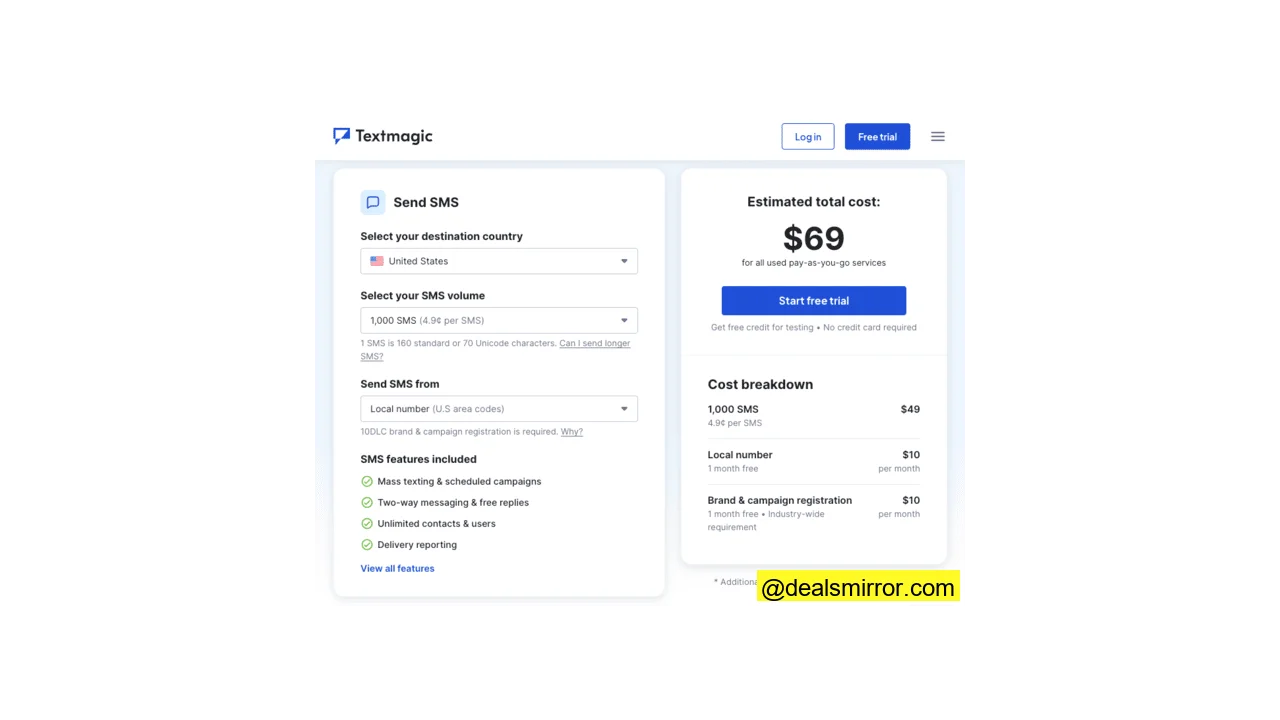
PAYG is generally more flexible and cost-effective for lower-volume senders or businesses with variable SMS requirements. For example, TextMagic offers a pay-as-you-go model, allowing users to easily calculate costs on their pricing page.
Subscriptions provide consistency and often include additional marketing features such as message templates, segmentation and automation tools, and analytics, especially beneficial for higher sending volumes. Many subscription services also offer discounts for annual payments.
Some platforms offer a hybrid pricing model that combines subscriptions and PAYG. This can be ideal for businesses looking to start small and scale their SMS sending as they grow.
SMS Marketing Messaging Fees
Most SMS marketing services quote prices for a certain number of SMS credits. However, the number of credits purchased doesn’t always directly equate to the number of messages sent or the exact cost per message.
Longer SMS marketing campaigns, or messages containing anything other than plain text, consume more credits. A standard SMS segment is 160 characters. Messages exceeding this limit, or those using Unicode characters or emojis, will incur additional credit costs. MMS messages, for instance, typically cost three credits.
Messaging fees also vary by destination country, with international SMS messages being more expensive than domestic ones.
It’s also essential to verify if incoming messages are included in the price and the allowance for contacts. Leading services often include two-way messaging and unlimited contacts as standard, but if these are not included, they can significantly increase your overall costs.
Phone Number Fees
SMS marketing services provide phone numbers for sending text messages. There are three primary types:
- Toll-free numbers: These are business-specific numbers, often recognizable by particular dialing codes. Historically, they allowed customers to call businesses free of charge, with the business absorbing the fees. For SMS, they often come with no additional charge beyond message fees, but they can sometimes be perceived as spam by recipients.
- Long code (or local) numbers: These are standard phone numbers. Many businesses prefer them as they appear more “genuine,” potentially leading to better open rates.
- Short code numbers: These are abbreviated, typically 5-digit numbers. Businesses favoring inbound texting often use short codes as they are easy to remember and include in advertising. Short codes almost always incur additional charges, usually being the most expensive option.
For an extra fee, some services allow you to use an alphanumeric sender ID, which displays your business name to recipients instead of a numerical sender ID.
Add-ons and Extras
SMS marketing platforms often provide a range of features beyond basic message sending. These can influence the total cost depending on the service’s pricing structure. Many subscription services include these extra features in their base price, while PAYG services often offer them as optional add-ons.
Common add-ons and other fees in text message marketing tools include:
- Subscription keywords that allow recipients to sign up for or opt out of a list.
- Extra phone numbers.
- Auto-responder and drip campaigns for automating SMS sequences.
- Campaign analytics for tracking performance.
- Pay-by-text and other SMS payment processing options.
- Other marketing tools, such as CRM integrations and email marketing capabilities.
- Adding more users to the platform.
- Third-party integrations and API access.
How to Calculate SMS Marketing ROI
Calculating **Return on Investment (ROI)** is essential to determine if your SMS marketing spend is worthwhile. A positive ROI indicates that your investment generates more revenue than it costs.
ROI is calculated as the **percentage gain** from a business activity. This involves three key steps:
- Identify the **revenue** generated from the activity and its total **costs**.
- Subtract the costs from the revenue to determine your **profit**.
The ROI calculation formula is:
Determining revenue from SMS campaigns is usually straightforward because SMS marketing is often sales-focused and transactional. Direct payment links, unique landing pages, and promotional codes make it easy to attribute sales directly back to specific campaigns.
Let’s illustrate with an example. Suppose you launched a campaign to 1,000 contacts. The average cost for 1,000 messages is $43.65. Additionally, you pay $10 per month for a long code local number and $5 per month in carrier fees, bringing your total costs to $58.65.
If this campaign generated $150 in sales, your ROI would be calculated as:
($150 – $58.65) / $58.65 = 1.56 * 100 = 156%
From the same data, you can also calculate **Revenue per Message (RPM)**. In this scenario, it would be $150 / 1,000 messages = $0.15. RPM is a valuable metric for comparing the performance of different campaigns.
Other crucial metrics to monitor include **click-through rate (CTR)** and **conversion rates**. CTR indicates how many visitors your campaign directs to a page, reflecting message engagement. A low CTR often signals low interest and a potential hurdle to strong ROI. Similarly, the conversion rate shows how many clicks translate into sales. This can be compared to revenue: high revenue with a low conversion rate might suggest a few high-value sales, which might not be consistently repeatable.
It’s also wise to track **list growth** and **opt-out rates**. Sustained revenue growth is challenging with a stagnant audience, making list expansion vital. Conversely, a high opt-out rate indicates issues with message relevance or engagement.
How Profitable is SMS Marketing?
SMS marketing’s popularity stems from its proven ability to deliver results. Text messages boast incredibly high open rates of up to 98%, with 82% of individuals reporting they open every SMS received, in stark contrast to the 81% who ignore all business calls. High open rates naturally lead to strong click-through rates; the average SMS marketing CTR is 19%, significantly outperforming social media at 1%.
These excellent engagement rates translate directly into sales. A remarkable 72% of consumers have made a purchase after receiving a text message, and 65% affirm that SMS marketing accelerates their buying intentions.
Consequently, 73% of SMS marketers report that text campaigns effectively boost their revenue. While precise ROI can vary based on campaign size, industry, and input costs, businesses can generally expect a robust 25x return on their SMS marketing investment.
Which SMS Marketing Pricing Should You Choose?
Navigating SMS marketing pricing is key to achieving excellent returns from your efforts. A strong ROI hinges on finding the optimal balance between the cost per message and the revenue generated per message. This means selecting a pricing model that aligns with your specific SMS marketing needs and, crucially, your anticipated sending volume.
For businesses with lower or seasonal sending volumes, a PAYG pricing model typically offers better value. These plans often present lower upfront costs. For example, TextMagic starts at just $10.90 for 1,000 texts, allowing you to use credits at your own pace and selectively add features as needed. Brevo offers a competitive price for 1,000 SMS in the US, including a toll-free number with its subscription plan.
For higher volumes, subscription services provide bundles of 50,000 or 100,000 credits per month, often accompanied by significant bulk discounts. These plans commonly include advanced marketing tools to support larger and more frequent campaigns. For instance, Brevo offers a plan with 50K credits for $939, which is a considerable saving compared to sending 50K SMS with TextMagic‘s PAYG model.
To help evaluate your options further, consider reviewing an email vs SMS marketing cost comparison.
SMS Marketing Pricing FAQ
What is the cost per SMS?
- $0.049 per message for sending in the US and Canada,
- £0.04 per message for sending in the UK,
- €0.088 per message for sending in Germany,
- €0.08 per message for sending in the Netherlands.
Most SMS marketing services quote message fees in blocks of 1,000, 5,000, 10,000, or more. On top of these, you might face additional costs for phone numbers, telecommunication operators, or other features. Different service types have distinct pricing models. For a subscription platform, the monthly cost often includes a block of messages plus all features. For pay-as-you-go services, prices generally cover messages, with other features costing extra.